Search This Blog

Showing posts with label list 1. Show all posts

Friday, December 30, 2011

Taxus x media 'Hicksii' - Hicks Yew

Vertical growing evergreen small tree, growing to about 15’ x 4’ wide. Quite slow. Great for formal hedges and screens or to create a vertical accent. Dark green color all year. Often used in place of the Irish Yew which you can see at Filoli or on Rio del Mar blvd across from the Arco Station. These are at the Sesnon House on Soquel Dr. You can see the one on the right starting to splay open a bit. This is a problem as the trees age and will require prompt pruning or they will develop a large open space that will not fill easily.


Leaves are dark green and about 1", with pointed tips. They appear to be arranged radiating around the stem. Lower surface is lighter green and there is a distinct midrib. The foliage of all yews are toxic as are all parts of the tree except the red aril surrounding the fruit. The foliage is used to make the cancer drug Taxol.


Stems are ridged, light green with rounded green buds.


Male and female stroboli are borne on the lower side of the branchlets. There are different male and female plants in the yews, but interestingly there are both male and female versions of this plant in the industry.

Fruit is a seed partially contained in a red fleshy aril. The attractive portion is the red aril. This is late in the winter and is not as red as it could be.


A hybrid between the English yew and the Japanese yew. Provides hardiness of the Japanese and the dark green foliage of the English yew.

Misidentification: Irish yew. Look at the size of the plant, the Irish yews are very wide compared to the Hicks yew. Foliage only.... good luck.

Locations: Cabrillo College Sesnon House.

Pseudostuga menziesii - Douglas Fir

The douglas fir is a native conifer that spreads over much of the west coast into the mountains of Colorado and into Mexico. Generally not planted in residential landscapes or even larger commercial ones and likely the ones you have may be there naturally. In it's native habitat the douglas fir is a huge tree, up to 300' and is the source of most of our common building materials. Usually too large even in cultivation to grow anywhere but the largest of lots. It is none the less a beautiful tree. The English love to use this tree. We buy one as our Christmas tree yearly from Hester Family Farms.


This is an "old" one in RDM.


Leaves are linear, 1-1-1/4" long, green upper surface, lighter on the lower surface. Leaves arranged spirally but bending making a V. The bases are bent allowing the leaves to form a flattened spray or at least all the leaves pointing upward. The terminal buds are quite long, pointed, and imbricately scaled.


Notice the way the leaves are bent at the base. Some have referred to this as being like a hockey stick.


Cones, 3-4", brown in color, are perhaps the most recognizable characteristic of the doug fir. Actually it's the three tipped bracts that are the key. The funny story is that something scares a mouse into the cone and it can only get so far in and you see the tail and two rear legs.


Male and female "flowers" are red.


Bark on old trees very deeply furrowed.


Misidentification: Look at the base of the tree for the cones, you cant miss them. The terminal buds are very distinct and look like nothing else, the firs are mostly covered in resin and the spruces have somewhat rosette like bud scales. Leaves fall with a slight bump, not like a fir.

Location: Nice big one fell on a house in Santa Cruz last year.
Nisene Marks, Corner of Monterey and Bay Ave.
On River St across from Probuild.

Picea pungens 'Glauca' - Colorado Blue Spruce

The Colorado Spruce is an evergreen conifer native to the Rocky Mountains. It is quite variable in habit, generally an upright pyramidal, slow to medium grower, 60' x 20' in urban areas, over 100' in its native habitat. Branches are perpendicular to the main stem and can either hang slightly or be strongly ascending. Usually branched to the ground unless cut off so people can use the area under the tree. Can be very full or open depending on the cultivar. Lots of cultivars are available and you will not likely be planting a seedling.


The evergreen leaves are linear, 1 - 1 1/4" long deep blue, very sharp pointed, held almost perpendicular to the stems. Leaves 4 sided so they roll between your fingers. Leaves are attached to the stem on a small bump or pulvinus that remains when the leaf falls. Blue can be very blue to only slightly blue depending on the cultivar. Notice the bud in this image, they are somewhat rosette like but not covered with resin like Fir trees.


Male cones are reddish colored in spring back from the tip of the branches.


Cones are light brown, 3-4" long x 1" wide. Scale tips are undulated and quite papery textured. Borne in large numbers near the ends of the branches and pendulous. Falling whole in one year.


Orangish brown colored stems and distinctly grooved.  After the foliage falls they are rough due to the pulvinus remaining. See image of leaves above to see the grooved twigs. Bark deeply fissured, brown and dark brown.


Lots of excellent cultivars, way too many to list, but some are dwarf, columnar, weeping, very blue.

Misidentification: not sure, if you will have a problem with this one, look at the leaves, the angle they are held from the stem (P. abies is green and held about 45 degrees to the stem).

Locations:
Quite a few around, none look that great, they really need a colder winter and warmer summer. Best over the hill or even better in Oregon.

Juniperus chinensis torulosa - Holly Juniper

The Hollywood juniper has been planted in California landscapes forever. They seem to be planted everywhere, perhaps not as a focal point but as a filler with an interesting habit. Junipers in general get a bad rap mostly because they are over-planted, especially the "dwarf" ground cover types. The Safeway juniper (J. chinensis 'Pfertziana') is planted in all the wrong spots and is as far as I am concerned the cause of the bad name. There are some really nice juniper trees that need to be grown and planted, and I will try to cover some later.

Juniperus chinensis torulosa  (also known as J. chinensis 'Torulosa' or Kaizuka')  is a fast growing evergreen conifer,  to 15 -20' by 10' wide with spreading branches. The branches are narrow, spreading and spinning loosely around the main stem. They seem to be variable and don't all seem like clones as some suggest, and there seems to be several forms in commerce. The twisting may be to one side or all around the tree, and not always clockwise. The form is often referred to as "picturesque" or "Japanese like". I like picturesque. 


The twisting is not just the main laterals wrapping around the main stem but the whole branch twists. Notice the tufts of foliage on the branches.


The leaves are mostly scale-like, evergreen, tiny, maybe a 1/16" long, bright green. They are held tightly to the stems.  Foliage is very fragrant. They may have some juvenile foliage which is awl-shaped but not much on this tree.


The foliage is often in tufts near the ends of the branches.


Juniper fruit are fleshy at maturity and because of this are often call berries, but as you know conifers do not have berries, they have cones. The cones are about 1/4" diameter, ripening bluish black.


"Flowers" are small, hardly noticeable.

Bark is peeling, stringy and attractive like many others in the family.


Misidentification: hopefully you can get to Juniper, from there you are on your own.  No really, look at the form of the tree, many junipers are more symmetrical and not twisting. If you are not at juniper, look at the cones, Cupressus have large cones and are woody when mature, Chamaecyparis have cones about 1/2" and are also woody. If you are somewhere else in CA. and in the mountains you may run into natives but I have not seen any here.

Locations: Nice row at the intersection of 41st and Soquel. Otherwise, very common.
Santa Cruz
154 S. Morrissey Blvd

Chamaecyparis obtusa - Hiniki Cypress

Hinoli cypress trees are not very common here, too bad, they are beautiful evergreen conifers. The species is a large tree perhaps to 60' but you are unlikely to encounter one. There are at least 100 cultivars and most are dwarfs. Generally will see plants in the 10-20’ range, by about 5-10’wide. Some are open, others more compact.  All are very attractive. A golden one is ‘Crippsii’.


The evergreen leaves are scale-like of two sizes. They give them different names due to the way they are attached to the stems. The facials are smaller than the laterals. Laterals wrap around the stems and can be seen from both sides of the flattened stems. The facials are facing you and are in full view. White stomatal areas obvious on lower surface.  May resemble small X’s or barbells with X's on the ends.


Stems grow in fan-like sprays unlike the elongated sprays of Chamaecyparis lawsoniana. Chamaecyparis species are more oval than round and this is why they have facial and lateral leaves.


Male and female stroboli "flowers" are very small, you can see the remnants of the males in the picture above, and the female below.


Cones are 3/8" round with peltate scales. They look bigger in this image than they really are.


Bark is typical of this family, and is stingy and fibrous.


A common selection of this species in the area is C. obtusa filicoides which is found in green or yellow foliage varieties. The foliage is arranged in fern like sprays and not rounded like the normal C. obtusa. 


Misidentification: Look for the smaller woody cones and the lower side of the branchlets having the distinct white X's. Not exclusive of this species but the small cones and the flatted sprays will help.

Locations: To be honest they are not that common, several at Cabrillo College on the "lower campus",
A nice one on the corner of Chestnut and Center in SC.

Monday, May 9, 2011

Cedrus atlantica 'Glauca' - Blue Atlas Cedar

Such a beautiful tree, especially when old. A bit stiff and awkward when young. A several hundred year old tree at Bodnant Gardens, Wales.


Large evergreen conifer, slow growing to 60-80' x 30' wide. Generally upright and stiff. Full canopy, great color. Main leader is vertical, main lateral branches strongly ascending often coming off the main trunk and curving 90 degrees to vertical then flattening out. The secondary laterals are horizontal and relatively short, and very stiff, but the tips do weep a bit. Much more stiff than the Deodars. An averaged aged tree in Chico.


Narrow form seen in Santa Cruz.


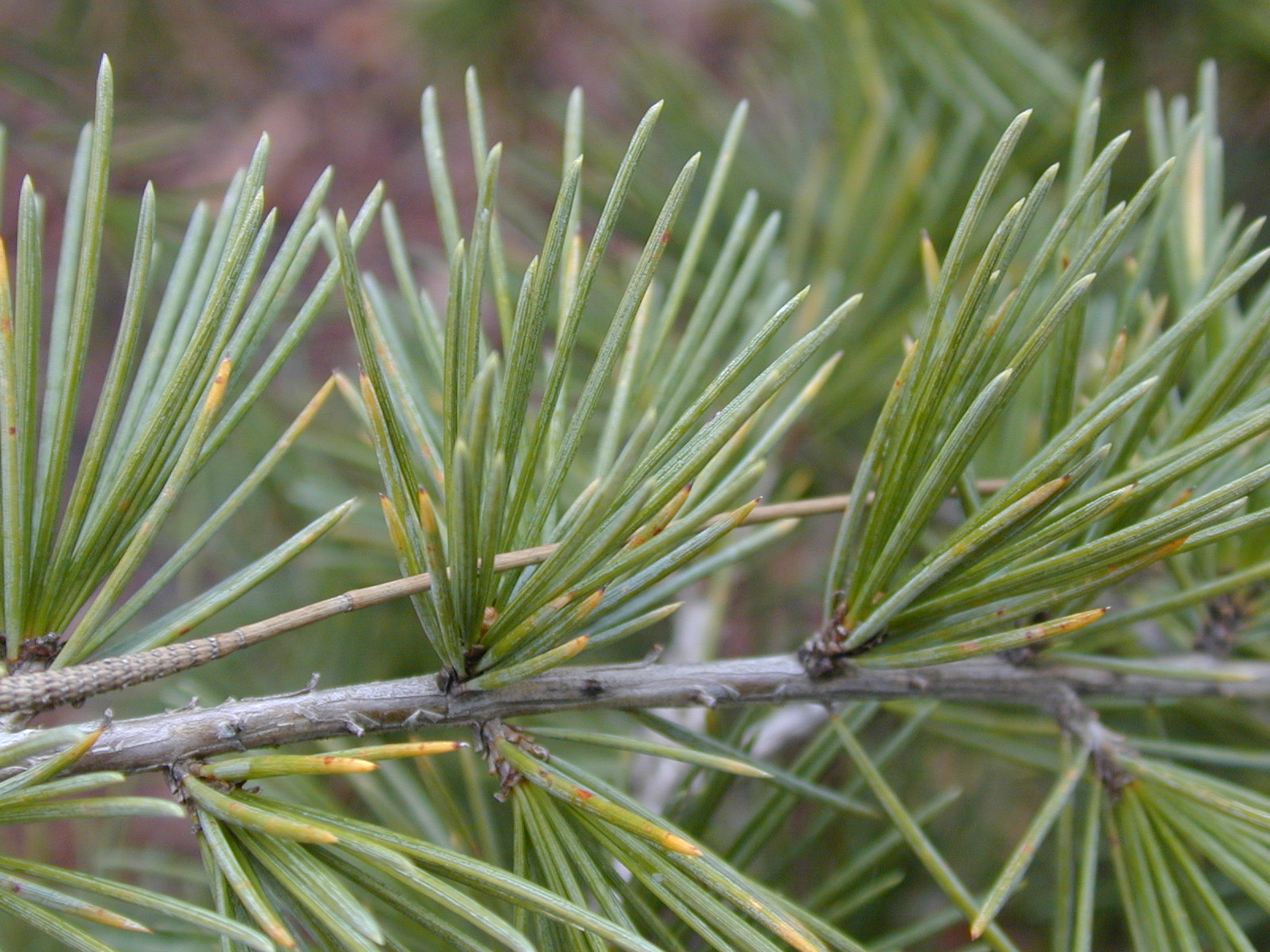
Foliage linear, needle like, bluish to silvery blue, usually not longer than 1", with 20-30 on a spur. Sharp and stiff.


Young stems thickly pubescent. Secondary branches are flat, horizontal in more or less one plane.


Male and female stroboli (Flowers) appearing from June to September. Males distinctly upright, 3-4" long x 3/4" wide. You can see remnants of males in the image above.

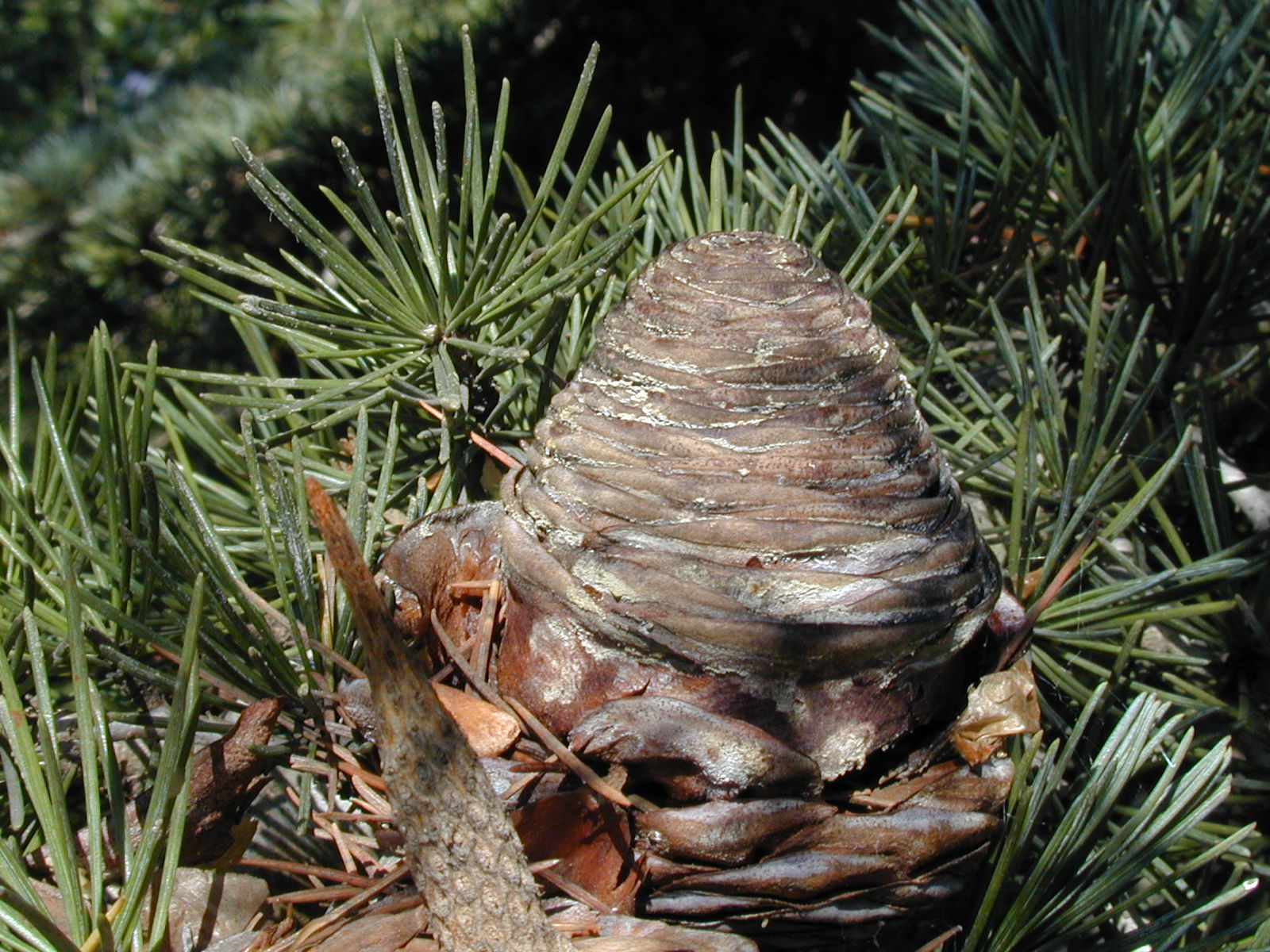
Female cones cylindrical, with level or concave top, 2-4" long, up to 2" wide, glossy, light brown, maturing in September and October and shedding scales. Cones disintegrate on the tree leaving only the central stalk behind. The scales are about 1" across, or less, while the deodar cedar scales are almost 2" across.


Bark is grayish brown, shallowly fissured, somewhat alligator skin like.


Noted cultivar and all around great plant for residential neighborhoods is Cedrus atlantica 'Glauca Pendula'. Some references list this as a cultivar of Cedrus libani.  Great. So some experts put C. atlantica in with C. libani as C. libani var. atlantica.


Cool use of the plant.


Misidentification:
Other true cedars (especially the Cedar of Lebanon). Notice the tree on the left, rigid, green, most likely Cedrus libanii.


When blue it will not be easily mistaken however greener forms exist. I was told years ago that the primary scaffold branches are always vertical while deodar cedars were flat, but that does not hold true. look at the orientation of the secondary branches, on the deodar they are weeping while on this they are very flat.

Location:

Monday, March 28, 2011

Cedrus deodara - Deodar Cedar

Deodar cedars are very attractive large evergreen conifers. Younger specimens are beautiful, soft and weepy, while mature specimens are more open.

Best in parks, schools and others areas where it can be allowed to grow, however more often than not you will find them in the front yard of your neighbors house. Not hard to understand why, they have an almost hug-able texture and habit when young. Soft, weepy, graceful with a weeping leader, ahhh.


Then you wake up 10 years later and OMG what have I planted in my small front yard? Not quite the front yard but yikes

Fast growing evergreen conifer to 50' tall and about 30' wide, strongly pyramidal shape, strong central leader with outward horizontal laterals when mature, or more upright when young like in the picture above. The secondary laterals are pendulous as is the central leader adding to the soft texture. Can be up to 80 feet under great conditions, like in the pacific northwest. This is a reasonably mature specimen at the Sesnon House showing the typical habit but with greater age they will become more flat topped.


Leaves (needles) are evergreen, linear or needle like, gray-green color, 1-2" long and in clusters (spurs) of 20-40 per spur. New stems produce same needles radially around the trunk with bud in the axil of each leaf. The bud grows into the spur, each year producing leaves and losing others. Generally on a 5-6 yr rotation.


One-year shoots densely pubescent. Also showing the leaves on elongating shoots are not in clusters but that the clusters come from the lateral buds just starting to grow.


Male cones are elongated ephemeral structures lasting only long enough to release the pollen. Borne on the tops of lower branches.


Female cones are 3-4" tall x 2" wide, forming in the fall, maturing in the summer and breaking up into scales that fall to the ground, along with the seeds. The central axis remains for some time. Initially green and purplish, then later turning a reddish brown when mature, usually resinous. Cones generally rounded at the top.


Trunks straight grayish brown bark, shallowly fissured with flat ridge plates.


Many cultivars available, too many for sure, one of my favorite conifer nursery, Stanley and Sons lists at least 40.

Please give them room. This is trouble waiting to happen.


Misidentification:
More than likely a greener form of Cedrus atlantica or perhaps if you are lucky and stumble across a C. libani.

Location:

Saturday, March 19, 2011

Cupressus macrocarpa - Monterey Cypress

Cupressus macrocarpa, the Monterey Cypress, is another great native conifer. These are hanging on to a very beautiful if not difficult slope at Point Lobos. The trees limited natural range is from Point Lobos to Pescadero with another small pocket in Carmel.  Trees perform well especially near the coast where it receives plenty of fog and tolerates the salt wind as well. In its native habitat it grows in thick bunches with little else growing underneath.


As some of you know plant names always seem to be in a state of flux and this genus has been "revised". Lets hope the taxonomists don't get out of control but the genus is being "split" into new and old world cypress groups, and guess who gets the genus named Cupressus? Not us! They have been moved to a genus called Callitropsis. There is some hope that this will not be excepted using the conservation of names concept. Oops, new information, now called Hesperocyparis, meaning western cypress.

Anyway, while they do what they do, we can enjoy one of the most picturesque trees in our native landscapes. The monterey cypress is one of the few trees that can tolerate coastal winds, salt spray and cooler temperatures of summer. Too far from the coast they are susceptible to a fungal canker disease called Seiridium which is quickly fatal.

Further away from the coast, like all the way inland to Soquel Drive in Aptos they have the possibility of looking like this. Cupressus macrocarpa is a large tree reaching 70-80 feet away from the coast and often becomes more flat topped when mature. (This one is GONE.) Continue south on Soquel to the next light. A nice big one at the Chase Bank.


Foliage of the cypress species are difficult to differentiate and require the use several features. One is the arrangement of the lateral branchlets on a young stem. They can be flat or rounded. These are in the rounded group, meaning that the smaller lateral branches come out on all sides of the branch.

Secondly, you will need to use a small hand lens to you look at the facial portion of the leaves, look for a gland. Presence or absence as well as being pitchy if there is one. These do not have a gland.

Leaves are scale like, small, 2mm in length, bright green but also dark green, fragrant when crushed and as you can see they radiate out from the stems.


The fruit are pretty distinct. They remind me of small soccer balls. The scales of the cones are peltate, they have a stalk on the back and are fused together along the margins and are not overlapping link seen in pine trees. The cones are green, turning brown, with 4-6 pairs of scales. Each scale has a small bump, but nothing like some of the other species. Individual cones are 1- 1.5" in diameter.


The bark and trunks are magnificent. I am not sure how they develop into the shape they are in, it seems that smaller branched are grafted to the main stem as they get larger and larger. Makes pruning large stems a problem (which is good really). Anyway, the trunks are very large in diameter and not at all round. They have persistent fibrous bark.


Monterey Cypress is a very fast growing tree. When young they are very upright with the main lateral branches arching up at about 45 degrees. These are a few young ones at Cabrillo.


It can also be grown as a hedge as seen here in Santa Cruz. Forgot the street name but I will stumble across it again. Its 221 Getchell St. Thanks to Peter Beckmann.


As I mentioned in RDM they were planted one per lot or sometimes 2. But they are dying and coming down due to a number of fungi and age. Here is the remainder of a trunk with the tree loggers left in for perspective.


You may encounter several cultivars of this species. This species is far more popular in New Zealand, where they have more than 25 named cultivars. Find a great conifer online store (Stanley and Sons) and look at the amazing selections.

One older one is called 'Lutea' and seen in reasonable frequency.


Another is an odd yellow one with branches very thin and few lateral branches creating a wispy droopy smaller tree. 'Saligna Aurea'. (Also known as 'Aurea Saligna')


Misidentification: 
Just about any other Cupressus I am afraid. Use the gland on the leaves, the color, maybe the bark, the cones may help as the name suggests, large fruit, and the form. Not an easy one.
Also, this in one of the parents of xCupressocyparis leylandii. 

Location: Everywhere, Point Lobos in Monterey is one of the best locations.
Aptos
7855  Soquel Drive  Chase bank