Search This Blog

Showing posts with label evergeen. Show all posts

Friday, July 12, 2024

Callitropsis nootkatensis 'Pendula' - Weeping Alaskan Cedar

Great plant --- names are a mess --- one of my favorites of all time. This cultivar is distinctly weepy when compared to the species which is slightly weeping itself. Trees grow to about 30' tall by 15' wide in cultivation. The lateral branches are slightly upright or horizontal with drooping branchlets giving the tree a graceful soft look.

This tree was sitting in a large nursery box for several or more years prior to being planted. Could have been placed a bit further from the house, they make such great focal points in landscapes.


Leaves are arranged on flat sprays (branchlets). 

Leaves opposite one-another, sort of in 4 rows, scale-like, bluish green in color, no more than 1/8" with distinct white lines on the lower surface where the leaves overlap.


Cones are smaller than Monterey cypress but larger than the Lawson falsecypress. They have a sharp bract (point) on the end of each scale. Usually 4 scales. Maturing brown and opening on the tree.


Bark is thin, gray silver in color with small resin bumps.

This is the "non" weeping species showing the more upright lateral branching with drooping branchlets.


These are 'Strict Weeping' at The Oregon Garden in Silverton.


These are also 'Strict Weeping' in Chelan WA.


I mentioned at the top of this post that the plant was great, but the naming is a mess. I prefer Chamaecypress nootkatensis, but that's because it's what I call it.

Kew Garden places the plant in Callitropsis and Wikipedia lists all of the names this poor plant has been given in alphabetic order but not chronological order. Read the wiki page for an interesting history lesson in plant classification and nomenclature.


Misidentification:
Lots of Chamaecyparis look alike. You need to look closely at the foliage. Lawson false cypress has small translucent glands when seen if you hold the foliage up to a light or the sun.
Cone size is larger than a Lawson cypress (maybe 1/3") as well.

Location:
Aptos - Corner of Dolphin and Lagunitas Ct. Might be 102 Lagunitas Ct. DEAD

Friday, July 11, 2014

Platycladus orientalis - Oriental Arborvitae

The Oriental Arborvitae species is a rare sight around here. The  most commonly planted examples are dwarf or variegated cultivars.  This evergreen large shrub or small tree grows 15-25' tall and about 15' wide. They form a rounded to spreading habit and usually an open canopy. 

Its an old school conifer. One of those trees that gets moved from one genus to another. Can be found as Thuja orientalis, Biota orientalis, or Platycladus orientalis.


Leaves are evergreen, scale-like, very small, lighter green in color. Notice the way the leaves on the sides of the branchlets wrap around the stem, and the leaf base runs down the stem. The smaller darker areas on the ends of the stems are male cones.


The leaves are held in vertical flattened sprays, which is very characteristic. This happens to be a variegated cultivar.


Being a conifer, they produce male and female cones. These are young females. Plants are monoecious, having both male and female on the same plant.


Mature female cones are about 3/4" long, with long recurved hooks on the scales.


Bark is fibrous peeling off in long narrow strips. Light brown to tan color.


You are much more likely to encounter dwarf and or variegated cultivars. There are lots of them around.

Here is a dwarf green one.


Here is a variegated cultivar.


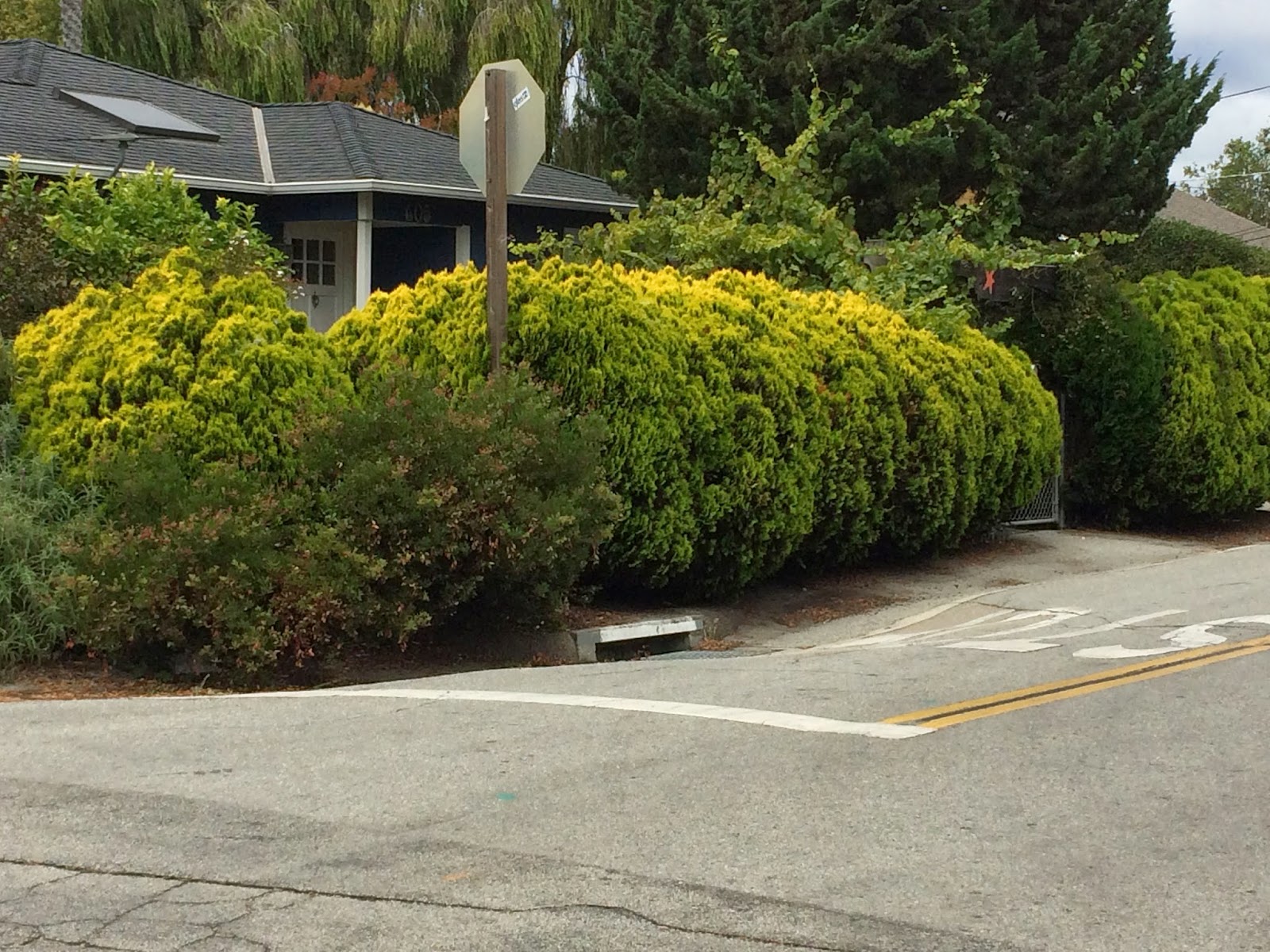
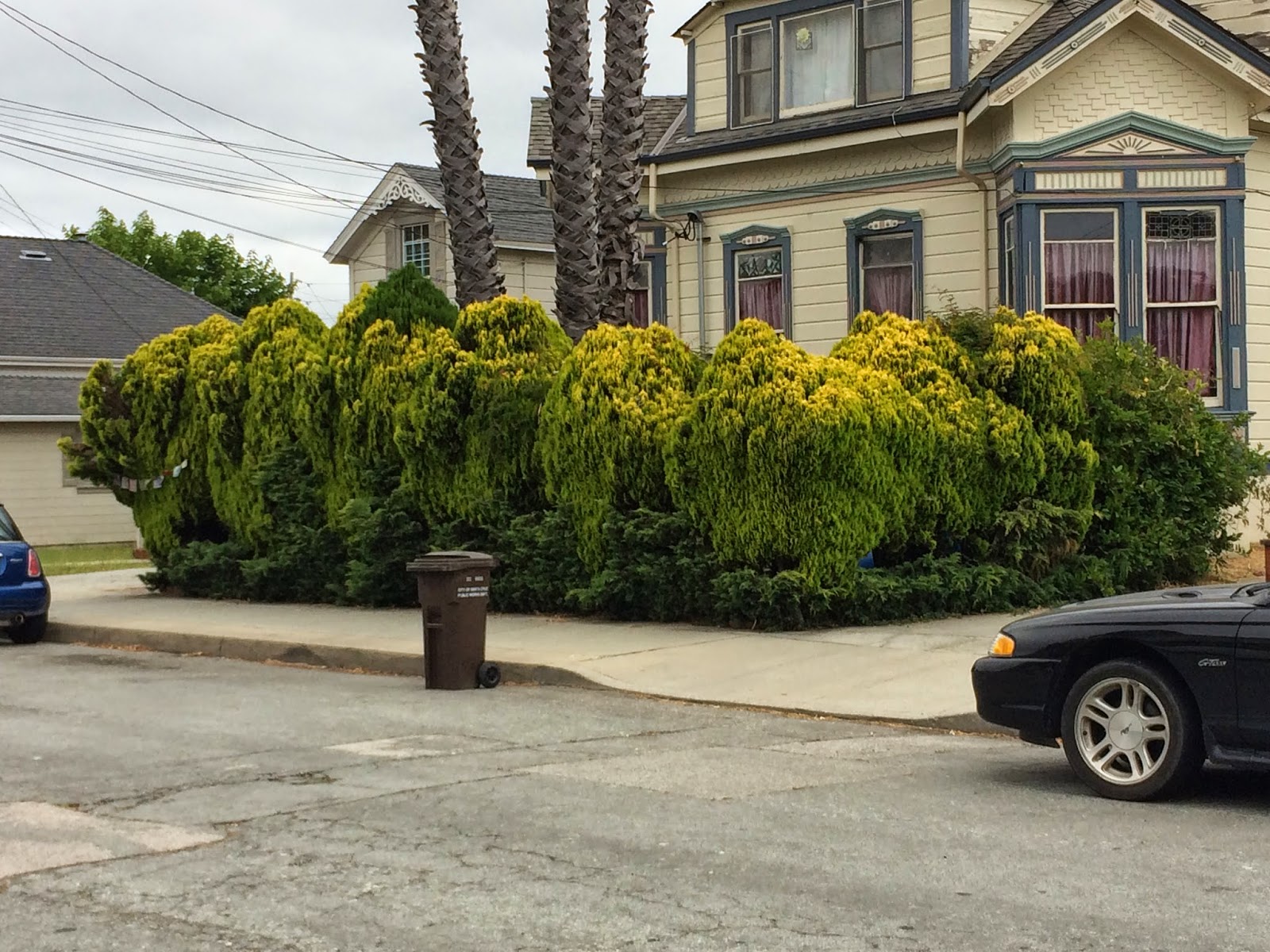
Here is a nice hedge on 38th and Flora.


and another needing some help on Oceanview.


Aptos - Seacliff
619 Seacliff Dr (Golden cultivar)

Santa Cruz -
705 Walnut Ave.
304 Caledonia St.
Santa Cruz High School - in front of the Main Building, not on Walnut but the other front.

Santa Cruz - Pleasure Point
3230 Hawes Dr.

Soquel
2800 Porter, just in the vacant lot towards Soquel Dr. by far the largest one I have seen locally.