Search This Blog

Showing posts with label 3 needle pine. Show all posts

Wednesday, December 24, 2014

Pinus attenuata - Knobcone Pine

The Knobcone Pine is a California native conifer closely related to the Monterey Pine and will hybridize in overlapping native stands. Often seen as a single stemmed tree, one of the most obvious features to me is its commonly seen multi-stemmed habit. The trees prefer poor sandy soils and will likely reach 30-50' tall. The most recognizable features are the clusters of long lasting cones and groves of all the same age due to their dependance on fire to open the cones.


Leaves are evergreen, needle shaped, 3 needles per cluster, medium green or yellowish green, straight or twisted, slender but stiff, lasting 4-5 years, 3-1/2 to 6" long.


Stems reddish brown, not thick, not thin.


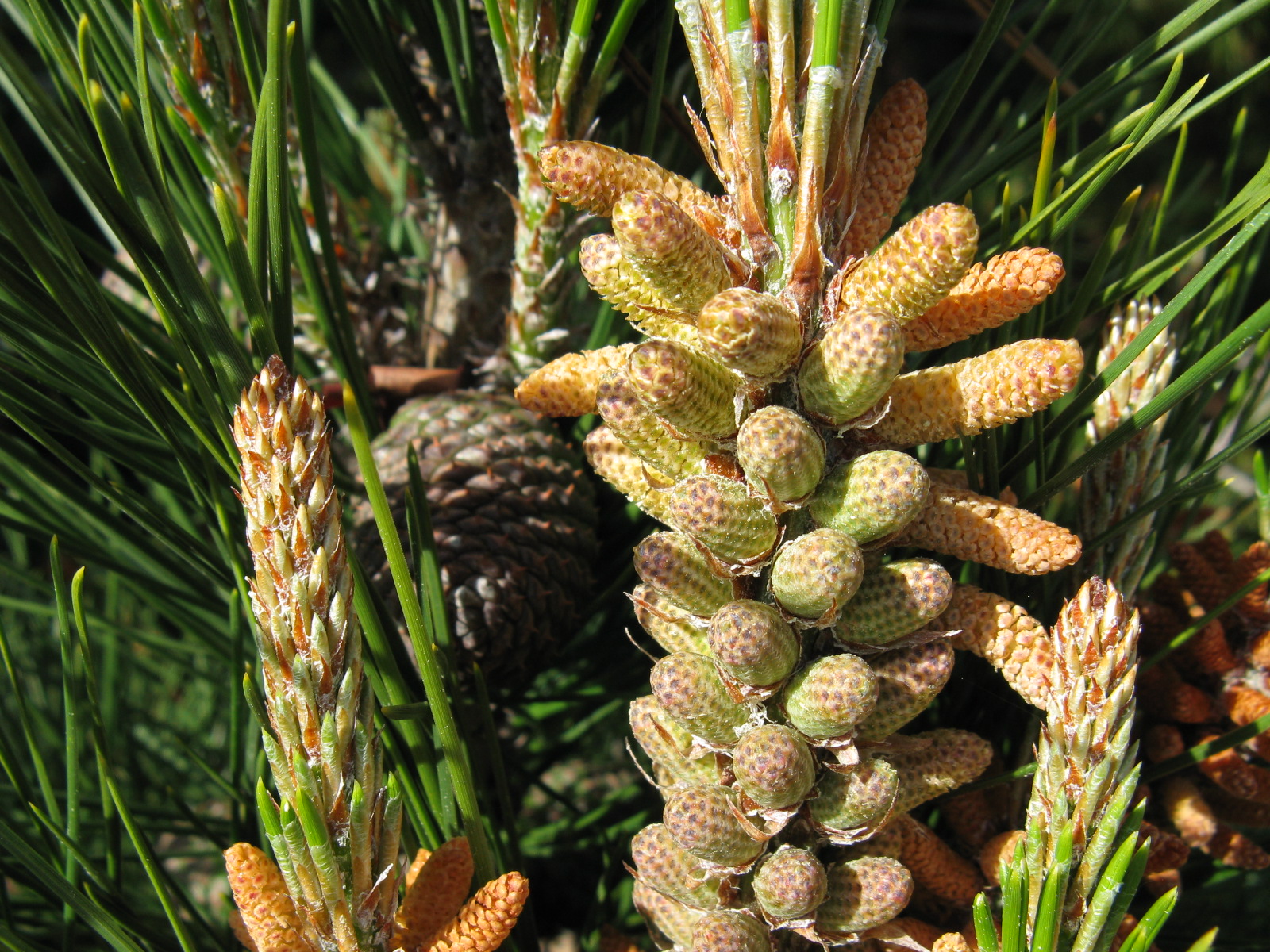
Long terminal bud, most likely going to develop female cones.


Cones 4-6" long, in whorls of 4-5, conical but asymmetrical, yellowish brown, hard, and heavy. The scales are tipped with prickles that are long on the tops of the cone but do not elongate on the cone side closest to the stem. Cones very persistent and do not open without the heat of fire. (Other closed cone pines do open with high heat after some years). 


You can see the color, the pitch, and the asymmetrical shape. You can also see the shape of the scales at the top of the cone, larger, verses the ones on the lower edge, more compressed. While the picture below is too close to the branch, you can also get a sense of how many cones are produced in one area.


Here is somewhat of a close up of the scales with hooks.


Bark is thin, brown to gray, with thin fissures showing some reddish color.


Misidentification:
Pinus radiata for sure. They are both 3 needle pines, with variable color leaves and asymmetrical cones, though these have cones that remain on the tree forever, and have pointed hooks on the ends of the scales. The growth habit is also very different.

Other 3 needle pines in our area:
P. attenuata, Knobcone Pine is native to the northern county and can be seen in UCSC wild areas. Cones are very different, in large clusters on the main stems and held for years.
P. canariensis, much longer softer needles, longer cones, much fuller habit but more or less the same overall shape but way full.
P. coulteri, longer bluer leaves, more stiff and dont seem to droop on the stems, not as restricted to the ends of the branches as they last 3-4 years. Much broader habit. There are some around.
P. jefferyi, the cones are different in that the prickle on the scale is curved inward and will not stick you and you will not likely see one in SC.
P. radiata,  dark green leaves, shorter and softer cones without curved hooks.


Location:
Santa Cruz
Empire Grade at the enter section with Felton Empire Rd and Ice Cream Grade. Actually they are all along Empire Grade well past UCSC.

Sunday, January 19, 2014

Pinus coulteri - Big-Cone Pine

The Coulter Pine is another California native conifer and a big one. Everything about them is big; big cones with big long flat prickles, big thick stems, big thick and long needles, and a large thick trunk. Cool tree. Also called the Big-Cone Pine or the Widow Maker Pine. 

The coulter pine is native to the coast ranges and can be seen growing in the Gilroy area, up in Boulder Creek and the Big Sur area. The trees are fast growing from 30-80' tall and tend to have an upright open habit when growing in a group, shorter, denser and rounder in the open.


Leaves are in fascicles of 3's, 6-12" long, stiff, bluish-gray green, sharply pointed, remaining only 2-3 (4) years so they are clustered at the ends of the branches. The leaves are stiff enough they do not bend or weep even though they are almost a foot long.


Large thick sharply pointed terminal bud.


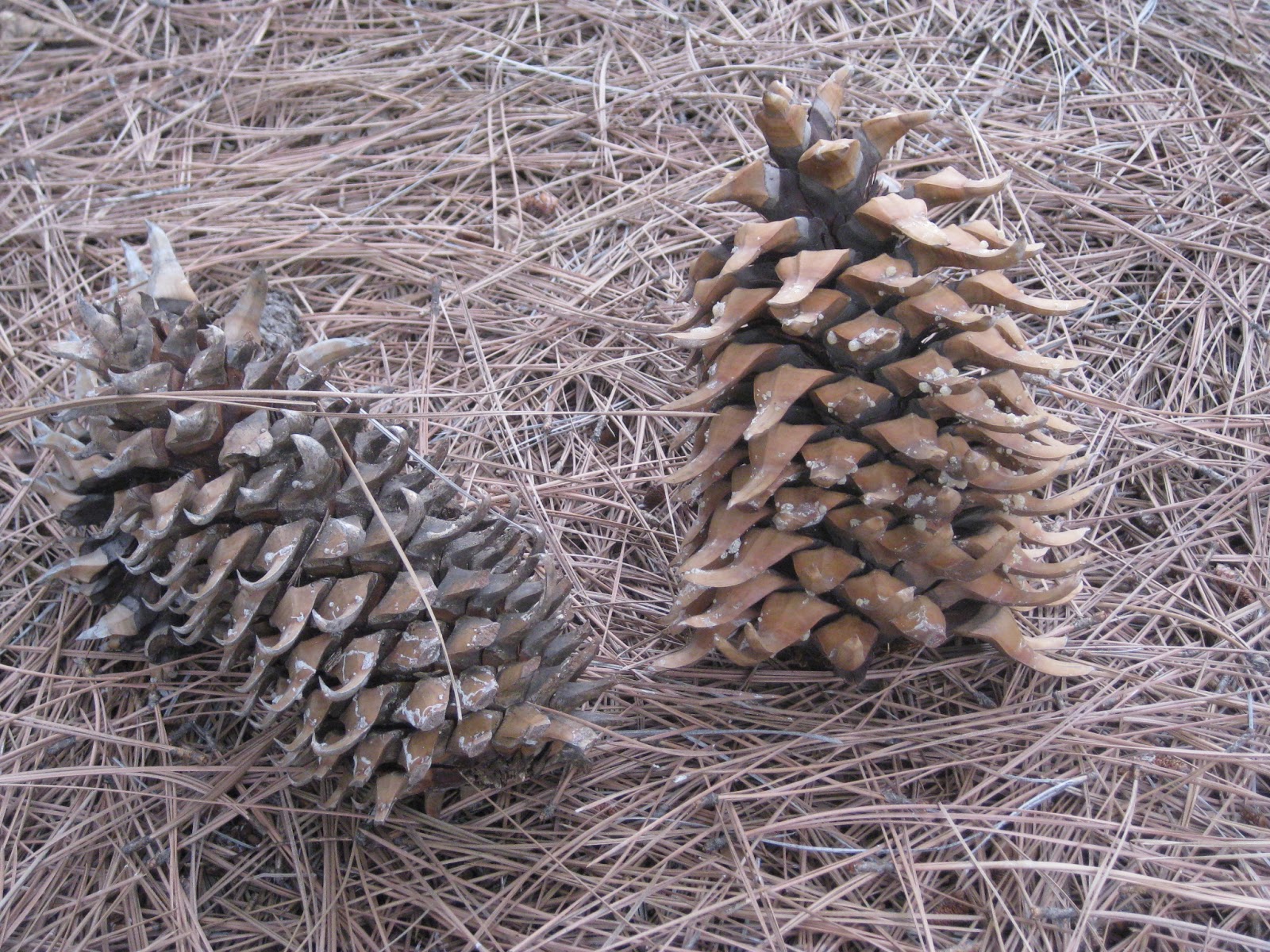
Its not called the big-cone pine for nothing. The cones are 8-15" long, and can weigh 4-10  pounds when ripe. They are the largest cones in the pine genus, though you will see longer ones (Pinus lambertiana - the sugar pine). Usually borne on strong lateral branches, they tend to be in groups of 2 or 3 somewhat asymmetrical and attached to the stem by a short thick stock. They are light tan colored when mature. The prickle is long, sharp and flat and curves out and up towards the free end. 


These were on the ground at Tilden Park.


Like the ponderosa pine, the cones fall off the tree leaving some scales behind.


Trunks are thick, maybe 3' wide with dark gray to black deeply furrowed bark.

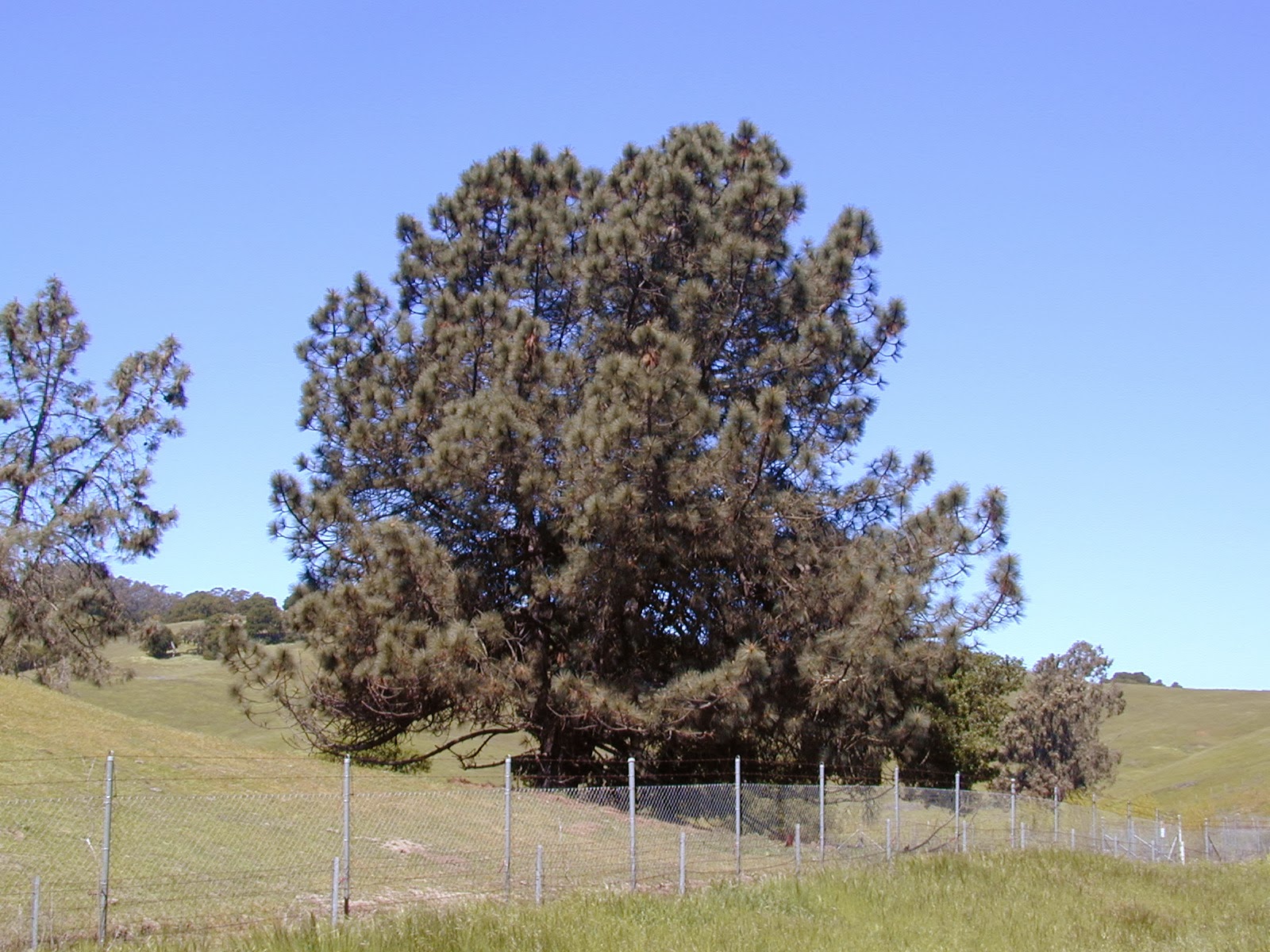
A nice specimen off highway 101 at the 126 interchange. You can see the open habit of another specimen to the left.


Misidentification:

Other 3 needle pines in our area:
P. attenuata, Knobcone Pine is native to the northern county and can be seen in UCSC wild areas. Cones are very asymmetrical, in large clusters on the main stems and held for years.
P. canariensis, much longer softer weeping needles, much fuller upright habit.
P. jefferyi, Long leaves, similar to ponderosa leaves, and the cones are smaller, and the prickle on the scale is curved inward. You will not likely see one in SC.
P. radiata, Dark green leaves, shorter and softer. Cones without a large prickle.
P. ponderosa: Shorter leaves, taller open habit, smaller cones
P. sabiniana: You might see another tree called the digger pine. I have not seen any here, but they have similar looking cones but smaller and more round, but the habit is multi-stemmed.

Location:

Felton
Gram Hill Rd and Covered Bridge Rd, right above the Felton sign

Santa Cruz mountains along Hecker Pass.

Summit Rd; on the SC county side, at the school/community center, along the back road.

Wednesday, May 22, 2013

Pinus patula - Mexican Weeping Pine

There was a quote about a pettable tree earlier but this one is beyond pettable. The Mexican Weeping Pine tree is so soft when young it is one you just want to have in your yard so you can rub up against it. I cant remember the first one I saw, may have been this one below at Kew Gardens but I fell in love with them and still feel the same.


Most commonly seen in our area as a small to medium evergreen tree with a rounded crown, growing to maybe 35' by 30 wide. Primary lateral branches are low and tend to be ascending with the secondary and smaller being weepy. 

The oldest/largest one I have encountered can be seen from Green Valley Road just east of the Kralj Dr. intersection. Gone.(Hard to photograph).  This one below (actually 2 in the picture) is over the hill.


Leaves are in clusters of 3-4 (5) long 6-9", and slender, light green to yellowish green. They tend to be in two rows on either side of the stem which arches slightly at the tip. Lasting only 2-3 years on the stems. Stems have a whitish bloom when young.


Medium aged trunks are beautiful. Reddish brown with some yellow, slightly flaking off in bits. 


Cones are a yellowish-chestnut brown color, 2-4" long, elongated egg-shaped with a short stalk holding on the stem. Growing in clusters, rarely alone. Scale tips are pretty smooth without a distinct raised area or prickle.


Misidentification
Any other weeping pine. Look for 3-4 needles, a reddish bark and smaller cones. Many other weeping pines are white pines with 5 needles.

Location
Watsonville, Not exactly sure where its home is, only looked at it from Green Valley but it looks like it could be in the back of the Trinity School on Lawrence or just in a vacant lot along Kralj. (Gone.)

Capitola
502 El Salto Ave. not in great shape but large. (Gone.)

Santa Cruz (Pleasure Point)
339 Anchorage is a nice larger one

Aptos
386 Baltusrol Dr.(Gone)


Tuesday, January 24, 2012

Pinus ponderosa - Ponderosa Pine

The Ponderosa pine is one of my favorite conifers. It is native to parts of SC county as well as the Sierras and into the eastern portions of  the PNW.  Tall columnar shape when older, trunks void of branches for about a third of the trunk showing off the beautiful bark. Lateral branches short, mostly perpendicular to the trunk. As would be expected there are variations of this species as some are found in the Sand Hills area and others at 2000 feet elevation of the inland pacific northwest. Growth rate is medium and has been noted to grow several feet per year when young. The ponderosa pine is also know as bull pine, blackjack pine and the western yellow pine.


Leaves are needle like, in bundles of 3 (there is a botanical variety with 2 or 3 needles P. ponderosa scopulorum) 6-8" long, light to medium green color and very sharp pointed. Needles tend to be restricted to the ends of the branches as they only last 3 years. They are also somewhat droopy on the branch.


Reproductive structures are separate on the trees, males generally dark reddish purple (or can be yellow) before opening and releasing massive amounts of yellow pollen. Generally borne on the lower branches.


Females are red, and borne higher up in the tree.


Immature cones vary in color with subspecies, and can be black to purple as seen in this image from eastern washington to green colored.  All the cones turn dark reddish brown as they mature. They are about 4" long, oblong or ovate shaped, with very sharp prickles on the ends of the scales that reflex backwards (outward, unlike the Jeffery Pine). 


Mature cone. Note the tips of the scales pointing outward.


The cones leave behind a row a scales on branches when they fall. The are not the only ones that do that, its just a helpful characteristic.


Stems are very stout, greenish-brown. 


Trunks with mature bark is one of the most beautiful barks I know. If you look closely the bark bits look like jigsaw puzzle pieces. But it takes a long time to develop this sort of trunk. Orange in color, with black crevices. 


Misidentification: Always look at the needle number first, these have 3.
Jeffery pine for one,
Other 3 needle pines in our area:
P. attenuata, Knobcone Pine is native to the northern county and can be seen in UCSC wild areas. Cones are very different, in large clusters on the main stems and held for years.
P. canariensis, much longer softer needles, longer cones, much fuller habit but more or less the same overall shape but way full.
P. coulteri, longer bluer leaves, more stiff and dont seem to droop on the stems, not as restricted to the ends of the branches as they last 3-4 years. Much broader habit. There are some around.
P. jefferyi, the cones are different in that the prickle on the scale is curved inward and will not stick you and you will not likely see one in SC.
P. radiata, covered earlier, dark green leaves, shorter and softer.

Location: Several nice places,
From the road you can see them on:
Highway 17 between Granite Creek Rd and Mt Herman Exits on the north side,
Highway 1 to the east, lining the area below Cabrillo College
Graham Hill Rd just past Quarry Rd on your way to Ben Lomond on the right is a beautiful one.
Mt Herman Rd as it leaves Scotts Valley area and heads into the Sand Hills area.
Scotts Valley has a great collection, there is a nice big one on the corner of SV Drive and Bean Creek Rd.

In town, you can see one that was supposed to be a P. pinea so its planted with other Italian Stone pines, on Mar Vista Dr in Soquel outside the Seacliff Adult mobile homes on your left.

Tuesday, May 10, 2011

Pinus canariensis - Canary Island Pine

Certainly one of the most commonly planted pine trees in our area. Usually quite easy to identify from a distance. Tall and skinny, sort of billowy for the most part with pendulous long needles. Very tolerant of urban conditions, seems to like dry soils but tolerates wetter sites and does well in poor soils. Here is a group planted at Stanford U.


The Canary Island pine is a moderate to fast growing pine to about 50-80' tall and 20-30' wide. Pyramidal when young becoming conical mid-aged and eventually flat topped (see the one below at the Huntington Garden). Main trunk thick very straight. Laterals short (but can be long) and typically upright eventually becoming horizontal with the tips curving up at the ends, creating a somewhat layered tree or appearing whorled or billowy as I mentioned.


The linear needle-like leaves, retained 1.5-3 years are in fascicles of 3 with a persistent 1" sheath, and are 6 - 12" long. They are bright green to yellow-green, and slender which is why the longer ones droop gracefully with their weight.  Shoots stout, buff to yellow-brown, and rough from the non-photosynthetic leaves.


You will see lots of juvenile foliage on this species, along the trunk or near cut branches. They are borne singly, light bluish colored, and about an inch long.


Buds are about 1" long and already contain all the leaves that will grow that season.


Male cones are clustered at the ends of lower shoots, opening up to be yellow, releasing lots of pollen. After these fall off you will spaces on the branch without any leaves. Do not be mistaken that something is wrong or is dropping leaves.


Female cones are slightly curved on short stout stalks, glossy chestnut-brown symmetrical, hard, heavy, ovoid-conic, 4-8" long.


As they open.


The bark is extremely thick, reddish, with small flaky plates separated by shallow furrows.


This is what they like to do to them in Southern California.


Here are two I saw several weeks ago growing at the base of the SF Bay Bridge.


Misidentification:  Be sure to count the needles and look at the length as well as them being soft. Pinus coulteri also has long needles in 3's but they are blue, very stiff and the tree is more rounded. 

Other 3 needle pines in our area:
P. attenuata, Knobcone Pine is native to the northern county and can be seen in UCSC wild areas. Cones are very different, in large clusters on the main stems and held for years.
P. canariensis, much longer softer needles, longer cones, much fuller habit but more or less the same overall shape but way full.
P. coulteri, longer bluer leaves, more stiff and dont seem to droop on the stems, not as restricted to the ends of the branches as they last 3-4 years. Much broader habit. There are some around.
P. jefferyi, the cones are different in that the prickle on the scale is curved inward and will not stick you and you will not likely see one in SC.
P. radiata, covered earlier, dark green leaves, shorter and softer.

Thursday, March 10, 2011

Pinus radiata - Monterey Pine

Pinus radiata

Conifers are my favorite group of trees, and Pinus is my favorite genus. It's best to start with my favorite group. Also, might as well start with a very common native of the area. You can see this tree all along the freeway and in most neighborhoods in the county.

Pinus radiata, commonly known as the Monterey Pine is a very interesting pine tree. It has a very restricted native distribution, and is also considered to be one of the most widely planted conifers in the world, particularly in the southern hemisphere for timber use. 

There are said to be 3 native populations, all in the fog belt of coastal California. One in San Mateo and Santa Cruz counties near the county line at Ano Nuevo. The second in Monterey county, (you have to go see them at Point Lobos) and the third in Cambria. There is also one or two subspecies from the islands of Cedros and Guadalupe off Baja.

Monterey Pine is a popular landscape tree in England. We generally don't plant them here, ahh yes the grass is always greener. This one is in Beth Chatto's Garden.


The first time I heard about mycorrhizae years ago at the College of San Mateo, it concerned Monterey Pines in Australia, funny that I completed my PhD with mycorrhizae.

Trees can range from 45-90' tall. Usually single stemmed but occasionally multi-stemmed. The branching habit is pretty distinct, with the primary scaffold branches angled about 45 degrees. As these branches grow the tree takes on a broad diamond shape. As the trees age they eventually develop into a tall tree with a somewhat open rounded or flat topped canopy. As I mentioned they are very popular elsewhere. They grow really fast when young. Most pines only put out one whorl of branches per year and this one can put out several.


Young trees are rapid growers and form a narrow upright form.


Monterey Pine is a 3 needle pine. The needles are medium bright green, but can also be pretty dark, about 3-6" long. (The two subspecies have only 2 needles so watch out). Color seems to be related to age, younger trees being darker green. Needles are blunt tipped, not sharply pointed. Note in the image below that the sheath is about 1/4 - 1/2"and more or less gray. The sheath is the "wrapping" around the base of the leaves. The leaves are retained for 4 years before being shed. This is important in identifying a pine you don't know, you need to see how many years of leaves there are on a branch. How do you do that? We will discuss that some other time when we talk pines.


The cones are very attractive and quite symmetrical when open still attached to the tree and when on the ground. All pines have scales that are radially arranged but when these open they are very attractive. Cones are 3-6" long, light brown and ovoid shaped. They are held on the branches asymmetrically, usually in groups of 3. They have a short stalk or none at all.


They are reported to open mostly by fire but they also open in hot weather. You can tell they open without fire as most of the trees in residential areas are not the result of fire. The cones do stay attached for many years.


Early in the spring the male and female "flowers" appear. They are really a special type of reproductive structure called a strobilus, and not real flowers. Anyway, the females can be very attractive but you may not notice them as much as the males. The reason for this is that the females are usually near the top of the tree and the males are low down on the tree, plus the males release the yellow rain or the pollen and you tend to notice that more.

As I mentioned, these pines are a bit unusual and may produce 2 sets of cones in one year.


Bark is an attractive gray to reddish brown, deeply V-furrowed. This is an old tree.


Misidentification:

Other 3 needle pines in our area:
P. attenuata, Knobcone Pine is native to the northern county and can be seen in UCSC wild areas. Cones are very different, in large clusters on the main stems and held for years.
P. canariensis, much longer softer needles, longer cones, much fuller habit but more or less the same overall shape but way full.
P. coulteri, longer bluer leaves, more stiff and dont seem to droop on the stems, not as restricted to the ends of the branches as they last 3-4 years. Much broader habit. There are some around.
P. jefferyi, the cones are different in that the prickle on the scale is curved inward and will not stick you and you will not likely see one in SC.
P. radiata, covered earlier, dark green leaves, shorter and softer.


Location:
Interesting specimens can be seen everywhere, but you should to go see them at Point Lobos, with the mixture of the blue water and the cliffs, just remarkable. Don't forget to look at the Monterey Cypress on the cliffs as well. Go to Waddell Creek by the county line, the olds ones are covered with moss, and those that are still alive are pretty nice. Pinus radiata is susceptible to pitch canker that kills many of our trees.


There is a nice specimen on E Cliff in Capitola
In the south county there is a real survivor in the rail junction yard on Salinas Rd in Pajaro.
This is the large one in Aptos Village across from the entrance to the park. (Hope they don't cut it down when "they" redo the village.)