Search This Blog

Showing posts with label Pine. Show all posts

Tuesday, January 24, 2012

Pinus ponderosa - Ponderosa Pine

The Ponderosa pine is one of my favorite conifers. It is native to parts of SC county as well as the Sierras and into the eastern portions of  the PNW.  Tall columnar shape when older, trunks void of branches for about a third of the trunk showing off the beautiful bark. Lateral branches short, mostly perpendicular to the trunk. As would be expected there are variations of this species as some are found in the Sand Hills area and others at 2000 feet elevation of the inland pacific northwest. Growth rate is medium and has been noted to grow several feet per year when young. The ponderosa pine is also know as bull pine, blackjack pine and the western yellow pine.


Leaves are needle like, in bundles of 3 (there is a botanical variety with 2 or 3 needles P. ponderosa scopulorum) 6-8" long, light to medium green color and very sharp pointed. Needles tend to be restricted to the ends of the branches as they only last 3 years. They are also somewhat droopy on the branch.


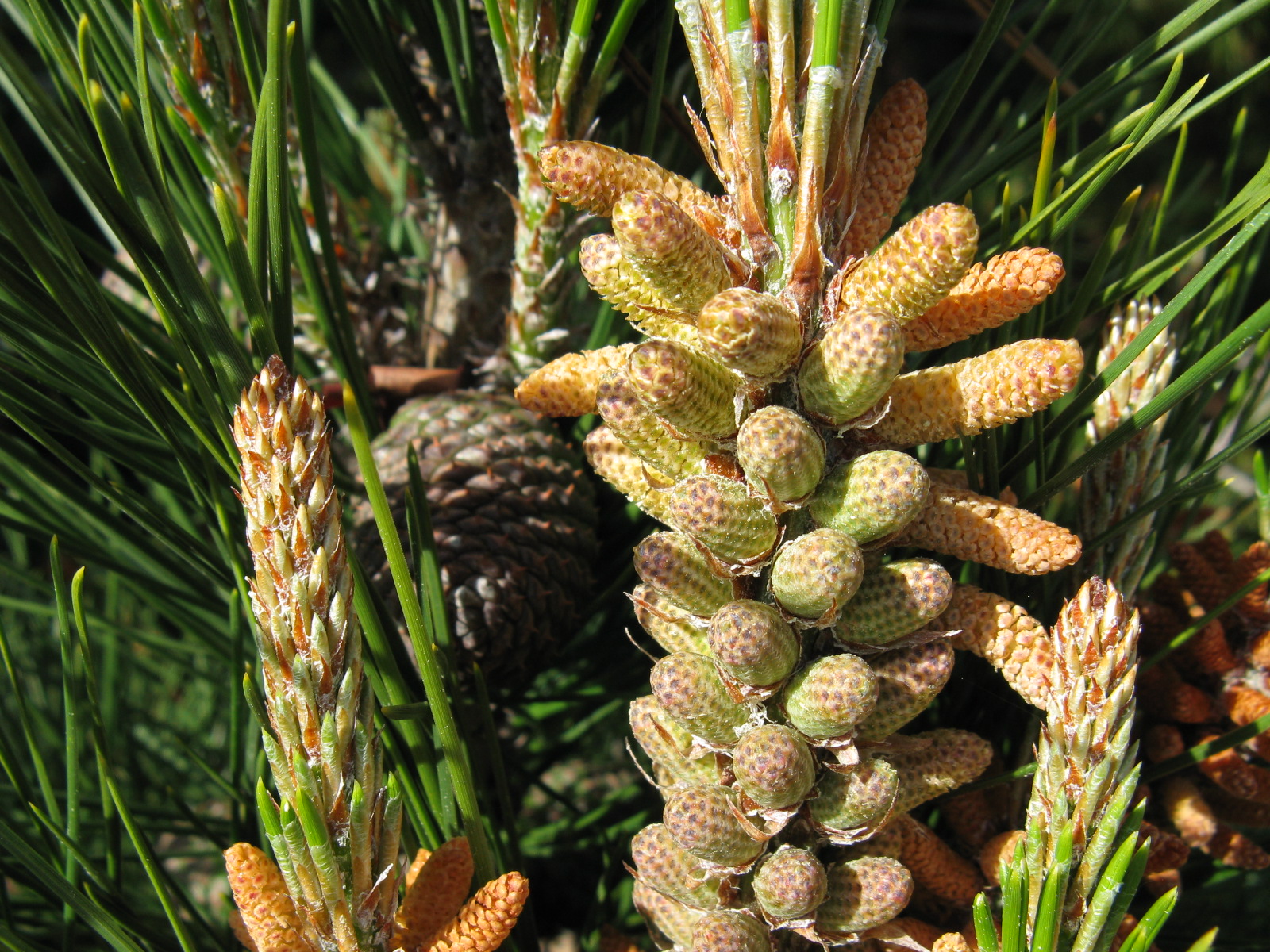
Reproductive structures are separate on the trees, males generally dark reddish purple (or can be yellow) before opening and releasing massive amounts of yellow pollen. Generally borne on the lower branches.


Females are red, and borne higher up in the tree.


Immature cones vary in color with subspecies, and can be black to purple as seen in this image from eastern washington to green colored.  All the cones turn dark reddish brown as they mature. They are about 4" long, oblong or ovate shaped, with very sharp prickles on the ends of the scales that reflex backwards (outward, unlike the Jeffery Pine). 


Mature cone. Note the tips of the scales pointing outward.


The cones leave behind a row a scales on branches when they fall. The are not the only ones that do that, its just a helpful characteristic.


Stems are very stout, greenish-brown. 


Trunks with mature bark is one of the most beautiful barks I know. If you look closely the bark bits look like jigsaw puzzle pieces. But it takes a long time to develop this sort of trunk. Orange in color, with black crevices. 


Misidentification: Always look at the needle number first, these have 3.
Jeffery pine for one,
Other 3 needle pines in our area:
P. attenuata, Knobcone Pine is native to the northern county and can be seen in UCSC wild areas. Cones are very different, in large clusters on the main stems and held for years.
P. canariensis, much longer softer needles, longer cones, much fuller habit but more or less the same overall shape but way full.
P. coulteri, longer bluer leaves, more stiff and dont seem to droop on the stems, not as restricted to the ends of the branches as they last 3-4 years. Much broader habit. There are some around.
P. jefferyi, the cones are different in that the prickle on the scale is curved inward and will not stick you and you will not likely see one in SC.
P. radiata, covered earlier, dark green leaves, shorter and softer.

Location: Several nice places,
From the road you can see them on:
Highway 17 between Granite Creek Rd and Mt Herman Exits on the north side,
Highway 1 to the east, lining the area below Cabrillo College
Graham Hill Rd just past Quarry Rd on your way to Ben Lomond on the right is a beautiful one.
Mt Herman Rd as it leaves Scotts Valley area and heads into the Sand Hills area.
Scotts Valley has a great collection, there is a nice big one on the corner of SV Drive and Bean Creek Rd.

In town, you can see one that was supposed to be a P. pinea so its planted with other Italian Stone pines, on Mar Vista Dr in Soquel outside the Seacliff Adult mobile homes on your left.

Thursday, March 10, 2011

Pinus radiata - Monterey Pine

Pinus radiata

Conifers are my favorite group of trees, and Pinus is my favorite genus. It's best to start with my favorite group. Also, might as well start with a very common native of the area. You can see this tree all along the freeway and in most neighborhoods in the county.

Pinus radiata, commonly known as the Monterey Pine is a very interesting pine tree. It has a very restricted native distribution, and is also considered to be one of the most widely planted conifers in the world, particularly in the southern hemisphere for timber use. 

There are said to be 3 native populations, all in the fog belt of coastal California. One in San Mateo and Santa Cruz counties near the county line at Ano Nuevo. The second in Monterey county, (you have to go see them at Point Lobos) and the third in Cambria. There is also one or two subspecies from the islands of Cedros and Guadalupe off Baja.

Monterey Pine is a popular landscape tree in England. We generally don't plant them here, ahh yes the grass is always greener. This one is in Beth Chatto's Garden.


The first time I heard about mycorrhizae years ago at the College of San Mateo, it concerned Monterey Pines in Australia, funny that I completed my PhD with mycorrhizae.

Trees can range from 45-90' tall. Usually single stemmed but occasionally multi-stemmed. The branching habit is pretty distinct, with the primary scaffold branches angled about 45 degrees. As these branches grow the tree takes on a broad diamond shape. As the trees age they eventually develop into a tall tree with a somewhat open rounded or flat topped canopy. As I mentioned they are very popular elsewhere. They grow really fast when young. Most pines only put out one whorl of branches per year and this one can put out several.


Young trees are rapid growers and form a narrow upright form.


Monterey Pine is a 3 needle pine. The needles are medium bright green, but can also be pretty dark, about 3-6" long. (The two subspecies have only 2 needles so watch out). Color seems to be related to age, younger trees being darker green. Needles are blunt tipped, not sharply pointed. Note in the image below that the sheath is about 1/4 - 1/2"and more or less gray. The sheath is the "wrapping" around the base of the leaves. The leaves are retained for 4 years before being shed. This is important in identifying a pine you don't know, you need to see how many years of leaves there are on a branch. How do you do that? We will discuss that some other time when we talk pines.


The cones are very attractive and quite symmetrical when open still attached to the tree and when on the ground. All pines have scales that are radially arranged but when these open they are very attractive. Cones are 3-6" long, light brown and ovoid shaped. They are held on the branches asymmetrically, usually in groups of 3. They have a short stalk or none at all.


They are reported to open mostly by fire but they also open in hot weather. You can tell they open without fire as most of the trees in residential areas are not the result of fire. The cones do stay attached for many years.


Early in the spring the male and female "flowers" appear. They are really a special type of reproductive structure called a strobilus, and not real flowers. Anyway, the females can be very attractive but you may not notice them as much as the males. The reason for this is that the females are usually near the top of the tree and the males are low down on the tree, plus the males release the yellow rain or the pollen and you tend to notice that more.

As I mentioned, these pines are a bit unusual and may produce 2 sets of cones in one year.


Bark is an attractive gray to reddish brown, deeply V-furrowed. This is an old tree.


Misidentification:

Other 3 needle pines in our area:
P. attenuata, Knobcone Pine is native to the northern county and can be seen in UCSC wild areas. Cones are very different, in large clusters on the main stems and held for years.
P. canariensis, much longer softer needles, longer cones, much fuller habit but more or less the same overall shape but way full.
P. coulteri, longer bluer leaves, more stiff and dont seem to droop on the stems, not as restricted to the ends of the branches as they last 3-4 years. Much broader habit. There are some around.
P. jefferyi, the cones are different in that the prickle on the scale is curved inward and will not stick you and you will not likely see one in SC.
P. radiata, covered earlier, dark green leaves, shorter and softer.


Location:
Interesting specimens can be seen everywhere, but you should to go see them at Point Lobos, with the mixture of the blue water and the cliffs, just remarkable. Don't forget to look at the Monterey Cypress on the cliffs as well. Go to Waddell Creek by the county line, the olds ones are covered with moss, and those that are still alive are pretty nice. Pinus radiata is susceptible to pitch canker that kills many of our trees.


There is a nice specimen on E Cliff in Capitola
In the south county there is a real survivor in the rail junction yard on Salinas Rd in Pajaro.
This is the large one in Aptos Village across from the entrance to the park. (Hope they don't cut it down when "they" redo the village.)