Search This Blog

Showing posts with label Medium tree. Show all posts

Tuesday, December 10, 2024

Acer x fremanii 'Jeffersred' - Autumn Blaze®

The hybrids between the red (A. rubrum) and the silver A. saccharinum) have been around for a long time but they are not very common in our area. The two species overlap in their natural habitats so the hybridization has been occurring naturally as well as controlled hybridizing. The red maple parents provide the fall color and the "better" branching structure while the silver maple parents provide the leaf shape and fast rate of growth and perhaps tolerance to adverse conditions. There are a handful of cultivars. This particular cultivar grows into an upright oval shaped form to 60'. The Autumn Blaze® is the trademarked name but used interchangeably with the common name.

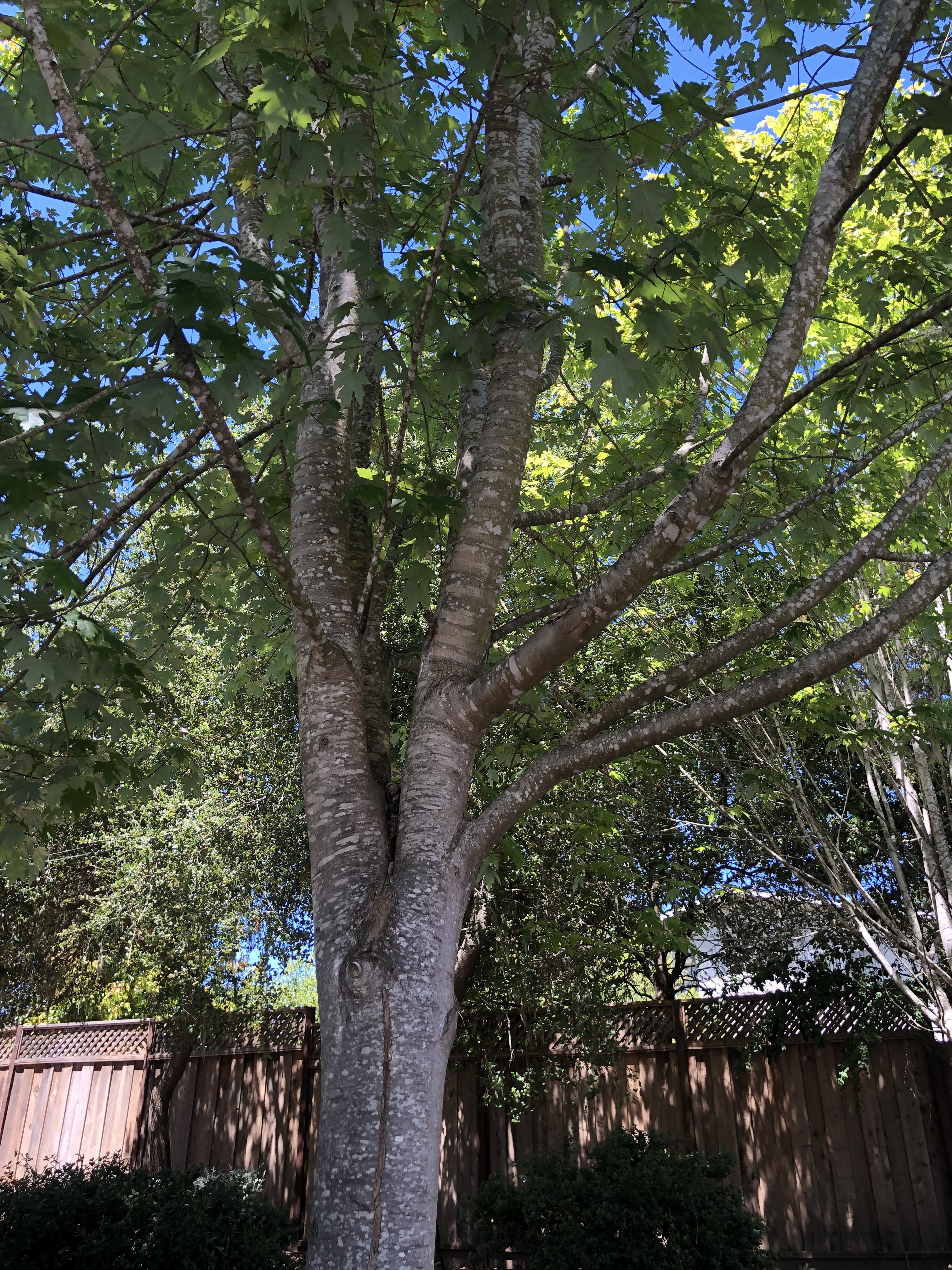
This image is really 3 trees in a row so they look a little wider than a single tree.


Fall color is one of the reasons people plant these trees.


Leaves are opposite, simple, 6-8" long and almost as wide. The leaves look more like the silver maple leaf than a red maple leaf. The lower surface is white like the silver maple.


The branch structure needs work when young or you end up with several co-dominate leaders. I mentioned better structure, but they usually end up with co-dominate leaders that result in splitting the trunk.


Oregon State University Horticulture department page and a nice writeup on these and red maple cultivars. They have been given various names, sometimes as a red maple cultivar or as a hybrid. 

This image was published by The Journal of Aboriculture years ago showing this cultivar listed as a red maple cultivar.


Misidentification: Silver maple most likely. The leaves look more Silver but the Silver leaves have a deeper dissection. Silver Maple

Location
Aptos 
404 Townsend Dr.
407 Ewell Ave.

Sunday, July 26, 2015

Persea americana - Avocado

The avocado is a really common sight here in SC county. They are medium sided trees forming an upright to eventually an oval to rounded form with age. Still, 30' is way too tall to easily harvest the fruit. This is the iconic tree at Shoppers Corner. Tough spot for a large tree, surrounded by asphalt, compaction and heat.


Foliage is more or less evergreen dropping leaves at flowering, simple, alternate, 4-8" long, elliptical to ovate to oval, with entire margins, glossy dark green upper surface, lighter or whitish below, though in the spring new foliage can be tinged red. Old leaves falling in early spring.


Blooming late winter to early spring, the yellowish green flowers are tiny produced in large quantities on an upright airy panicle, individual flowers lack petals but have perianth lobes (?).


Flowers are pretty normal looking but have some interesting blooming patterns. All the flowers open as females first, saying open for only several hours and then close up for a day or longer and then open up with males shedding pollen. There are two distinct flowering types, called A and B. With "A" types the flowers open as females in the morning and become males in the afternoon of the second day. The "B" types open as females in the afternoon and then as males the following morning. So, what does that mean or do for them? It means that for maximum fertilization, you should have more than one tree. But in cooler conditions the flower sequence is slowed allowing for more self fertilization.
Our local experts, Four Winds Nursery, say that in our climate they seem to flower differently, and there is no need for cross pollination.


Fruit is a fleshy drupe or a berry depending on your reference, and called both by the Royal Horticulture Society. The single large seed is surrounded by an oily flesh and a very thin skin. Different varieties can be large or small (3-13" long) firm or soft at maturity, green skin or dark, smooth to rough, round to pear shaped. I learned years ago, prior to studying botany, that the seed influences the flesh as we made guacamole and it oxidized quickly if you didn't put the seed in it.


Stems are thick, green during the first year, browning soon into the second year.


Bark is beautiful on older trees, gray brown with deep fissures.


I recall driving north from San Diego years ago on the "Avocado" highway. I also remember as a kid back in the early 60's a good friend of my dad's looking to cash in on the speculation of the Avocado boom. Seems the guy was always chasing the next big thing and lost.


Misidentification:
Not sure?

Location:
Santa Cruz
Shoppers Corner parking lot

Saturday, May 23, 2015

Fraxinus ornus - Flowering Ash

The Flowering ash or sometimes called the Manna ash is a small to medium sized deciduous tree growing 25-50' with a spreading habit. Most literature suggests they are small trees in their native habitat of Spain. Not a great shot below, nor a great specimen being pruned by highway crews, but for now it's all I have.


Leaves deciduous, opposite, pinnately compound, 8-12" long, with 7-9 leaflets. Each leaflet about 2-3" long, medium green, oblong except the terminal which is a bit wider, margins serrated, cuneate base and acuminate tip, lower surface lighter green. Known to have weak reddish fall color, but having just stumbled on this one specimen, I have not seen the fall color.


Flowers creamy yellow in mass but more or less white close up. Trees are androdioecious, new term for me, where plants can produce perfect flowers or they can produce only male flowers. Then again I read that they might not be "functionally" androdioecious?? The flowers are borne in very showy panicles emerging with the spring foliage, males with two stamens, four white strap-like petals and fragrant. They have the typical privet smell.


Fruit is a narrow samara typical of ash trees.


Terminal bud is large, dull brown, many other Ash trees are copper colored buds. Leaf scars are pretty small and more or less flat topped.


Misidentification:
Any other ash tree if not in bloom. Actually, I drive by the specimen almost every day on the freeway and I suspect I thought it was a Sambucus but the other day it just looked different to me so I went back to look. Flowers in May, looking a lot like Chionanthus flowers. Foliage is slightly different that others around here, the terminal is quite broad and the terminal buds are large and dull brown.


Location:
Aptos
9057 Soquel Dr. Really across the street at the bus stop.

Tuesday, November 25, 2014

Ilex aquifolium 'Argentea Marginata' - Variegated Holly

The variegated holly is a wonderful addition to our evergreen dominated urban tree canopy. Growing slightly more rounded than the species, they will reach 30+ feet and form a broad, dense pyramidal shape. While this may appear to be multiple plants it is only one, with multiple leaders. They are often pruned formally, though they do grow that way naturally. I think my favorite variegated holly is the Hedgehog Holly. If you are going to have spines then really have spines.


Foliage is evergreen, simple, alternately arranged, elliptical, 2-3" long, dark glossy green in the center of the leaf, margins yellowish-white (silver?), slightly undulated, with or without spines. Fewer spines on slower growing branches. Very attractive year round, especially with the fruit. New foliage in spring should be somewhat pink.


Flowers are dioecious, all females on this tree. Small white in short clusters, in the spring. You may not notice them.

Fruit is a red berry like drupe about 3/8", can't say round because they are somewhat elliptical though the ends are not pointed.


Stems are green as you can see in the picture above.

Trunks are smooth, gray to silver colored. The canopy can be so dense you might not see the bark.


Misidentification:
Assuming you are looking at a variegated holly, and the margins are yellowish you could be looking at one of a dozen cultivars. I am basing my identification on the most likely candidate to have been planted due to availability in the nursery trade. I am always up for  being corrected, so if you think I am wrong, let me know, it won't be the first time.

Location:
Aptos
204 Appleton Dr
248 Moosehead Dr.

Friday, November 14, 2014

Eucalyptus cinerea - Argyle Apple

The Argyle Apple (?) really, what the heck does that mean, I know funny golf socks but, whats the apple? Okay, the evergreen tree grows very fast to 25-50' with a variable habit, upright oval but generally irregular with a full canopy. This one has been pruned heavily. Nice color foliage, nice bark. More common and more obvious than E. purverulenta. Also known as Silver Dollar Tree (but so is E. polyanthemum)


Juvenile leaves opposite, clasping the stem without a petiole, round to ovate, covered with wax. Intermediate taking on a narrowly ovate to lanceolate shape but still opposite.
Adult leaves alternate, simple, broadly lanceolate, 3-4" long, less than 1" wide, blue gray due to the waxy covering (glaucous).


Oddly enough, they bloom on juvenile and adult stems. Flowers in clusters of 3's, with a glaucous bloom, caps with a short point, showy bits are yellow stamens.


Fruit is a capsule, about 3/8" diameter, with a raised ring around the middle.


Bark is rough, fibrous, persistent, deeply furrowed, reddish brown


Misidentification
E pulverulenta. has very similar look but the truck sheds its bark.

Location
Aptos
1935 Dolphin Dr

Santa Cruz
209 Merced Ave - cut to 8' tall stumps, hate when that happens

132 Kenneth Dr, Nice big specimen

Tuesday, November 11, 2014

Ficus microcarpa nitida - Indian Laurel

I was pretty surprised to run into my first specimen(s) of the Indian Laurel in SC yesterday. Was looking at something else across the street and what I though was a heavily pruned Carob Tree had the wrong bark. I am not sure why they are rarely planted as they grow rapidly and usually start life as a house plant and get too big. Not a lot of good things to read on the internet about fig trees as landscape trees. They are often planted as a city street tree in warm coastal areas they quickly become unwanted guests. San Francisco can't pull them out fast enough. Older trees will lift sidewalks, clog sewers and create litter.  

Potentially a medium to large evergreen tree, 35 feet tall and wide. Heavily branched producing a thick canopy, ideal for a screen. Ideal for tropical cities. These trees have been pruned for years. 


Leaves are alternate, simple, oval to elliptical, 2-4" long, with entire margins, though sometimes undulated, dark green to lighter green, thick. New growth may be slightly reddish.


Young stems are green to brown. Long terminal bud is typical of most all Ficus species.


Bark is pretty. Mostly silver or gray color, smooth, potentially very thick.


The Indian Laurel will flower and produce small orange fruit that mature dark.


This tree has other names, Ficus retusa, F. nitida. Not sure what is right.

Misidentification:
Ficus benjamina is commonly grown as a houseplant as well and could be found outside. The leaves are thinner, more heavily undulated, have a longer acuminate tip, and tend to be weeping more heavily.
Bottle tree? maybe.

Location:
Santa Cruz
114 Escalona Dr.
River St and Front St at the parking garage.


Friday, October 17, 2014

Eucalyptus pulchella - Narrow Leafed Peppermint Tree

The Narrow Leafed Peppermint Tree is a medium sized evergreen tree growing to about 40 feet, with beautiful bark weeping small branchlets and very thin fragrant foliage. Nice soft look, can't say I have seen lots of them around so I am thinking its not commonly planted here.


Leaves are evergreen, simple, alternate, linear to narrowly falcate, 3-4" long by 1/4" wide, dark green with a peppermint smell when crushed.


Flowers are in clusters of 9-15 and open into a round ball of white stamens. Blooms early summer.


Flower buds in round clusters along the stem making for a great floral display.


Fruit is a small capsule, 1/3" diameter opening in fall.


Bark sheds in long sheets, but often smooth, cream to light green or gray colored bark. Eventually persistent close to the base.


Used to be know as E. linearis.

Thanks to Matt Ritter (CalPolySLO) for identification.

Misidentification:
The foliage of E. nicolii looks close but the willow-leaf peppermint has thicker leaves and of course persistent bark.


Location:
Aptos
151 Seacliff Dr. (Gone)

Sunday, September 21, 2014

Banksia integrifolia - Coast Banksia

Commonly called the Coast Banksia or Coastal Banksia, this interesting plant has a variable growth habit ranging from a large upright tree to a spreading large shrub, usually  with a single trunk but can me multi stemmed if shrub like. Other sources indicate there are four subspecies so my guess is that has a lot to do with the variability. The specimens I have seen in town grow upright and are about 25-30' and look like the one below seen at the USCS Arboretum. 


The evergreen simple leaves are whorled in groups of 3 to 5, oblanceolate, 3-5" long, dark green upper surface, silver below, thick and leathery texture.


Young stems are covered with a whitish coat of hairs, older stems become tan colored.


Notice the whorled leaf arrangement as well as the copper colored stems.


Banksia "flowers" are beautiful, though what we are looking at is an inflorescence or a group of flowers perhaps several hundred individuals on a woody stalk, arranged in a spiral, opening from the bottom up to the top. Individual flowers are usually light yellow or greenish and mostly what you see is the style, which is the female part of the flower.


After pollination, the "cone" develops, which is not a true cone but a collection of follicles arranged on a woody stalk and opening when dry or exposed to fire. Students mentioned they look like clams opening.


This image shows the new inflorescence starting on the right, the mature on the left, and the fruit center.


Bark is rough gray to brown and shallowly checked.


Misidentification:
Let's hope there are not many other Banksias out there, just kidding really, look at the foliage, as other Banksia trees have different leaf shapes.

Location:
Aptos
564 Santa Marguarita Dr. Hard to find in the planting.
517 Vista Del Mar
699 Vista Del Mar (along with a leaning (Leucadendron argenteum)