Search This Blog

Showing posts with label red fall color. Show all posts

Tuesday, December 10, 2024

Acer x fremanii 'Jeffersred' - Autumn Blaze®

The hybrids between the red (A. rubrum) and the silver A. saccharinum) have been around for a long time but they are not very common in our area. The two species overlap in their natural habitats so the hybridization has been occurring naturally as well as controlled hybridizing. The red maple parents provide the fall color and the "better" branching structure while the silver maple parents provide the leaf shape and fast rate of growth and perhaps tolerance to adverse conditions. There are a handful of cultivars. This particular cultivar grows into an upright oval shaped form to 60'. The Autumn Blaze® is the trademarked name but used interchangeably with the common name.

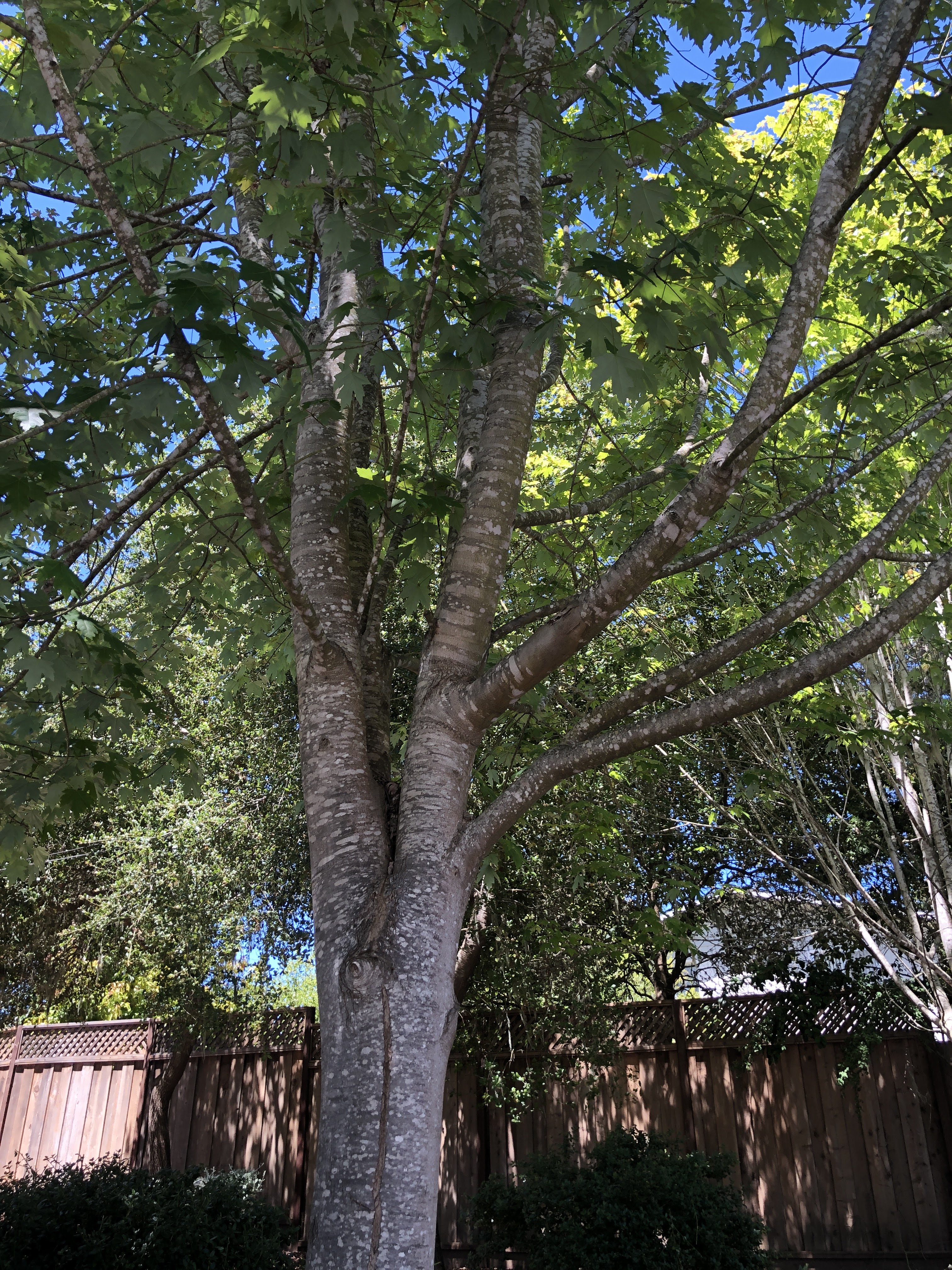
This image is really 3 trees in a row so they look a little wider than a single tree.


Fall color is one of the reasons people plant these trees.


Leaves are opposite, simple, 6-8" long and almost as wide. The leaves look more like the silver maple leaf than a red maple leaf. The lower surface is white like the silver maple.


The branch structure needs work when young or you end up with several co-dominate leaders. I mentioned better structure, but they usually end up with co-dominate leaders that result in splitting the trunk.


Oregon State University Horticulture department page and a nice writeup on these and red maple cultivars. They have been given various names, sometimes as a red maple cultivar or as a hybrid. 

This image was published by The Journal of Aboriculture years ago showing this cultivar listed as a red maple cultivar.


Misidentification: Silver maple most likely. The leaves look more Silver but the Silver leaves have a deeper dissection. Silver Maple

Location
Aptos 
404 Townsend Dr.
407 Ewell Ave.

Monday, May 25, 2015

Diospyros kaki 'Fuyu' - Fuyu Persimmon

The 'Fuyu' Persimmon tree is much like the 'Hachiya' except the fruit are less pointed, and from an eating perspective, less astringent. Trees typically growto 25' with an equal spread forming a rounded, oval or umbrella habit.  While I have not read others mention the spring or summer color of the leaves, these trees all seem to have yellowish foliage. Trees will reliably develop wonderful fall color.


Leaves are deciduous, simple, 3-5" long, ovate to elliptical shaped, entire margins, dark glossy green with distinct veins with a slight leathery texture. Very attractive in summer.


Especially attractive in the fall as they turn to yellow and orange.


Trees are monoecious, male and female flowers blooming in the spring to summer.


Fruit is a large orange berry, 3" wide, but about 2" tall, looking like a squatty apple. Retains its large green calix.


Stems originally slightly hairy, eventually without hairs. Dark rich brown with large lenticels.


Bark is great on all the persimmons.


Misidentification:
As a persimmon I doubt it, but cultivars are another matter. Distinguishing between 'Fuyu' and 'Hachiya' is easy if you see fruit, otherwise you are on your own. There are lots of 'Fuyu' like cultivars available.

If you have a different cultivar in a public space I would be very interested in seeing them.

Location:

Aptos
7535 Soquel Dr.

Corralitos
Corralitos Rd close to the Market, across the street is a row of both cultivars.

Santa Cruz
1104 King St
935 High St

Tuesday, October 28, 2014

Acer truncatum - Shantung Maple

The Shantung Maple is a beautiful small deciduous tree with a nice tight rounded canopy to 25'. Wonderful fall color and drought tolerance once established, I am surprised its not more common. Also known as the Purpleblow maple. Drought tolerant, smallish, fall color, what's not to like?


The deciduous leaves are opposite, simple, 3-5" long, dark glossy green, with five lobes which are usually entire but can be undulated. The base of the leaf is often truncated, or flat which is were the name comes from. White milky sap can be seen if you remove the leaves in summer. New spring growth with a reddish cast.


Flowers are small, greenish yellow and look like many other maples in this group (A. platanoides, A. campestre).

Fruit is a pair of samaras, usually broadly spreading into a U shape.


Stems are smooth, as is the bark.

Fall color can be yellow, reds, oranges. This is one I planted many years ago in Spokane.


This species is related to A. platanoides and has been hybridized to produce several commercially available trees including  'Pacific Sunset' and 'Norwegian Sunset'. Both hybrids resulting in a smaller size, better fall color and drought tolerance of A. truncatum.


Misidentification:
Most likely looks like a cultivar of A. palmatum around here. But the flowers are a different color.
Other locations where more maples grow you might see A. pictum mono, A. cappadocicum.

Stumbled across this https://www.metromaples.com/shantung-maples. Wow.


Location:
Aptos
114 Seacliff Dr
204 El Camino Del Mar

Edited 5/24

Saturday, August 23, 2014

Acer ginnala - Amur Maple

I ran into a specimen of the Amur Maple while cutting through the Soquel School. Not at all common in SC. The Amur maple is a nice little tree growing to maybe 20' tall with potentially great fall color. Often grown as a multi-stemmed specimen or can be trained as a single stem. A cultivar called 'Flame' has great fall color.


Sorry, old picture with low resolution, but shows the fall color.


Leaves are deciduous, simple, opposite, ovate shaped, with serrated margins, sometimes considered to be lobed with a prominent central lobe. Leaves are 2-4" long. 


Leaves can be quite variable in size as well as being very lobed or only slightly serrated. Age and rate of growth seem to be the deciding factor, with older slower growing plants showing smaller less deeply serrated margins.


Flowers are produced in spring, light green or yellowish, in chains, slightly fragrant. 


Fruit is typical of maples, paired samaras. The pairs hang almost parallel to each other and one is generally much smaller than the other. In summer they can be bright red. 


Bark is dark gray and usually pretty smooth but as they age they develop some longitudinal furrows. 


Also know as Acer tataricum ginnala.

Misidentification:
Not likely

Location:
Capitola
On Porter St at the Soquel School, near the east end of the campus close to the building. (Gone, removed for remodeling.)

Saturday, July 19, 2014

Nyssa sylvatica - Tupelo tree

The Tupelo tree (Tupelo honey) is a medium to large deciduous tree from the US, grown for the amazing fall color. Lateral branches are perpendicular to the main stem, sort of like a pin oak. Has the potential of reaching 80' in its native habitat. Many specimens in Santa Cruz have the tops removed, hopefully accidentally. 


This is one from Chico showing the "normal" growth habit.


Leaves deciduous, alternate, simple, obovate to oblong, 3-5" long, entire margins, dark green in summer, brilliant reds in fall. Lower surface lighter green.


Young stems light green, small lateral buds.


Flowers green, with the leaves, pretty easy to miss.


Fruit is a small round bluish drupe. These are not ripe and in pairs.


Bark is silver gray and slightly checked.


Misidentification:
Not sure.

Location

Aptos
544 Bayview Dr. Very nice specimens though they are behind a fence.
271 or 273 Dry Creek Rd. 

Capitola
Capitola Knolls condo complex, next to the Taxodium.

Santa Cruz
Mission Plaza in the lawn
River St and Front St Parking garage - 2 trees smallish and lacking terminal leader.

Saturday, June 7, 2014

Acer japonicum - Full Moon Maple

The full moon maple is an awesome small tree with great foliage and fantastic fall color. Trees are usually multi-stemmed with upright spreading lateral branches developing an rounded canopy to about 20' tall. Spectacular red and orange fall color. 

I think most specimens you are likely encounter will be 'Vitifolium' and these pictures are of that cultivar. Another you may see is 'Aconitifolium' which I will highlight in a different post.


Fall color is fantastic, reddish orange and yellows. 


Leaves are opposite, simple, 3-6" long and wide, almost round in outline, palmately lobed with 7-11 shallow finely serrated lobes. The leaves are also described as being palmate with deeply divided margins, about 1/3 of the way in. 


New leaves emerge rolled up and pendulous out of the elongating red buds.


One difference seen between this and the Japanese maple is the presence of hairs on the petioles.


Flowers are small, red and yellow colored, emerging with the new foliage but lasting well into full leaf out.


Fruit is a samara, in pairs, each about 1" long, usually at 180 degrees.


Misidentification:
Acer palmatum can look very similar. The leaves of the full moon maple are rounded (hence the full moon common name) and the petioles are hairy.

Leaves can look very much like the Vine maple, A. circinatum which is native to parts of CA and north. I think the leaves tend to have more coarsely serrated lobes.

Location
Went missing.

Acer capillipes - Snake Bark Maple

The snake bark maples are a really cool group of understory maples. Most are from Asia, but there is one from the east coast. Trees can reach 30 - 40' with a dense rounded crown. Often multi-stemmed with primary scaffold branches being upright and spreading. More branches = more cool bark. But young branches are the best. Not very common in our area. 


Leaves are deciduous, opposite, simple, 4" long, broadly ovate, with coarsely to finely 3-5 lobes, lobes serrated as well. Leaf veins deeply set and prominent on the lower surface. Petioles red. New leaves in spring are reddish as well.


Buds are stalked, slightly raised on a very short stem.


Flowers are small, yellowish green in long chains in early spring, blooming early March. This specimen does not produce fruit that I have seen.


Bark is awesome, but is best when young. Young stems are green with vertical streaks of white, as the stems age the white becomes more brown and slightly ridged, still nice.


Misidentification:
The snake bark maples are a tough group to differentiate from one another. Its too bad we have so few! This one is distinct due to its red petioles and lacking reddish hairs on the lower leaf surface. A. davidii has leaves that are rarely strongly lobed, usually only 3 lobes if any at all. There as several A. davidii specimens around but are not close to the street to see.

Location:
Better go see this one soon, just saw the house was for sale and you never know what people will do when they move in. Yep, gone.

Santa Cruz - Pleasure Point
3421 Yucca Dr. (Gone, too late, they saved the Liquidambars - go figure)