Search This Blog

Showing posts with label fall color. Show all posts

Saturday, October 7, 2017

Acer palmatum dissectum 'Seiryu' - Seiryu Japanese Maple

The Japanese maple cultivar 'Seiryu' is considered the only upright growing dissected maple available although my guess with such variety in the species there are others. Growing to about 15' they are usually a bit more open than the one shown below, which has been pruned over the years. These are fast growing maples with great dissected leaves and nice fall color.


Leaves are opposite and maple like though deeply dissected and each lobe is deeply serrated. Medium to light green in color, about 2" long. Fall color is nice gold though you might see some red depending on the site and the environment.


Flowers and fruit identical to other Japanese maples.

Misidentification: Doubt it.

Location:
Aptos
524 Humes, just recently planted.
505 Encino Dr and 2 great trees.


Seacliff
421 Hillcrest Dr. See above, pruned into a ball but still nice.

Monday, October 13, 2014

Acer x freemanii 'Armstrong' - Armstrong Maple

The best and worst examples of this tree are in Scotts Valley, where they were planted to create a nice vertical accent to the entrances of the shopping center, then had the tops cut out of them. Anyway, a nice hybrid red/silver maple with a tall narrow habit, 40+ feet tall and 15' wide. Potentially fair fall color.


Leaves are opposite, simple, palmately lobed, 5-6" long and deeply lobed margins much more silver maple like that red. Very long red tinged petioles.


Fruit is a samara, red wings turning brown. Wings are almost parallel.


Considered to have good, but not great fall color. I suspect it has too much of the silver maple fall color gene (to go along with the leaf shape).


Misidentification:
Other A. x Freemanii hybrids, but this one is very narrow. There are other similar columnar hybrid or red maples but they have leaves more like a red maple. 'Bowhall' and 'Columnare'.

Location:
Scotts Valley
Mt Herman Dr at most entrances to the shopping center.

Watsonville
Library at Freedom Blvd and Airport intersection.

Tuesday, August 26, 2014

Sorbus aucuparia - European Mt. Ash

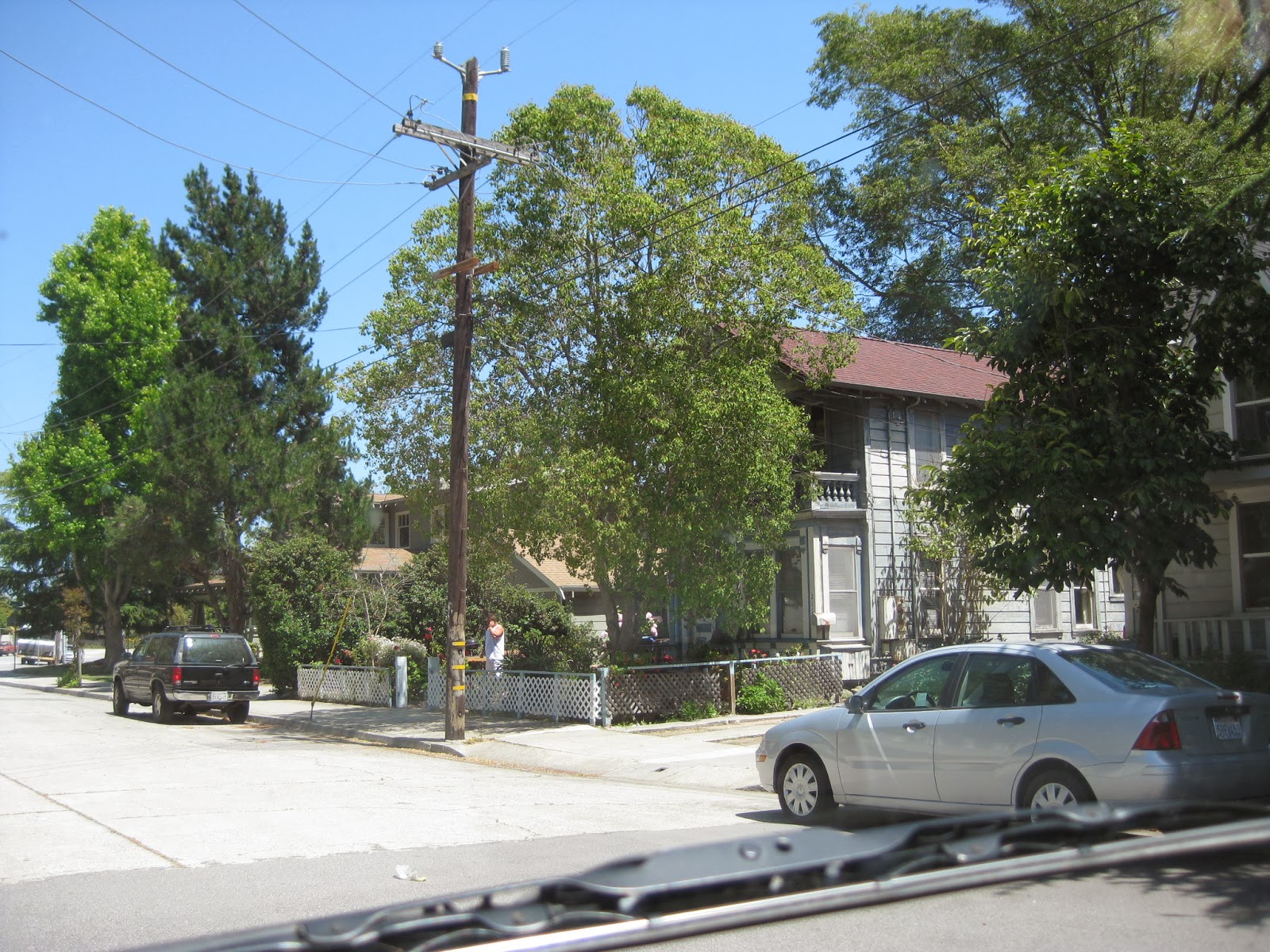
I saw this tree several years ago and thought it was being taken out, but its still hanging in there. The European Mt. Ash is a small to medium sized deciduous tree with great fall color and bright red-orange berries. Growing 20-40 feet tall and 8-10 wide with an upright oval habit but can be more open and rounded with age. Rarely seen in our area but more common over the hill. This one is multi-stemmed. You can see on the right that its growing pretty well over the neighbors house.


Different tree, in the fall.


Leaves are deciduous, pinnately compound, 7-9" long, with 9-15 leaflets, each about 1-2" long with serrated margins along the upper half of the leaf. Dark pale green upper surface, lighter green below, turning a beautiful red in the fall.


Flowers are white, small, about 1/3", white, borne in 6" wide flattened clusters.


Fruit is a small orange-red pome eaten by birds. 'Cardinal' is a bright red fruited cultivar.


Stems are thick, smooth by summer, with a large terminal bud that is covered with white hairs. Often with distinct lenticels. Trunk is more or less smooth.


Goes by several common names, some have Rowan in them meaning Red head….

Misidentification:
Chinese Pistachio maybe, it actually serves the same function in colder landscapes but has better looking flowers.

Location:
Capitola
419 McCromick Ave

Saturday, June 7, 2014

Acer japonicum 'Aconitifolium' - Fernleaf Fullmoon Maple

The Dancing Peacock Maple (Fern Leaf Fullmoon Maple) is one of my favorites and I am so glad they grow well around here. They are more reliable than the species from what I can tell, they are also more cold hardy but that's not an issue here. Small in stature, growing 10-15 or so feet tall, with an open upright to spreading habit. For those of us with a weakness for green cutleaf maples, the fullmoon maple is a great option as they tend to be more tolerant of sun.


The fall color is hard to beat.


Leaves are deciduous, opposite, simple, rounded in outline, 4-6" in diameter, with dissected margins all the way to the base of the petiole. Seem to be thicker than the species.


Flowers are small, red and look the same as the species, but they do bloom well.


Misidentification
Another maple perhaps, but rounded leaves and very finely dissected margins is a great starting place.

Location
Aptos
507 Monterey Dr.

Acer japonicum - Full Moon Maple

The full moon maple is an awesome small tree with great foliage and fantastic fall color. Trees are usually multi-stemmed with upright spreading lateral branches developing an rounded canopy to about 20' tall. Spectacular red and orange fall color. 

I think most specimens you are likely encounter will be 'Vitifolium' and these pictures are of that cultivar. Another you may see is 'Aconitifolium' which I will highlight in a different post.


Fall color is fantastic, reddish orange and yellows. 


Leaves are opposite, simple, 3-6" long and wide, almost round in outline, palmately lobed with 7-11 shallow finely serrated lobes. The leaves are also described as being palmate with deeply divided margins, about 1/3 of the way in. 


New leaves emerge rolled up and pendulous out of the elongating red buds.


One difference seen between this and the Japanese maple is the presence of hairs on the petioles.


Flowers are small, red and yellow colored, emerging with the new foliage but lasting well into full leaf out.


Fruit is a samara, in pairs, each about 1" long, usually at 180 degrees.


Misidentification:
Acer palmatum can look very similar. The leaves of the full moon maple are rounded (hence the full moon common name) and the petioles are hairy.

Leaves can look very much like the Vine maple, A. circinatum which is native to parts of CA and north. I think the leaves tend to have more coarsely serrated lobes.

Location
Went missing.

Triadica sebifera - Chinese Tallow Tree

The Chinese Tallow tree is a medium sized deciduous tree with mixed reviews. Considered very invasive in some areas, its also popular because of its nice shape and wonderful fall color. Growing to 35 feet, they form a rounded to oval habit. Specimens grow as a single stem or multi-stemmed. Has a reputation for being weedy, and is listed on many sites as being invasive.


Foliage is deciduous, simple, alternately arranged, rhomboid to ovate to cordate shaped, 2-3" long, light green in color, often developing a long accumulate tip.


Plants are monoecious, flowers small, yellow in weeping elongated racemes. These are upright to begin, and weep when open.


Fruit is a three lobed dry capsule about 3/4" long. Maturing white or light tan.


Bark on mature trees lightly furrowed. 


Reported to have great fall color, I can't say I have noticed it yet. Reds, oranges, yellows, sounds nice.

Synonyms:
You may know this tree as Sapium sebiferum but is has been renamed.

Misidentification:
Bark looks like an older Mayten tree, and the foliage looks like a lilac bush, but other than that I am not sure what else it looks like.

Location
Aptos
220 Baltusrol Dr.

Santa Cruz
211 High St
142 Hammond Ave
427 Grant St.
528 Windham (very nice specimen)


Tuesday, May 27, 2014

Lagerstroemia - Crape Myrtle

Lagerstroemia, commonly known as Crape myrtles, are small deciduous multi-seasonal  trees with beautiful flowers, fall color and bark. There are two species,  several hybrids and lots of cultivars. We generally see one of three colors, white, lavender and dark red. There are so many and I will not even start to guess which is which. Maybe some day I'll sort them out. So for now, they are all crape myrtles.


Foliage is deciduous, simple, opposite to subopposite, 1-1/2" to 3" long, ovate to elliptical, entire margins, often folded up on itself forming a V shape. Variable as I am including hybrids of at least two species under this generic listing. New leaves of some varieties show a reddish cast.


Flowers are pretty interesting to look at closely. The sepals form a 5 sided ball through which the petals come out with a long skinny stalk along with the stamens and single stigma.


Flowers are arranged in large 1' long panicles with tons of individual 1" flowers. Whites, reds, pinks, and lavenders are commonly seen. Blooms on new wood.


Fruit are small capsules about 3/8" diameter, brown.


Bark is beautiful, especially wet. Bark is the real selling point for me, but they do provide winter, summer and fall interest.


Fall color is about as good as it gets here in SC.


Misidentification:
bark? if you happen to see a Stewartia


Location:
Soquel
Corner of Soquel Drive and Potter

Santa Cruz
17th Ave is a great spot to see many older trees
1592 Seabright Avenue

Scotts Valley
Mt Hermen Shopping centers, the movie theater side.

Fraxinus angustifolia 'Raywood' - Raywood Ash

The Raywood ash is a fast growing deciduous tree forming a dense oval to rounded canopy 35' by 20'. Trees tend to have clustered primary scaffold branches because the leaves are whorled so three branches can grow from one node. The Raywood ash was going to save us from the ash trees, but alas, like so many other perfect trees they never really panned out once in the landscape. Seems they are susceptible to a fungus called Botryosphaeria which causes ash decline.


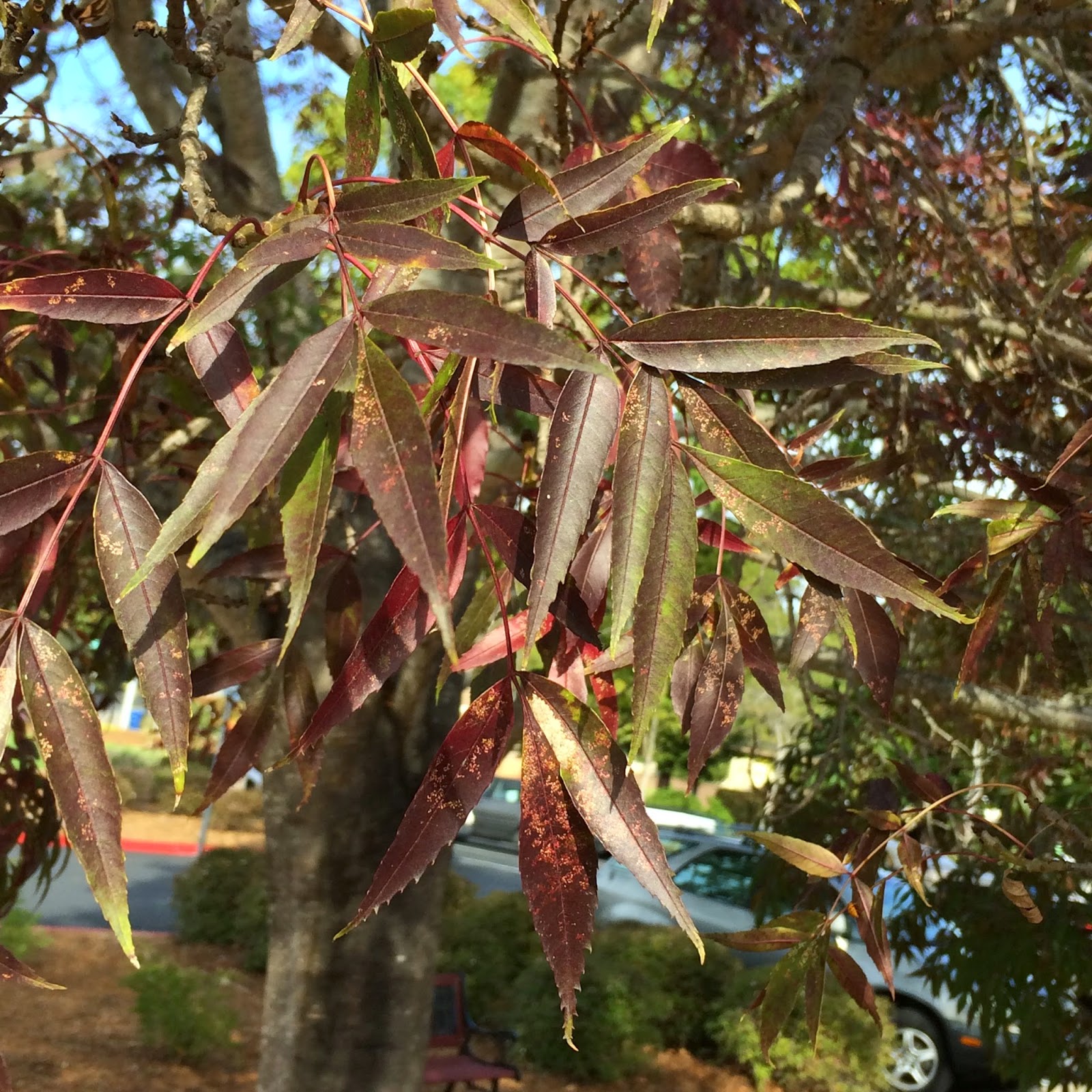
Leaves are deciduous, opposite or whorled, odd pinnately compound, 7-8" long with 7 leaflets. Leaflets, reaching 2 1/2" long are lanceolate to elliptical with serrated margins, and a pointed tip. Dark green in summer, with a great red to purple fall color.


Undersides are lighter colored, you can easily see the serrations on the margins.


The start of fall color.


Better…...


About as good as we get.


Twigs are smooth, reasonably thin and square at the internodes. Buds usually clustered.


Flowers monoecious, male and female trees available, which makes little sense to me. Are there more than one form with this name? Must be.

Bark is pretty smooth. Commonly seen issue, clustered primary scaffold branches acting as co-dominate leaders, leading to failure later is life.


Also known as Fraxinus oxycarpa 'Raywood'

Misidentification:
Ash trees can be tough in colder climates but we don't have that many species planted here. Narrow leaflets (angustifolia means narrow leaf), usually 3 leaves per node are good characteristics to look at and a canopy that might be dying back due to disease, see the ones downtown. Other ash tree characteristics we can look for is the position of the bud in relation to the leaf scar, but that's not an issue with this plant.

Location:
Aptos
608 Cliff Drive (seen in the top picture)
Soquel Drive at Aegus, there is one planted with all the Green ash trees.

Santa Cruz
Downtown, Cedar St from Union to Church St.

Watsonville
about 270 W. Riverside Dr.

Sunday, January 19, 2014

Liquidambar formosana - Chinese or Formosan Sweetgum

The Chinese or Formosan Sweetgum is an uncommon tree in SC. Trees generally have an irregular rounded to oval habit when mature and in cultivation hit about 40 feet tall. Noticed this tree one day, not sure how, but I think there was an open garden tour next door.


Leaves are alternate, simple, 3-5" long and wide, strongly 3 but sometimes 5 lobes, the middle lobe larger and triangular in shape. Margins with few large teeth. Mature leaves are glossy green, new leaves have a nice reddish cast as seen in the second picture.


Flowers are small, inconspicuous with males and females separate on the same tree (monoecious). Females look a lot like L. styraciflua flowers.

Fruit is a roundish spiny ball of individual fruits about 1" or larger in diameter. Softer than L. styraciflua fruit.


Bark is attractive, gray brown and furrowed.


Misidentification:  Sort of like a few cultivars of Japanese maples, but the leaves are alternate. Looks like a shallow lobed version of American sweet gum but the lobes are almost always 3 and the shape of the tree is very different.

Location:
Santa Cruz
303 Clinton St.