Not really a tree, anymore than other woody monocots, but they are still worth discussing. Often called the Red Albyssinian or the red banana its popular because of its reddish coloration that ranges from dark maroon to green with tinges of red. Grows locally to 8-10' tall. Creates a great tropical effect in the garden. Reasonably hardy and available.

Leaves are paddle-shaped, 8-10' long, with penni-parallel venation, petioles are red as is the midrib and usually the leaf margin. Underside is usually much more red. Petiole base is clasping around the stem. Leaves are a major source of starches and along with the stems are ground up and used as food source in Ethiopia.


Flowers after many years. Reportedly flowers then dies. Seems right, the one in the picture with the fruit cluster was gone the following year. Said to take 4-7 years to flower, and unlike true bananas, they rarely set offshoots.
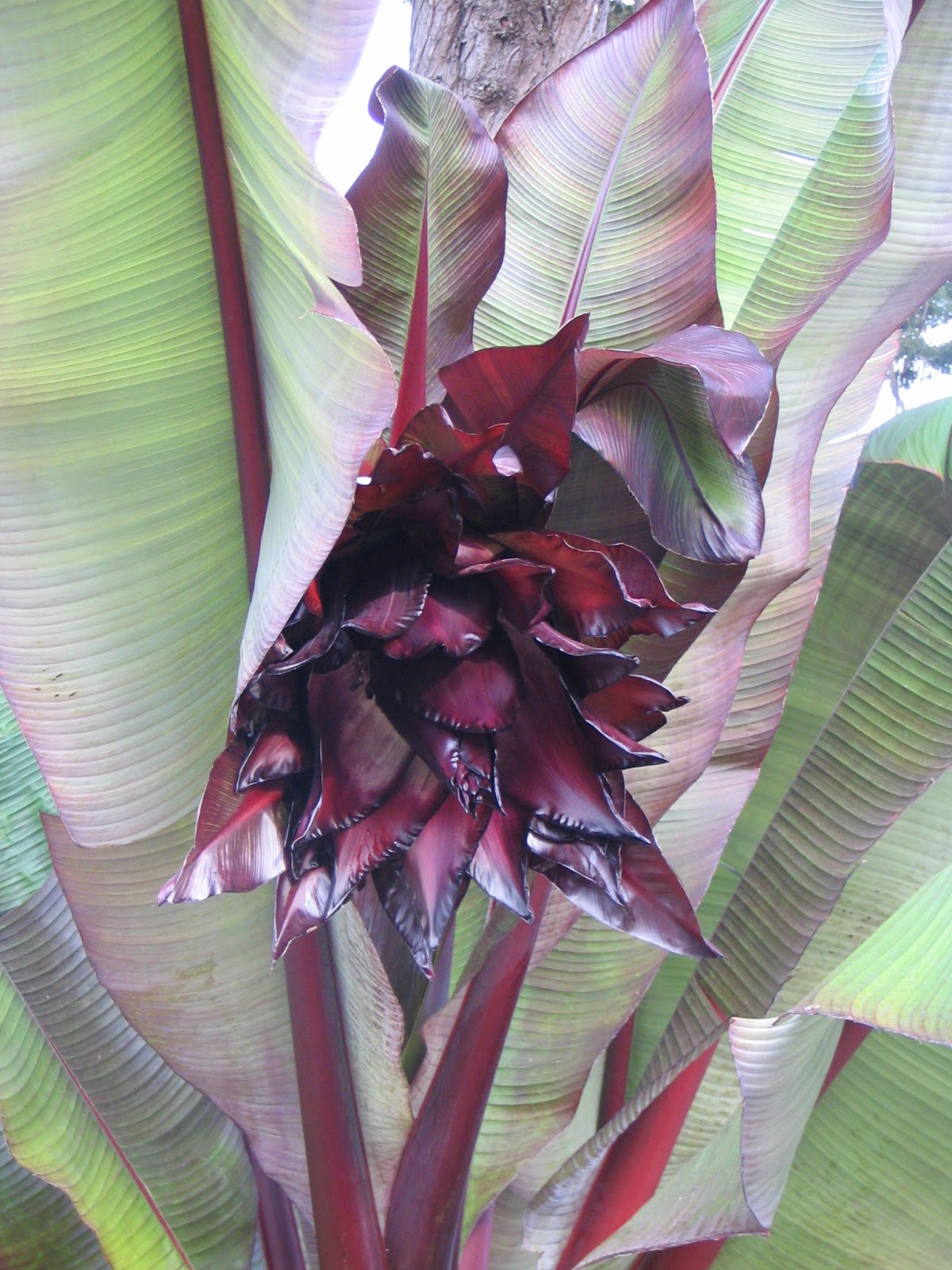

"Trunk" is not really a trunk but appears to be one. Remnants of leaf base covers the stem making what they call a pseudostem.
Misidentification:
Not sure
Location:
Aptos
514 Humes Ave, two actually, a small one in the driveway and a larger on in the front courtyard.
Across the street is the species, not the red cultivar.
Misidentification:
Not sure
Location:
Aptos
514 Humes Ave, two actually, a small one in the driveway and a larger on in the front courtyard.
Across the street is the species, not the red cultivar.


