Search This Blog

Showing posts with label monocot. Show all posts

Sunday, July 26, 2015

Ensete ventricosum 'Maurelii'

Not really a tree, anymore than other woody monocots, but they are still worth discussing. Often called the Red Albyssinian or the red banana its popular because of its reddish coloration that ranges from dark maroon to green with tinges of red. Grows locally to 8-10' tall. Creates a great tropical effect in the garden. Reasonably hardy and available.


Leaves are paddle-shaped, 8-10' long, with penni-parallel venation, petioles are red as is the midrib and usually the leaf margin. Underside is usually much more red. Petiole base is clasping around the stem. Leaves are a major source of starches and along with the stems are ground up and used as food source in Ethiopia.


Flowers after many years. Reportedly flowers then dies. Seems right, the one in the picture with the fruit cluster was gone the following year. Said to take 4-7 years to flower, and unlike true bananas, they rarely set offshoots.
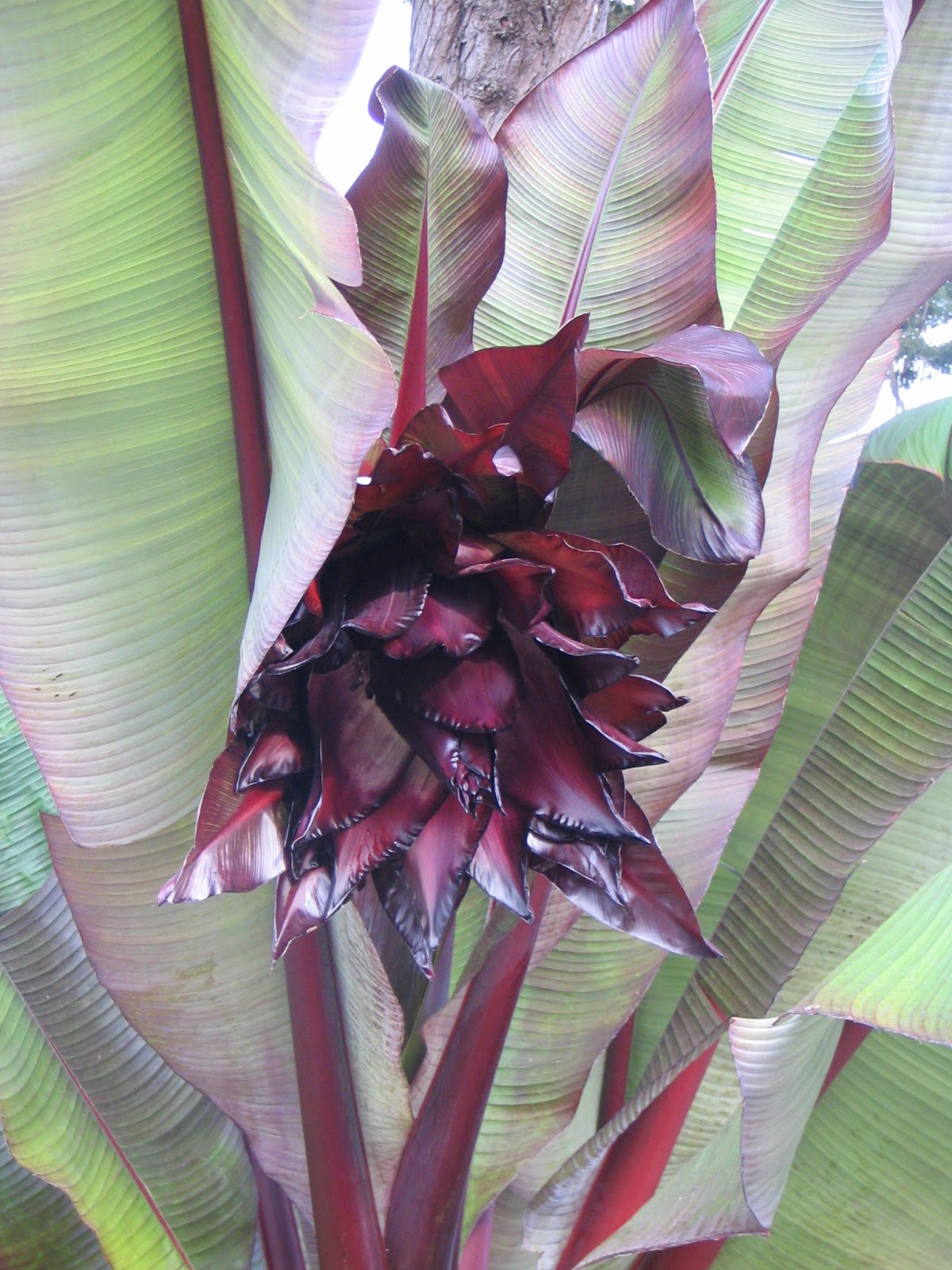


"Trunk" is not really a trunk but appears to be one. Remnants of leaf base covers the stem making what they call a pseudostem.


Misidentification:
Not sure

Location:
Aptos
514 Humes Ave, two actually, a small one in the driveway and a larger on in the front courtyard.
Across the street is the species, not the red cultivar.

Ensete ventricosum - Ethiopian banana

Great tropical looking banana from Ethiopia, the Ethiopian banana is seen frequently but less so than its red foliaged cultivar, 'Maursii'. I like this one with its distinct red midrib and its commonly wind damaged leaves. Best for tropical landscapes, growing with some protection to 20'.


Leaves are paddle-shaped, really narrowly elliptical, 8-10' long, with penni-parallel venation, petioles are red as is the midrib and usually the leaf margin. Petiole base is clasping around the stem. Leaves are a major source of starches and along with the stems are ground up and used as food source in Ethiopia.


You can see the way the leaves tear along the perpendicular vein lines.


You can see the old leaf bases still attached, and showing the vascular traces in parallel groups rather than bunches like a dicot.


Misidentification:
Bananas likely but bananas have more oval stems.

Location:
Aptos
515 Humes Ave

Santa Cruz
203 Blackburn St.

Saturday, May 23, 2015

Strelitzia nicolai - White Bird of Paradise

The White Bird of Paradise is usually planted to create a tropical feel in the garden with it's large banana like leaves. They are upright growing monocots on "woody" stems with the foliage clustered at the tips. Plants sucker at the base and can spread as wide as they grow tall.


Leaves are evergreen, banana-like, 5-8' long, about 12-16" wide, grayish green. Leaves get shredded along those veins running from the central to the margins. I like the edges of the petioles.


We often think of monocots having parallel venation, and they do, but they also have leaves like these where the veins seem to be in a pinnate venation pattern like a dicot. Well, they are. Kew Gardens says they are "pinnate with parallel-arching", while others call this penni-parallel venation.


Stems are eventually exposed when the older leaves fall off.


Flowers are strange indeed. They are cluster in a very complex inflorescence with a bluish boat shaped bract from which the individual flowers arise. Each flower has three free white steals and two fused petals and a purplish bit enclosing all the reproductive parts.


It took me years to "see" the bird in these flowers, not sure why but one day it just jumped out at me.

Misidentification:
I have read they are somewhat triangular resembling the Traveller's Tree, Ravenala, I wish, wow, what a plant that is.


Bananas?

Location:
Aptos
537 Humes Ave

Santa Cruz
302 Oceanview Ave
603 Washington St.