The Cockspur Coral Tree is a small deciduous tree with an umbrella shaped canopy reaching 15-20' in Santa Cruz, but you may find them smaller than that. The most obvious one in town is at city hall. Not a great specimen, was not sure why, but I looked at google street view history and the space was dominated by a Hollywood Juniper and this tree was being crowded out. When in full bloom it looks pretty nice. Waiting for the fall color… supposed to be yellow….
Leaves are deciduous, alternate, trifoliate, leaflets narrowly elliptical 3-5" long, margins slightly less than smooth, and spines on the lower portion of the main veins. Distinct swollen area at the base of the petiole, the pulvinus.
Flowers in the spring occasionally in summer and into fall, fragrant, showy bright red or pinkish-red, in long drooping panicles. Individual flowers are "pea-like" with a distinct elongated lower petal shaped like the keel of a boat. This is taken in December, winter here, but you can see the elongated lower petal. Looks like thrip damage maybe.
These are the flowers about to open.
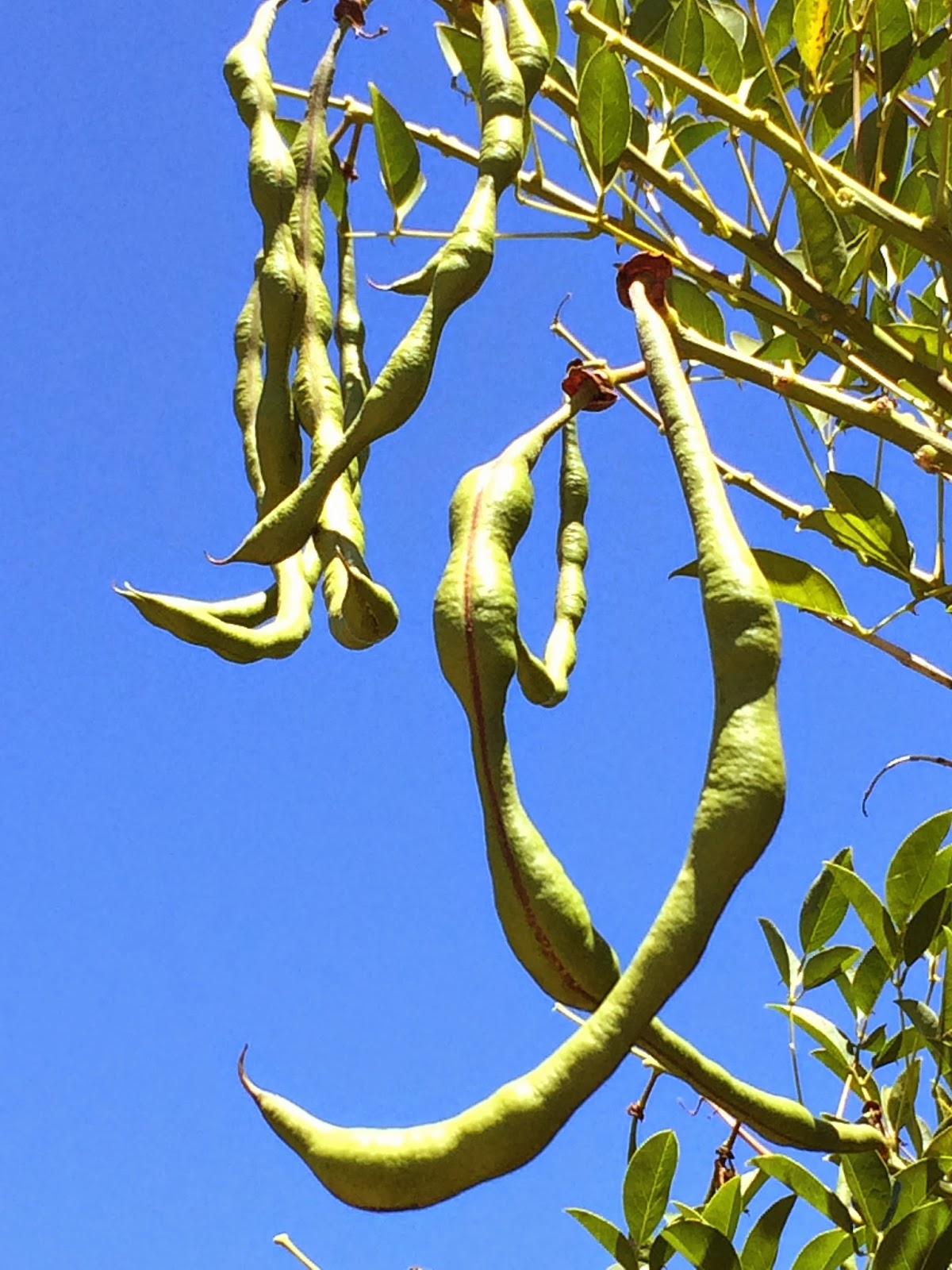
Fruit is a brown pod, with constrictions between the seeds. Ripening in the fall. This is summer. You can see the constrictions.
Interesting seeds if you take the time to look at them.
Stems are green, stout, with nasty prickles. You can even see the tell tale pulvinus on the petiole of the leaf.
Bark is usually attractive, potentially deeply furrowed.
Tree is also known as the Coral Tree, Crybabytree, Christ's Tears.
Misidentification:
Erythrina caffra, around here anyway, if you are in a more tropical area you are likely to become very confused. These have narrower elliptical leaflets and are smaller trees.
Location:
Aptos
Cabrillo College Hort Department has one in back garden area, its low growing.
Santa Cruz
City Hall along Center St.
114 Myrtle St.
Santa Cruz County has a wide assortment of tree species grown and some great examples located in public spaces. Trees are covered like a field guide. Walking and Driving tree tours are listed on the right. Search by common name or tree attributes in the search engine.
Search This Blog
Showing posts with label pods. Show all posts
Tuesday, August 4, 2015
Thursday, May 14, 2015
Acacia longifolia - Sydney Golden Wattle
Sydney Golden Wattle is more likely a large shrub but we will consider it a small tree commonly used as a utility tree along freeways. These evergreen trees grow really fast to 20' x 20' with a rounded habit, dense canopy with branches to the ground. The end result is nondescript evergreen screen. Trees become visible as soon as they bloom. Most commonly seen along the freeway.
Leaves are alternate, evergreen, simple, oblanceolate, thick, bright green, no distinct upper or lower surface, more or less 4" long, sometimes slightly curved. Like all simple Acacia leaves, these are phyllodes or flattened petioles.
Stems are thin, green with small rounded vegetative buds.
Older stems are sort of cool looking, nice color and lines on the stems from the buds.
Flowers in mid winter. Flowers are small, yellow, rounded balls of flowers in elongated clusters, fragrant. Bright yellow.
Fruit is a pod, usually twisted.
Misidentification:
In bloom, not as likely, the flowers are super bright yellow on an elongated inflorescence.
Location:
Most commonly seen on the freeway.
Aptos
Just below the railroad overpass closest to Rio Del Mar Exit
Santa Cruz
Along the highway at the old drive in movies, now the swap meet. (Pulled out for more lanes)
Thursday, January 1, 2015
Acacia retinodes - Water Waddle
The Water Waddle is a fast growing evergreen tree or large shrub reaching 20 x 20' forming a rounded to oval shape, if growing alone, but these seem to be in groves. Makes a nice fine textured screen. Reportedly blooms throughout the season, and called Ever-blooming Acacia.
Leaves are evergreen, alternate, simple, narrowly lanceolate to oblanceolate, slightly curved, dull gray green, no distinct upper or lower surface, slightly enlarged area near the base of the petiole.
Flowers are pale yellow or cream colored, fragrant, in clusters. Clusters (heads) are arranged in racemes with 5-9 heads per inflorescence. Other sites call this the ever-blooming wattle as it may bloom sporadically year round. My pictures are from winter, and only a few branches had flowers.
Fruit is a pod with some restrictions between the seeds. 4-5" long.
Young stems are bright red-mahogony eventually turning gray.
Trunk reportedly scaly at maturity but these trees are pretty young and smooth.
Wirilda Wattle is another common name.
There are two botanical varieties, but they seem to look alike, one preferring wetter soils.
Misidentification:
While taking pictures of the flowers one day a neighbor wanted to know what I was doing. After informing him he told me the tree was a black acacia and since he worked for a tree company for 30 years he was sure. But if you step back and look at the leaves, and flowers, he was not far off.
Odd Acacias are tough, helps to see the flowers, pods and leaves.
Location:
Santa Cruz
Harper St. at the east end, past the sign that says private road (oops) across from Daniva Ct. and above all the trash cans.
Leaves are evergreen, alternate, simple, narrowly lanceolate to oblanceolate, slightly curved, dull gray green, no distinct upper or lower surface, slightly enlarged area near the base of the petiole.
Flowers are pale yellow or cream colored, fragrant, in clusters. Clusters (heads) are arranged in racemes with 5-9 heads per inflorescence. Other sites call this the ever-blooming wattle as it may bloom sporadically year round. My pictures are from winter, and only a few branches had flowers.
Fruit is a pod with some restrictions between the seeds. 4-5" long.
Young stems are bright red-mahogony eventually turning gray.
Trunk reportedly scaly at maturity but these trees are pretty young and smooth.
There are two botanical varieties, but they seem to look alike, one preferring wetter soils.
Misidentification:
While taking pictures of the flowers one day a neighbor wanted to know what I was doing. After informing him he told me the tree was a black acacia and since he worked for a tree company for 30 years he was sure. But if you step back and look at the leaves, and flowers, he was not far off.
Odd Acacias are tough, helps to see the flowers, pods and leaves.
Location:
Santa Cruz
Harper St. at the east end, past the sign that says private road (oops) across from Daniva Ct. and above all the trash cans.
Sunday, January 19, 2014
Ceratonia siliqua - Carob Tree
The Carob Tree is a medium evergreen tree growing to 25-30' here, (much larger in warmer areas) with a broad dense canopy. Interesting female plants that produce a fruit that can be used as a cocoa substitute. Though most of the trees I see are males.
Leaves are alternate, even pinnately compound, with 6-10 broadly oval leaflets. Individual leaflets are 1 - 2.5" long, dark green to bluish green and glossy with coarsely undulated margins. Like many legume members the base of the petiole is swollen.
This is a cultivar called 'Cal Poly', not sure its origin of if anyone grows it but I like the blue foliage.
Stems are reddish brown, lightly lenticeled and have a waxy covering. You can see the swollen base of the petiole, typical for legume family.
Flowers in the spring from spurs. Males and females separate plants but could be on one plant. This is an inflorescence of males. Males have an odd less than desirable smell.
Here is a close up of female flowers.
And here is an hermaphrodite. You can see the female at the free end and the male pollen sacs at the attached end (top of picture)
Large spurs on the stems from where the flowers come out each year. Pretty odd looking.
Fruit is a 5-12" long light to dark brown flattened pod containing 10+ flattened seeds. When ripe the seeds are free inside the fruit and rattle when shaken that are glossy. When dried and ground up they are a substitute for cocoa.
The trunks can be really cool with age. This one is downtown Palo Alto.
Misidentification:
Other pinnately compound leaved plants. Carrotwood maybe, with fewer leaflets.
Capitola
41st Ave divider near Safeway and Soquel Drive
Santa Cruz
104 Kalkar Dr.
Corner of Chestnut St. and Union St. Two males and one female.
Seabright Ave, near the Clinton cross street
Labels:
Carob tree,
Ceratonia siliqua,
dioecious,
evergreen,
Medium tree,
pinnate leaf,
pods,
small tree
Subscribe to:
Posts (Atom)
