Search This Blog

Showing posts with label awl leaves. Show all posts

Friday, November 28, 2014

Chamaecyparis lawsoniana 'Ellwoodii'

The genus Chamaecyparis is a fun group of conifers. They have a high propensity to develop mutations and as a result there are hundreds of cultivars of every shape and color. This is one of several forming the columnar habit. There are even dwarf selections of this cultivar. The Ellwood Cypress trees are fairly common in Santa Cruz, used mostly as screen or for vertical accent.  They grow to a bit over 10' tall and about 3' wide with a wonderful bluish green color.


The evergreen foliage is bluish when new, slightly more green as it ages. Chamaecyparis have scale-like leaves, however this has awl-shaped leaves with white wax on all surfaces giving it a bluish cast and an overall more prickly feel.


They do not "bloom" as they are a juvenile form so they do not set cones either.

So thats it, nice bluish-green screen with no mess.


Misidentification:
Chamaecyparis 'Boulevard' has the same foliage look, though the leaves are longer than 'Ellwoodii' and the trees are very different looking.

Location:
Aptos
323 Martin Dr. - Gone

Thursday, September 25, 2014

Juniperus chinensis 'Kaizuka Variegata' - Variegated Hollywood Juniper

The Variegated Kaizuka Juniper or sometimes called the Variegated Hollywood Juniper is an uncommon sight in SC county, with only a few registering in my travels. Growing slowly to 15' with a spread of 10', the plants are very much tighter than the green hollywood juniper and lack the wide spreading branches, though the branches do twist. Grown for its splashes of cream foliage, it makes a nice specimen.


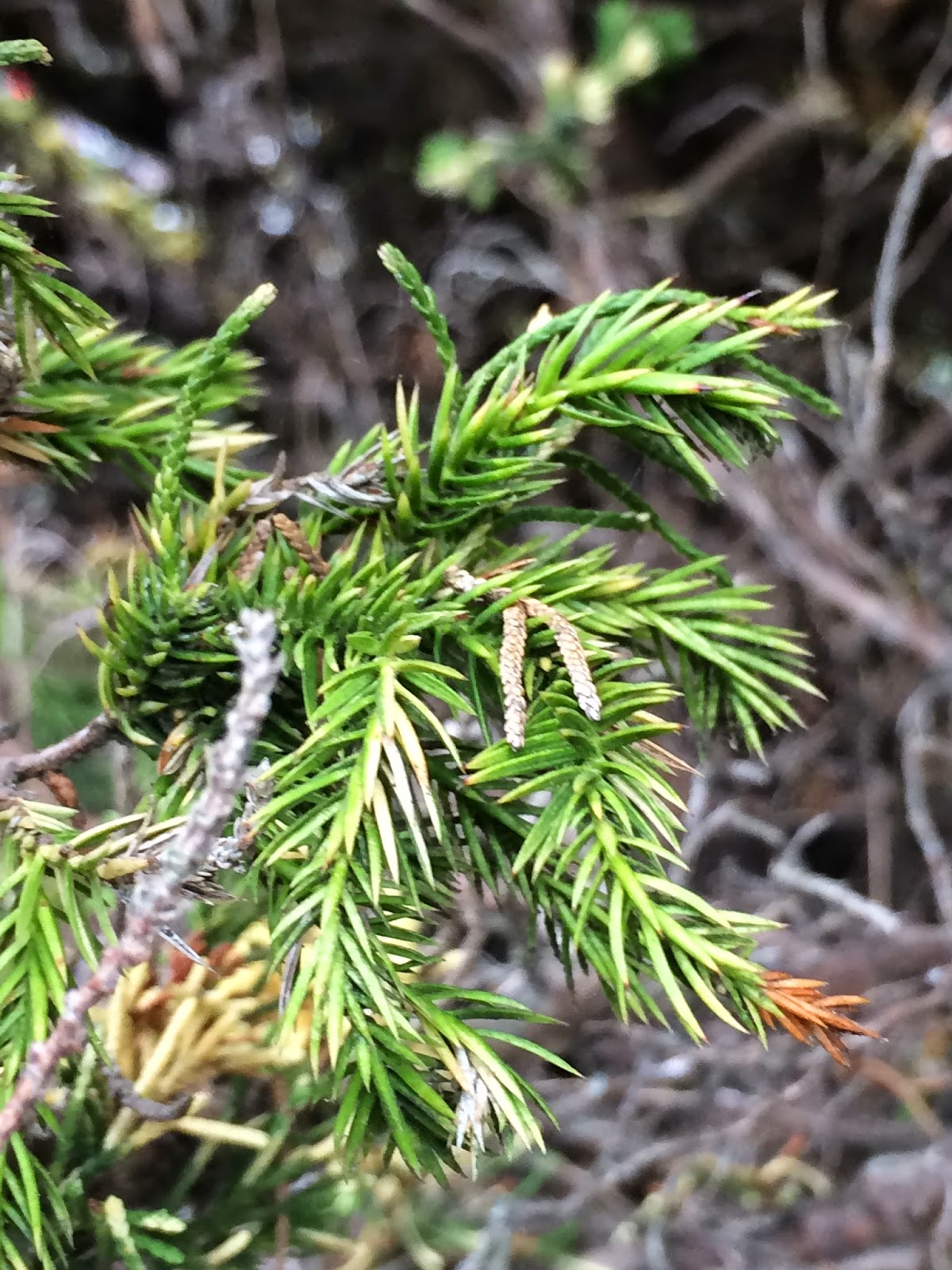
Evergreen leaves are spirally arranged, scale like, very small with juvenile awl-shaped leaves thrown in. The cream areas lack chlorophyll completely and provide no help in growth, but look cool.


Juvenile foliage awl-shaped and some lacking chlorophyll.


Quite frequently the cream foliage dies in summer heat.


This clone has cones.


Also known a Juniperus chinensis 'Torulosa Variegata'

Misidentification:
Not sure


Location:
Aptos
Corner of Soquel Dr and State Park in the parking strip of the Church, across from the Safeway gas station.

706 Clubhouse Dr.

Capitola
102 Grand Ave

Saturday, August 2, 2014

Chamaecyparis pisifera 'Boulevard' - Boulevard Cypress

One of many cultivars of the Sawara Cypress, seems the Chamaecyparis genus has lots of variability in its genes. This small slow growing evergreen conifer reaches 15' after many years and is often pruned with layers or with small tufts at the ends of the branches. Grown for its nice size and its pretty blue foliage. This one is gone, another house remodel.


This specimen is located at the Dawes Arboretum in Ohio, and most definitely a great spot if you like conifers.


Leaves are evergreen, spirally arranged, awl-shaped, about 1/4" long, leaning forward on the stems showing large areas of silver stomates on the back surface, which makes the leaves and tree look blue. Leaves are soft, which is nice.


Can't say I have ever seen them produce fruit.

Misidentification:
Might look like a juniper.

Location
Aptos
1206 Pinehurst Dr. (Gone 6/24)

Capitola
702 Gilroy Dr.

Santa Cruz
1713 Seabright Ave

Friday, June 6, 2014

Araucaria columnaris - Cook Pine

The Cook Pine is often encountered in our neighborhoods as a house plant gone bad, outgrowing its allocated space indoors and put into the landscape. They are very similar to the Norfolk Island pine and some references suggest that the majority of the house plants are Cook Pines and not NIP. 

These beautiful evergreen conifers are very narrow and have a curve in the stem, not sure why but they almost always do. Matt Ritter (Cal Poly SLO) says they curve lean towards the equator. Growing quite tall in their native habitat they are likely to read 40' around here. They have very short lateral branches making the tree very narrow. 


This specimen is at Cal  Poly, and seems unusually dense.


Leaves are evergreen and of multiple types. Juvenile foliage is needle-like, soft and about 1/2" long. Adult foliage is awl-like, short, stiff and sharp. The branches resemble cords. 


Female reproductive cones.


Bark is thin, and peels off in strips.


All the goodies.


Misidentification:
Many experts confuse the Cook Pine and the Norfolk Island Pine. I doubt I can tell the difference looking at the foliage. Only way I can tell is to look at the shape of the trees. They all lean. Great article with Matt Ritter in the LA times .. http://www.latimes.com/local/abcarian/la-me-abcarian-pine-tree-20170618-story.html

Location:
Aptos
1936 Seascape Blvd. Has a really strong lean.... could be falling over?

Santa Cruz
1039 Laurent St.
602 Chestnut,  Corner of Chestnut and Locust St

Santa Cruz  - Pleasure Point
230 30th Ave.

Wednesday, May 21, 2014

Cupressus cashmeriana - Kashmir Cypressus

The Kashmir Cypress is one of the most beautiful trees that you might encounter. Grown as a container plant by Suncrest Nursery, it seems to be hard to find in the landscape. The pictures below are from the UCSC arboretum. 

The tree reminds me of Chamaecyparis nootkatensis with its upright leader and primary scaffold branches and its weeping secondary branches. Growing to 40' by 20' in our area,  it makes a wonderful focal point. 


The primary scaffold branches are weekly vertical while all of the secondary branches are totally pendulous. They are arranged in flattened sprays like you see on Thuja plicata


Leaves are somewhere between awl-like and the typical scale-like leaves of Cupressus. They very are aromatic. White lines of stomates show the margins of the leaves.


Cones are round, scales peltate, about 1/2" diameter, brown maturing in 2 years. You can see the light green one year cone as well as the 2nd year cone.


Immature female stroboli


Bark is beautiful like so many Cupressus species. Furrowed, slightly stringy or fibrous.


Like many plants, this one comes with several names. Two common synonyms are Cupressus tortulosa and Cupressus darjeelingensis.

Misidentification:
Thuja plicata maybe due to the flattened sprays of foliage and the cones are different.

Location:
Santa Cruz
UCSC arboretum

412 Escalona is a very nice one.
119 Effey St in a container.

Sunday, January 19, 2014

Sequoiadendron giganteum - Giant Redwood

Giant is hardly an adequate description, but its pretty hard to come up with adjectives to describe Sequoiadendron giganteum. What a magnificent tree. The largest trees on earth (not the tallest but the most mass). The specimen named General Sherman (seen below) is 285' tall, has a circumference of 102' near the base of the tree and 10-15' in diameter. They can live 3500 years. Restricted to a 200 mile area in the western slopes of the Sierra Mountain range luckily most are in the Sierra National Forest and are protected.


Trees in cultivation grow very quickly. They maintain a very formal pyramidal habit with the lower branches being retained. In a forested situation the lower branches are self shedding.  


This is a blue form growing next to a green form on the campus of Portland State.


Not sure where this picture came from, since I like vanagons and Redwoods….


Leaves are evergreen, awl-like, sharp pointed, medium green color with some waxy bloom giving them a bluish cast. They tend to be divergent from the stem and appear to be opposite but they are alternately arranged. Some leaves maybe scale-like as well.


Cones are oval, 1-1/2 to 2-1/2" long, brown at maturity with peltate scales.  Records suggest that a large tree can produce 11,000 cones with 400K seeds.


When the scales open up they remind me of the wax lip candy filled with some sort of sugar water.


Comparison of Sequoiadendron on the left and Sequoia on the right.


Reddish brown spongy bark, may be up to 2' thick. A common name in the UK is the boxing tree as you can punch it without hurting your hand.


Cross section of a giant redwood at the Natural History Museum in London, with historic dates assigned to the rings. Wish I could find the Far Side cartoon showing a dad with an axe in his hand explaining to his son Billy how a tree miraculously survived drought, fires, but not the axe.


Certainly one of my all time favorite trees, the weeping giant sequoia.


The tree is known in the UK as Wellingtonia or the Wellington tree. But that name was rejected as it had been used for another unrelated species. The trees are very common in the UK and some magnificent trees can be seen at some of the largest estates. They would be planted in rows creating a "Wellington Avenue".

Misidentification:
Sequoia sempervirens maybe, at times you might find some branches on the ground after a storm that show awl-like leaves but most of the leaves are needle-like, Cryptomeria japonica has awl-shaped leaves as well as a small cone with peltate scales.

Location

Capitola
621 Bay In back behind the house, next to a Coast Redwood.
202 Central Ave, at the intersection of Fairview Ave. Two large specimens.

Santa Cruz
1420 King St
1251 7th Ave. or in the vacant lot next door