Search This Blog

Showing posts with label weeping. Show all posts

Tuesday, May 26, 2026

Agonis flexuosa 'Burgundy' - Burgundy Peppermint Willow

This is a newer cultivar of the Australian Willow and seems to develop a fuller canopy than the dark purple 'Jervis Bay Afterdark' which has been planted all over town. Reported to grow to 25' by about 15' wide with a weeping habit. One issue I have seen is the very narrow crotch angle formed on the trunk which might be a structural issue as the trees mature.


A nice specimen at Sierra Azul Nursery in Watsonville.


The new leaves come out in early spring with a beautiful burgundy color. The color fades by the end of winter but the new foliage comes out quickly with another flush of color.


This is the issue I see with all of the trees I have seen. The trunk splits into two co-dominate leaders with a very narrow crotch angle. As those stems increase in diameter they will push the other away and eventually split.


Misidentification:
Not sure what you might think it is.

Location:
Aptos

280 Baltusrol Dr


Santa Cruz
36 Rockview Drive

Watsonville 
Sierra Azul Nursery

Tuesday, April 7, 2015

Agonis flexuosa 'Jervis Bay Afterdark'

I really like this tree, it pushes all the right buttons for me, small, weeping, and purple. Discovered as a mutation in a nursery it is now way more popular than the species from which it was derived. Estimated height is a about 20' with a spread of 10'. Mature specimens are a bit more open and said to be less purple. (This one tipped over in the wind.)


The new foliage comes out scarlet in the spring before darkening to a deep purple. Leaves are smaller than the species which adds to its soft weeping texture.


Flowers are white, with a pinkish purple center, five petals that are obovate allowing you to see though the flower.


Fruit is a small persistent capsule and should be like the species.

Misidentification:
Perhaps Leptospermum 'Dark Shadows'. Both have small white flowers, and short purple leaves. Agonis lacks the hairs on the leaves and is by far more weeping.

There is a new purple leaved Agonis 'Burgundy', but the foliage quickly becomes green and is no way close to the dark purple of this one. However, seems to make a fuller tree.

There is a dwarf, 'Nana' that I would like to see.

Location:
Aptos
420 Clubhouse


Capitola
816 41st. Ave. in the alley between Verve Coffee and Penny Ice Cream are 3 nice recently planted specimens.

4690 Crystal St. (lots of other unique trees)

Next to Verve coffee shop on 41st are 3 nice specimens.

Santa Cruz
1313 Escalona Dr 5 in one yard.

Wednesday, May 21, 2014

Cupressus cashmeriana - Kashmir Cypressus

The Kashmir Cypress is one of the most beautiful trees that you might encounter. Grown as a container plant by Suncrest Nursery, it seems to be hard to find in the landscape. The pictures below are from the UCSC arboretum. 

The tree reminds me of Chamaecyparis nootkatensis with its upright leader and primary scaffold branches and its weeping secondary branches. Growing to 40' by 20' in our area,  it makes a wonderful focal point. 


The primary scaffold branches are weekly vertical while all of the secondary branches are totally pendulous. They are arranged in flattened sprays like you see on Thuja plicata


Leaves are somewhere between awl-like and the typical scale-like leaves of Cupressus. They very are aromatic. White lines of stomates show the margins of the leaves.


Cones are round, scales peltate, about 1/2" diameter, brown maturing in 2 years. You can see the light green one year cone as well as the 2nd year cone.


Immature female stroboli


Bark is beautiful like so many Cupressus species. Furrowed, slightly stringy or fibrous.


Like many plants, this one comes with several names. Two common synonyms are Cupressus tortulosa and Cupressus darjeelingensis.

Misidentification:
Thuja plicata maybe due to the flattened sprays of foliage and the cones are different.

Location:
Santa Cruz
UCSC arboretum

412 Escalona is a very nice one.
119 Effey St in a container.

Tuesday, March 25, 2014

Juniperus scopulorum 'Tolleson's Weeping' - Tolleson's Weeping Juniper

This weeping Juniper is a pretty popular form in other areas of the county, but I see very few here. I am always a fan of weeping conifers and Junipers get a bad rap. Seeing a mature specimen like this one in Santa Cruz should change peoples minds.

Tollesons blue weeping juniper grows 20' by 15' with an upright leader and weeping lateral branches. Very nice look for those of us that like weepers. (Might be a poor man's Cupressus cashmeriana and might be more reliably grown as junipers are very drought tolerate.)


Foliage is scale-like, bluish color covering the stems. Distinct white bands of stomates seen where the leaves overlap. Stems are rounded like Cupressus, and are very hard to tell apart, sometimes the smell is different with junipers.


Here is a lateral branch with weeping secondary branches.


Trunks are pretty and add some texture to the softness of the foliage. Bark is somewhat shaggy, with small plates that peel up on the edges.


As I recall these are male trees, and will not have fruit.

Misidentification:
if you see it you will not misidentify it, but if you only get a small branch, good luck. Not many other trees have such a distinct weeping habit. Cupressus cashmeriana has flattened sprays of foliage, junipers have 3 dimensional branching.


Location:
There are several around but they don't look anything as nice as this one:

Santa Cruz
230 Chilverton Ave

Monday, February 24, 2014

Callistemon viminalis - Weeping Bottlebrush

This species was one of the first trees I learned in class. I was blown away by the flowers, like nothing I had ever seen, wow, so long ago. The weeping bottlebrush is a smallish evergreen tree with a dense weeping habit (usually but look at the one at the Mission). The tree tends to be multi-stemmed and branches low resulting in some training required if you want to walk under. This one is located at UCSC arboretum and has been pruned to be able to walk under the branches. Generally needs some irrigation to grow well. Native to Australia. (The other common bottlebrush C. citrinus is a shrub or small tree.)


The medium dark green evergreen leaves are narrowly lanceolate to linear, 3-4" long and pretty stout. Tend to be restricted to the ends of the branches. New foliage is a pink color like many trees in the genus melaleuca for which is was once included.


Stems are thin, light brown and have hairs. Notice the red base of the petiole. Lateral buds are tiny.


Its all about the flowers. Blooming heavily in the spring and lightly throughout the rest of the year. When these trees are in bloom they are magnificent. Individual flowers are small and all stamens, but they occur in a long pendulous spike about 5" long. The common name comes from the inflorescence looking like a bottlebrush (Did I really have to say that?)


The small capsules follow the flowers. They are about a 1/4" and in large clusters. Persistent on the stems for years.


Every time I go to the UCSC arboretum I seek out this tree. There is a path under the branches.


Misidentification: If you are looking at a piece of stem without flowers you might be hard pressed to identify it as the leaves look like so many others, like C. citrinus or even a Melaleuca. Can't say this works all the time but I look at the base of the petiole for the red color. Wikipedia lists this as a member of the Melaleuca genus.

Location:
Santa Cruz
312 Poplar Ave. is huge, very beautiful, one of the best I have seen, share a yard with a huge Pecan.

UCSC arboretum has several great specimens. 


Thursday, February 20, 2014

Podocarpus henkelii - Long Leafed Yellowwood

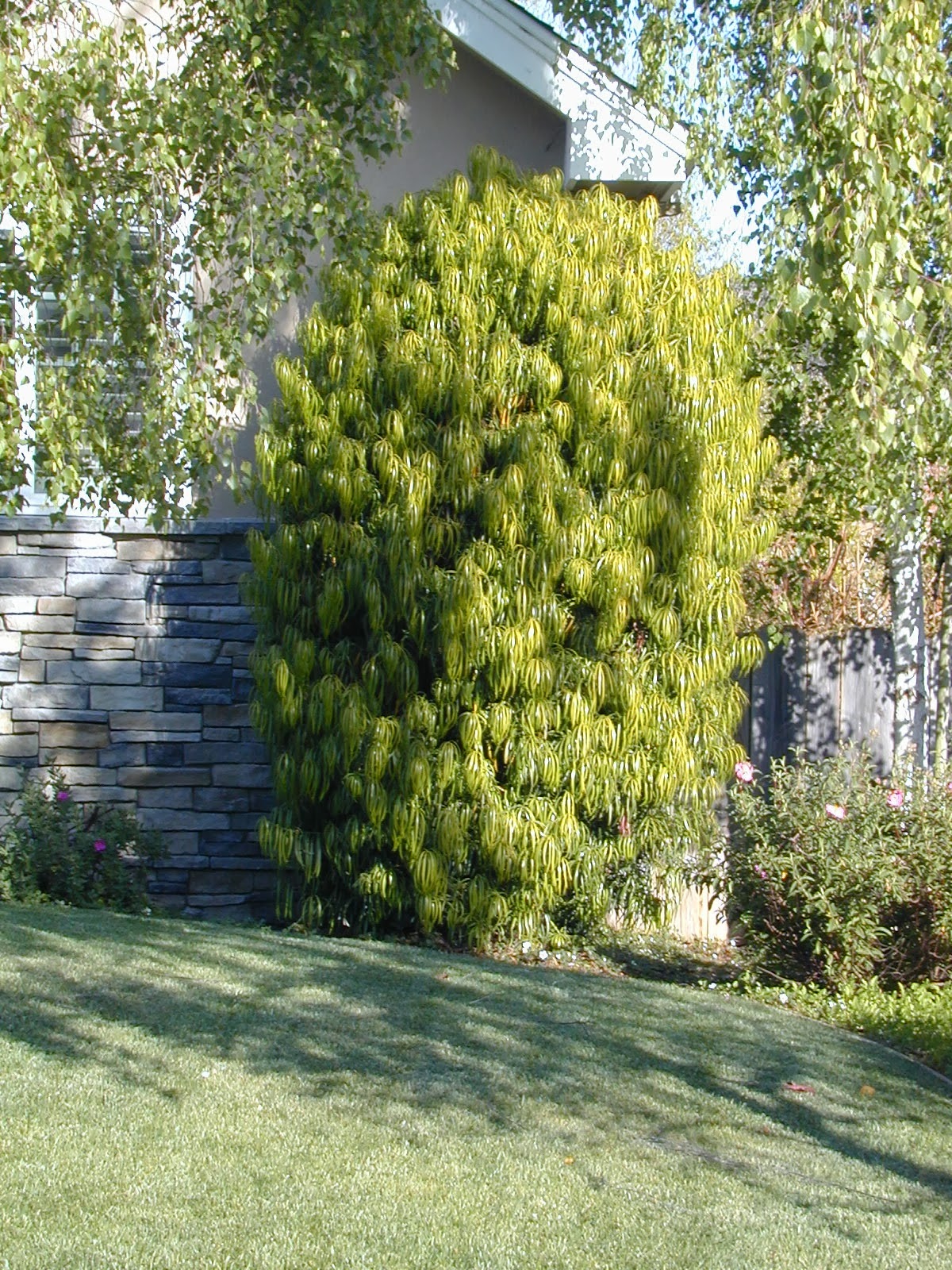
The long leaved yellowood is an evergreen conifer from South Africa. I love this tree, its tight habit and drooping foliage makes it really different than most trees around here. And I like weeping conifers. Reportedly growing 75' tall in it's native habit I have not seen any larger than 25 feet. Usually they are narrowly columnar to pyramidal and quite dense, about 6-8' wide if 15' tall. Several at the Strybing Arboretum are much wider than the ones we seem to have here. There was a planting of five in pots in Aptos several years ago that was beautiful but the trees were pulled in favor of something else.


This is one of many at SF arboretum showing a very different habit that we I see in Santa Cruz.


Leaves evergreen, spiraly arranged or looking opposite, simple, drooping, shiny dark green, 3.5 - 7"  long, 1/2" wide, slightly curved, oblong to lanceolate, while the tip is narrow and drawn out. Usually clustered at the tips of the branches.


Terminal bud with nicely imbricate scales. Stems pale green, shallowly grooved, thin and generally curving upwards.


Plants dioecious, 
female reproductive structure borne along the stem, shows red in the early spring, giving rise to a pointy green cone, fleshy at maturity, 1" looking somewhat like an olive. 


Bark is shaggy tan to gray.


Misidentification: Maybe another Podocarpus, but I hope not. 

Location:
Aptos
538 Bayview Drive

Wednesday, May 22, 2013

Pinus patula - Mexican Weeping Pine

There was a quote about a pettable tree earlier but this one is beyond pettable. The Mexican Weeping Pine tree is so soft when young it is one you just want to have in your yard so you can rub up against it. I cant remember the first one I saw, may have been this one below at Kew Gardens but I fell in love with them and still feel the same.


Most commonly seen in our area as a small to medium evergreen tree with a rounded crown, growing to maybe 35' by 30 wide. Primary lateral branches are low and tend to be ascending with the secondary and smaller being weepy. 

The oldest/largest one I have encountered can be seen from Green Valley Road just east of the Kralj Dr. intersection. Gone.(Hard to photograph).  This one below (actually 2 in the picture) is over the hill.


Leaves are in clusters of 3-4 (5) long 6-9", and slender, light green to yellowish green. They tend to be in two rows on either side of the stem which arches slightly at the tip. Lasting only 2-3 years on the stems. Stems have a whitish bloom when young.


Medium aged trunks are beautiful. Reddish brown with some yellow, slightly flaking off in bits. 


Cones are a yellowish-chestnut brown color, 2-4" long, elongated egg-shaped with a short stalk holding on the stem. Growing in clusters, rarely alone. Scale tips are pretty smooth without a distinct raised area or prickle.


Misidentification
Any other weeping pine. Look for 3-4 needles, a reddish bark and smaller cones. Many other weeping pines are white pines with 5 needles.

Location
Watsonville, Not exactly sure where its home is, only looked at it from Green Valley but it looks like it could be in the back of the Trinity School on Lawrence or just in a vacant lot along Kralj. (Gone.)

Capitola
502 El Salto Ave. not in great shape but large. (Gone.)

Santa Cruz (Pleasure Point)
339 Anchorage is a nice larger one

Aptos
386 Baltusrol Dr.(Gone)


Wednesday, January 4, 2012

Maytenus boaria - Mayten Tree

The Mayten tree is an evergreen rounded tree with long thin weeping branches, 25' tall x 15 wide, with  a fine texture. Has a tendency to root sucker on damaged root areas. There is one common cultivar that really looks different, the foliage is dark green. Mayten trees root sucker and they have a reputation of being weedy. Not sure I agree with the second point.


Leaves are evergreen, alternate, simple, narrowly elliptical, 1" long x 1/4 - 3/8" wide, lightly serrated margins, light green both surfaces.


This is the foliage of the popular cultivar 'Green Showers' which has larger darker green leaves, almost to 2.5" long.


Small yellowish green flowers in the axils of the leaves.


Small brown capsule with a orange seed.


Stems are green, thin and generally pendulous. They are often in groups like this sort of like a weeping willow or a cutleaf weeping birch.


Bark is dark brown and fissured like alligator skin.


Misidentification: Be sure you are looking at the foliage and see they are simple leaves and not compound, many people look too quickly at this one and think the leaves are pinnately compound and then they are lost.

Locations: Very common