I first encountered this specimen while investigating Oceanview Ave. on a tip from a student about the huge trees. I was in Oceanview park and came out to find this poor little tree with only a few leaves, looking like it might be dead soon. Put in my notes that is was there but didn't think much about it. I went back in late November only to find it in bloom and doing quite well. I doubt it will reach its full potential here, it's reportedly damaged with temperatures of 20F. Trees reportedly semi-deciduous or completely deciduous, 15-20' tall and usually wider that tall, dome shaped. Looks a bit coarse with its long branches going in all directions.
Leaves are semi-deciduous or deciduous, alternate, simple, and more or less round in outline. The tip of the leaf is deeply lobed at least 1/3 of the way to the base. All the veins originate at the base of the leaf and radiate outward. Generally bluish green in color and often folded up like a clam closing or a butterfly.
Fragrant flowers appearing in fall into the winter and blooming until spring. Magenta color, five petals and sepals, 5+ inches wide, asymmetrical, long stamens with curving tip and female part even longer and more curved.
Stems some what zig-zagging at the nodes, smooth and green or brown in the fall, but new strong growth may have copper colored hairs. Vegetative buds look naked but I have not seen references to that.
Misidentification:
I have read references suggesting the leaves can look like Cercis canadensis but deeply lobed at the tip. I think the give away that its not a Cercis is the leaves folded up and deeply lobed. Now the trouble begins, as there are more than on species of Bauhinia, B. variegata has smaller leaves, less shallowly lobed to almost not lobed, smaller flowers, but same color flower or very pale to almost white. The pictures I have seen of B. variegata in full bloom the flowers all look very light colored, almost white.
I am open to being schooled on this plant. Doubt the owner will read this and most don't know what is planted in their yards.
Location:
Santa Cruz
113 Oceanview Ave.
Santa Cruz County has a wide assortment of tree species grown and some great examples located in public spaces. Trees are covered like a field guide. Walking and Driving tree tours are listed on the right. Search by common name or tree attributes in the search engine.
Search This Blog
Showing posts with label blue foliage. Show all posts
Thursday, December 4, 2014
Friday, November 28, 2014
Chamaecyparis lawsoniana 'Ellwoodii'
The genus Chamaecyparis is a fun group of conifers. They have a high propensity to develop mutations and as a result there are hundreds of cultivars of every shape and color. This is one of several forming the columnar habit. There are even dwarf selections of this cultivar. The Ellwood Cypress trees are fairly common in Santa Cruz, used mostly as screen or for vertical accent. They grow to a bit over 10' tall and about 3' wide with a wonderful bluish green color.
The evergreen foliage is bluish when new, slightly more green as it ages. Chamaecyparis have scale-like leaves, however this has awl-shaped leaves with white wax on all surfaces giving it a bluish cast and an overall more prickly feel.
They do not "bloom" as they are a juvenile form so they do not set cones either.
So thats it, nice bluish-green screen with no mess.
Misidentification:
Chamaecyparis 'Boulevard' has the same foliage look, though the leaves are longer than 'Ellwoodii' and the trees are very different looking.
Location:
Aptos
323 Martin Dr. - Gone
Friday, November 14, 2014
Cussonia paniculata sinuata - Mountain Cabbage Tree
The Mountain Cabbage Tree is a slow growing small tree, much like a dracaena with a swollen trunk designed to hold water. South African native, tolerant to about 20*F. Ours (DEAD) in the garden showed some cold damage at 22, losing some of the newer foliage.
Flowers after many years, yellow tiny flowers on a woody stalk.
Fruit
Trunks are deeply furrowed, usually single when young but later may be branched after initially flowering.
Santa Cruz
1310 Laurel Dr.
Leaves are clustered at the tip of the plant.
Evergreen leaves are palmately compound, 2-3' long, mostly petiole, with 10 or so bluish green, deeply dissected or lobed leaflets.
Flowers after many years, yellow tiny flowers on a woody stalk.
Fruit
Trunks are deeply furrowed, usually single when young but later may be branched after initially flowering.
Misidentification:
Can't think of anything
Location:
Aptos
Cabrillo College Horticulture Gardens (Dead)
Rio Del Mar Flats
216 Venetian
458 Seaview Dr. Might still be okay, they were not looking to good.
Santa Cruz
1310 Laurel Dr.
Sunday, September 21, 2014
Podocarpus elongatus 'Monmal' - Icee Blue® Yellow-Wood
This cultivar is pretty new on the market but the blue color should make it very popular and I have seem them popping up in several yards. According to Monrovia Nursery, it's a slow grower but will reach 15-25' and be as wide (oops) and be pyramidal, not sure how that works, but we will see. Spectacular specimen in South Africa.
Foliage is spirally arranged, narrowly oblong or elliptical, 1-2" long, blueish gray, stiff and thick. They have longitudinal stomatal bands on the upper leaf surface along the edge of the leaf, as well on the lower surface.
Plants are dioecious and I have no idea which sex this clone is. There seems to be remnants of some reproductive structures but I don't know which they are. You can see the dried up bits, but again, I am not sure what they are.
As you may notice Monrovia has trademarked the name Icee Blue so no one else can use the term, and as typical they have bent the rules for naming cultivars by assigning it a nonsensical name. Mon for monrovia.
Misidentification:
not sure, blue foliage is pretty unique.
Location:
Aptos
Cabrillo College Hort center, by the main building,
440 Cliff Drive.
Foliage is spirally arranged, narrowly oblong or elliptical, 1-2" long, blueish gray, stiff and thick. They have longitudinal stomatal bands on the upper leaf surface along the edge of the leaf, as well on the lower surface.
Plants are dioecious and I have no idea which sex this clone is. There seems to be remnants of some reproductive structures but I don't know which they are. You can see the dried up bits, but again, I am not sure what they are.
As you may notice Monrovia has trademarked the name Icee Blue so no one else can use the term, and as typical they have bent the rules for naming cultivars by assigning it a nonsensical name. Mon for monrovia.
Misidentification:
not sure, blue foliage is pretty unique.
Location:
Aptos
Cabrillo College Hort center, by the main building,
440 Cliff Drive.
Saturday, August 2, 2014
Chamaecyparis pisifera 'Boulevard' - Boulevard Cypress
One of many cultivars of the Sawara Cypress, seems the Chamaecyparis genus has lots of variability in its genes. This small slow growing evergreen conifer reaches 15' after many years and is often pruned with layers or with small tufts at the ends of the branches. Grown for its nice size and its pretty blue foliage. This one is gone, another house remodel.
This specimen is located at the Dawes Arboretum in Ohio, and most definitely a great spot if you like conifers.
Leaves are evergreen, spirally arranged, awl-shaped, about 1/4" long, leaning forward on the stems showing large areas of silver stomates on the back surface, which makes the leaves and tree look blue. Leaves are soft, which is nice.
Can't say I have ever seen them produce fruit.
Misidentification:
Might look like a juniper.
Location
Aptos
1206 Pinehurst Dr. (Gone 6/24)
Capitola
702 Gilroy Dr.
Santa Cruz
1713 Seabright Ave
Monday, April 28, 2014
Cupressus arizonica - Arizona Cypressus
The Arizona cypress is/was a commonly planted tree that seems to have lost favor but should be reconsidered due to its drought tolerance. They make good screens, but get a little big for a narrow yard after years. Growing to a height of 30-40' with a pyramidal to conical shaped crown generally dense and retaining its branches to the ground. Usually narrow when young, widening with age.
This species has several botanical varieties or is considered to be highly variable species depending on your interest in the plant. If its not a favorite, just clump them together into one large variable species, or if you really love them split them into the four botanical varieties or even into different species. Taxonomy at its best. Hesperocyparis (Cupressus) arizonica var. glabra or Hesperocyparis (Cupressus) glabra. (All new world cypress have been moved to this new genus.)
The most widely planted variety is the bluish colored ones. There is a cultivar names 'Blue Ice' that is popular, though I do not see many planted and I see very few young plants around.
Leaves are opposite, decussate, very small (1.5- 2 mm), scale-like, bluish green in color due to a waxy coating that is variable in quantity, and distinct white spots which are bits of resin. Stems appear somewhat square.
Foliage clustered near the ends of the branches.
Rounded or slightly elongated cone, 3/4 - 1" diameter, peltate scales 6-8 pairs, with a slightly elongated horn on the back of the scales. Green when young, silver brown maturing in two years.
Bark is attractive but variable. Peeling flakes of gray giving way to red.
Here is an older picture of the cultivar 'Blue Ice' in Spokane.
While I have not seen any in Santa Cruz, C. 'Raywood's Weeping', is one of may favorites.
Misidentification:
other Cupressus, or even a juniper for that matter. Look for the bluish foliage with resin drops, larger cone (eliminates junipers) and flaky bark.
Location:
Aptos
7300 Mesa Dr 2 large specimens.
Capitola
in the back yard of a house on Escalona, that you can see poking over the fence from Park Ave. Maybe eventually we will see them pretty well.
Tuesday, March 25, 2014
Juniperus scopulorum 'Tolleson's Weeping' - Tolleson's Weeping Juniper
This weeping Juniper is a pretty popular form in other areas of the county, but I see very few here. I am always a fan of weeping conifers and Junipers get a bad rap. Seeing a mature specimen like this one in Santa Cruz should change peoples minds.
Tollesons blue weeping juniper grows 20' by 15' with an upright leader and weeping lateral branches. Very nice look for those of us that like weepers. (Might be a poor man's Cupressus cashmeriana and might be more reliably grown as junipers are very drought tolerate.)
Foliage is scale-like, bluish color covering the stems. Distinct white bands of stomates seen where the leaves overlap. Stems are rounded like Cupressus, and are very hard to tell apart, sometimes the smell is different with junipers.
Trunks are pretty and add some texture to the softness of the foliage. Bark is somewhat shaggy, with small plates that peel up on the edges.
As I recall these are male trees, and will not have fruit.
Misidentification:
if you see it you will not misidentify it, but if you only get a small branch, good luck. Not many other trees have such a distinct weeping habit. Cupressus cashmeriana has flattened sprays of foliage, junipers have 3 dimensional branching.
Location:
There are several around but they don't look anything as nice as this one:
Santa Cruz
230 Chilverton Ave
Tollesons blue weeping juniper grows 20' by 15' with an upright leader and weeping lateral branches. Very nice look for those of us that like weepers. (Might be a poor man's Cupressus cashmeriana and might be more reliably grown as junipers are very drought tolerate.)
Foliage is scale-like, bluish color covering the stems. Distinct white bands of stomates seen where the leaves overlap. Stems are rounded like Cupressus, and are very hard to tell apart, sometimes the smell is different with junipers.
Here is a lateral branch with weeping secondary branches.
Trunks are pretty and add some texture to the softness of the foliage. Bark is somewhat shaggy, with small plates that peel up on the edges.
Misidentification:
if you see it you will not misidentify it, but if you only get a small branch, good luck. Not many other trees have such a distinct weeping habit. Cupressus cashmeriana has flattened sprays of foliage, junipers have 3 dimensional branching.
Location:
There are several around but they don't look anything as nice as this one:
Santa Cruz
230 Chilverton Ave
Sunday, January 19, 2014
Pinus flexilis 'Vanderwolf's Pyramid' - Vanderwolf's Pyramidal Limber Pine
The most commonly planted "variety" of the CA native limber pine is the cultivar 'Vanderwolf's Pyramid'. The cultivar is far superior to the species for landscape plantings. Growing narrowly to 30 feet by 15 wide it has upright lateral branches and a bluish cast to the tree. Not commonly seen planted in our county but available through the local nurseries.
Needles are in fascicles of 5, usually 2-3" long, stiffish, bluish green in color, twisted, distinct white stomatal bands on both leaf surfaces but much more on the inner face of the leaf. Remaining on the tree 5-6 years making the tree reasonably full in appearance. Needles are pointing forward on the newer growth. Fascicle sheath is deciduous, like most white pines.
Male cones on lower branches, yellow.
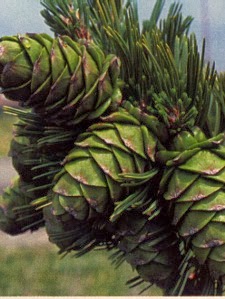
Female cones 3-8" long, yellowish green when mature, developing into a light brown color when open. White pine cones are quite different than yellow pine cones. White pines tend to be narrow, elongated, with scales that don't have a real distinct umbo, just a short darker area at the tip where a yellow pine has some sort of prickle usually.
I planted this tree in Spokane as a 4 foot specimen and it grew to 15 feet in 8 years. Very nice specimen.
Misidentification:
Other 5 needle pines we can see in our area:
This tree is small, short but thick blue foliage very distinct white bands of stomates
P. strobus - thin needles, usually bright green. The only one I have seen is the contorted one.
P. torrreyana - Long thick, sharp pointed needles, round cone.
P. wallichiana - long, thin needles, weeping on the stems, longer cone, larger tree.
Location:
Capitola:
4525 Crystal in the Jewell Box
507 Sunset Dr is a very nice specimen along with a purple redbud
Monday, December 23, 2013
Butia capitata - Pindo Palm
The Pindo Palm (Jelly Palm) is a pretty common sight in our county and I am glad because it provides a nice palm with the blue foliage that I like. They grow as solitary stem to about 20' in our area but maybe to 35' elsewhere.
Leaves are pinnate, 10-15' long, distinctly arched, V shaped in cross section (leaflets are sticking upright) usually bluish to silvery green colored. Very sharp modified leaflets along the leaf stalk.
Stems are covered with criss crossing leaf bases projecting from the stem at least 8" until very old then becoming smooth.
Flowers prolifically here, throwing up 3-5 spikes from woody bracts that look like boats. Flowers are unisexual but both on same inflorescence.
Fruit round, 1" orange and edible. These are not ripe yet.
Love the aloe with this palm - all spiky.
Misidentification
not sure, distinct pinnate palm with bluish and arching foliage, knobs on trunks.
Locations:
Aptos
7000 Soquel Drive in the thin planting strip
Twin Lakes Church sort of at the back with the school - near the Nursery school room.
Capitola
105 Wesley Street
4775 Opal Cliff Drive
Santa Cruz
126 Miles St
Leaves are pinnate, 10-15' long, distinctly arched, V shaped in cross section (leaflets are sticking upright) usually bluish to silvery green colored. Very sharp modified leaflets along the leaf stalk.
Love the aloe with this palm - all spiky.
Misidentification
not sure, distinct pinnate palm with bluish and arching foliage, knobs on trunks.
Locations:
Aptos
7000 Soquel Drive in the thin planting strip
Twin Lakes Church sort of at the back with the school - near the Nursery school room.
Capitola
105 Wesley Street
4775 Opal Cliff Drive
Santa Cruz
126 Miles St
Labels:
blue foliage,
Butia capitata,
Jelly Palm,
Palm,
Pindo Palm,
pinnate palm
Subscribe to:
Posts (Atom)