Santa Cruz County has a wide assortment of tree species grown and some great examples located in public spaces. Trees are covered like a field guide. Walking and Driving tree tours are listed on the right. Search by common name or tree attributes in the search engine.
Search This Blog
Wednesday, October 29, 2025
Hesperocyparis macrocarpa 'Saligna Aurea' - Golden Weeping Monterey Cypress
Monday, December 30, 2024
Quercus x ganderi - Gander's oak
I have been looking at these two Oaks for years and I think I am close to getting to the correct identification. I always guessed they were hybrids between the Coast Live Oak and California Black Oak but the difficulty was (is) the amount of hybridization and genetic studies that Q. agrifolia has been part of makes it difficult to come up with the name. Additionally, the experts are not in agreement.
My favorite old book "Pacific Coast Trees" by McMinn and Maino lists one hybrid, Q. morehus. More recent publications suggest there are more. But, perhaps the botanical variety oxyadenia is not really a distinct variety which eliminates the hybrid group.
Regardless of the name, I will continue.
Large semi-evergreen tree growing to 50' with a broadly oval outline. Often with multiple main branches. For those local, this one is on Bonita close to the Fire Department end.
This one has a different shape due to it growing up against a house.
Misidentification: Quercus kelloggii though those leaves are bigger, broader, more deeply lobed, and the acorn cap is different.
CalFlora calls this tree Q. Xchasei.
There was a species originally named Q. chasei (McMinn, 1949)
Kew Gardens considers the proper name as Q. Xganderi with Q. agrifolia var. oxyadenia and Q. kelloggii as the parents.
Cal Poly SLO does not mention Q. Xchasei
https://selectree.calpoly.edu/tree-detail/1727
Observers on Inaturalist refer to Q. XChasei as a synonym of Q. Xganderi though some use the prior as the proper name.
Location
Sunday, July 2, 2017
x Chiranthodendron lenzii
This is a man made hybrid between the Mexican hand tree and a California native.
Chiranthodendron pentadactylon x Fremontodendron 'Pacific Sunset'. Sometimes called x Chiranthofremontia lenzii and I recall a citation that the whole group might be one species. There is not a lot of information on these trees and I think I have only seen 3-4 of them in person. I think the more common name is the Hybrid Monkey Hand Tree.
Evergreen tree growing 30+ feet tall upright branching, sort of pyramidal to columnar with stiff branches. Lower branches flattening out, which is nice because the flowers sit on the tops of the stems.
Foliage is attractive, resembling its parents, alternately arranged, simple, 4-5" long and wide, palmately lobed with 3-5 lobes, dark green glossy leathery upper surface and a whitish bronze below due to all the hairs on the surface.
Stems are also covered with hairs, at least when young. The oldest specimen I have seen shows smooth bark.
Flowers are really pretty cool looking. Borne on the upper surface of the stems, they are a yellowish orange color on the outside and more orange inside. The monkey paw part of the flower is the 5 stamens and are golden colored rather than red like one of its parents. You can see the stigma pointing to 11 o'clock.
Flower bud.
Flowers are often found along the tops of the branches.
Misidentification:
Likely to think its a Fremontidendron but the flowers are different, these flowers have red/orange inside and not yellow like our native tree.
Chiranthodendron pentadactylon has red stamens.
Location:
Corralitos
2957 Freedom Blvd
Santa Cruz
Arboretum, past the small nursery growing area.
Tuesday, July 28, 2015
Chrysolepis chrysophylla - Golden Chinqapin
Leaves are evergreen, simple, alternate, lanceolate to narrowly elliptical, 2-5" long, folding upward along the main vein, boat keel like, about 1" wide, dark green upper surface and a golden lower surface.
Plants are monoecous, males at the ends of the catkins. Male flowers creamy white at the ends of the branches forming in middle summer, July here.
Fruit is a nut, enclosed in a spiny husk (cupule = cup-like structure like those surrounding the base of an acorn), very much like that of a chestnut. These are three-angled to round, but caught a nice triangular one,
Spins on the outer husk variously branched and very sharp. One distinction between this and a chestnut is that there are separations between each of the 3 nuts.
Here is the fruit on the left with a chestnut on the right.
Bark smooth when young, developing over time to become deeply furrowed.
Synonyms: Castanopsis chrysophylla
Misidentification:
A chestnut due to the fruit, but the leaves look totally different.
Location:
Santa Cruz
5187 Empire Grade
Sunday, July 26, 2015
Sambucus mexicana - Blue Elderberry
Leaves are deciduous, opposite, pinnately compound, 6-12" long, with 5-7 lanceolate to narrowly ovate leaflets with serrated margins and noticeable unequal leaf bases. Leaflets are about 2-4" long and about 1" wide, and medium green. Trees growing with little water have smaller leaves that are often curled.
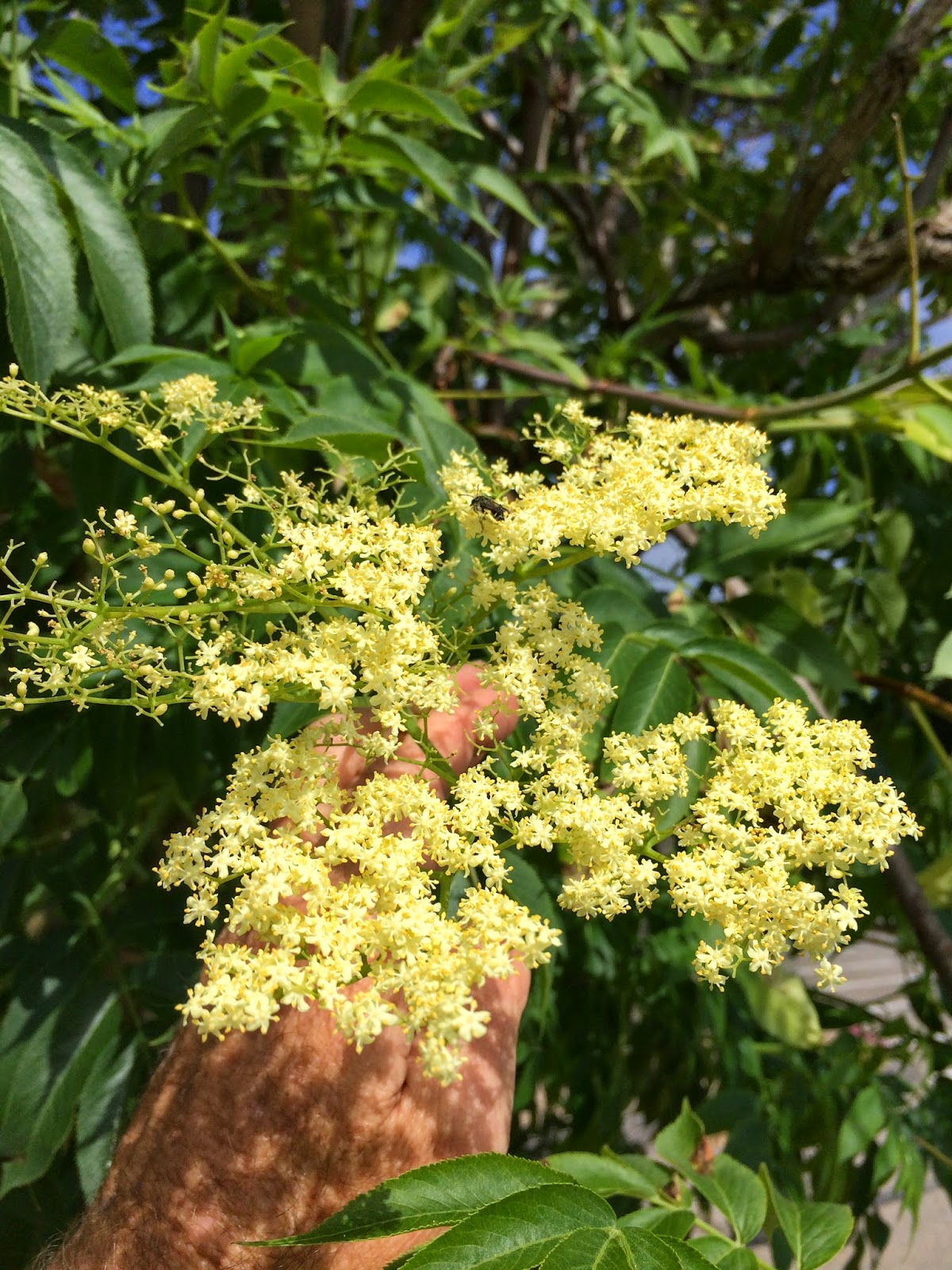
Flowers yellowish white, in a flat topped cyme. Individually small, but in large quantities making a nice display.
Fruit is blue when ripe, 3/8' diameter, sometimes with a distinct waxy covering. Infructescence gets very heavy and hang when fruit is ripe.
Young stems are bright green with orangish lenticels. Suckers can be very thick and grow very rapidly.
Bark on older trees is ridged, reddish brown in color.
I learned this plant as Sambucus caerulea back in the day, and will always recall seeing them all over Pullman WA and "getting" the caerulea part due to the fruit color. Also called S. mexicana caerulea or S. nigra cerulean.
Misidentification:
Not hard to identify, suckering habit, unequal leaflet bases, blue fruit.
Location:
Just about everywhere you find native plants growing.
Aptos
Nisene Marks all over the road prior to the pay station,
502 Loma Prieta Dr.
Aesculus californica 'Canyon Pink' - Canyon Pink Buckeye
I've seen several pinkish flowered trees at Wilder State Park (below) so the genes are there for more selections.
Foliage is really the same as are most all traits except the flower color.
Misidentification:
Don't mistake it for the various pink horse chestnuts, Aesculus x carnea, which have much larger wider leaves and furrowed bark and are much larger trees.
Location:
Aptos
Cabrillo College Horticulture Building 5000.
Thursday, April 23, 2015
Fremontodendron 'California Glory' - California Glory Flannel bush
Fruit is a capsule surrounded by bracts.
Stems are also covered with those nasty hairs. Be very careful working with these plants, the hairs get in your nose and are very uncomfortable to say the least. Stipules present as well.