Search This Blog

Showing posts with label yellow flowers. Show all posts

Sunday, July 2, 2017

x Chiranthodendron lenzii

I can't tell you how many times I must have driven past this tree and not seen it. Then, a few days ago there is was in full bloom standing up against a larger magnolia that must have caught my eye.

This is a man made hybrid between the Mexican hand tree and a California native.
Chiranthodendron pentadactylon x Fremontodendron 'Pacific Sunset'. Sometimes called x Chiranthofremontia lenzii and I recall a citation that the whole group might be one species. There is not a lot of information on these trees and I think I have only seen 3-4 of them in person. I think the more common name is the Hybrid Monkey Hand Tree.

Evergreen tree growing 30+ feet tall upright branching, sort of pyramidal to columnar with stiff branches. Lower branches flattening out, which is nice because the flowers sit on the tops of the stems.


Foliage is attractive, resembling its parents, alternately arranged, simple, 4-5" long and wide, palmately lobed with 3-5 lobes, dark green glossy leathery upper surface and a whitish bronze below due to all the hairs on the surface.


Stems are also covered with hairs, at least when young. The oldest specimen I have seen shows smooth bark.


Flowers are really pretty cool looking. Borne on the upper surface of the stems, they are a yellowish orange color on the outside and more orange inside. The monkey paw part of the flower is the 5 stamens and are golden colored rather than red like one of its parents. You can see the stigma pointing to 11 o'clock.


Flowers with the stamens still closed.


Flower bud.


Flowers are often found along the tops of the branches.


Misidentification:
Likely to think its a Fremontidendron but the flowers are different, these flowers have red/orange inside and not yellow like our native tree.

Chiranthodendron pentadactylon has red stamens.


Location:
Corralitos
2957 Freedom Blvd

Santa Cruz
Arboretum, past the small nursery growing area.

Sunday, July 26, 2015

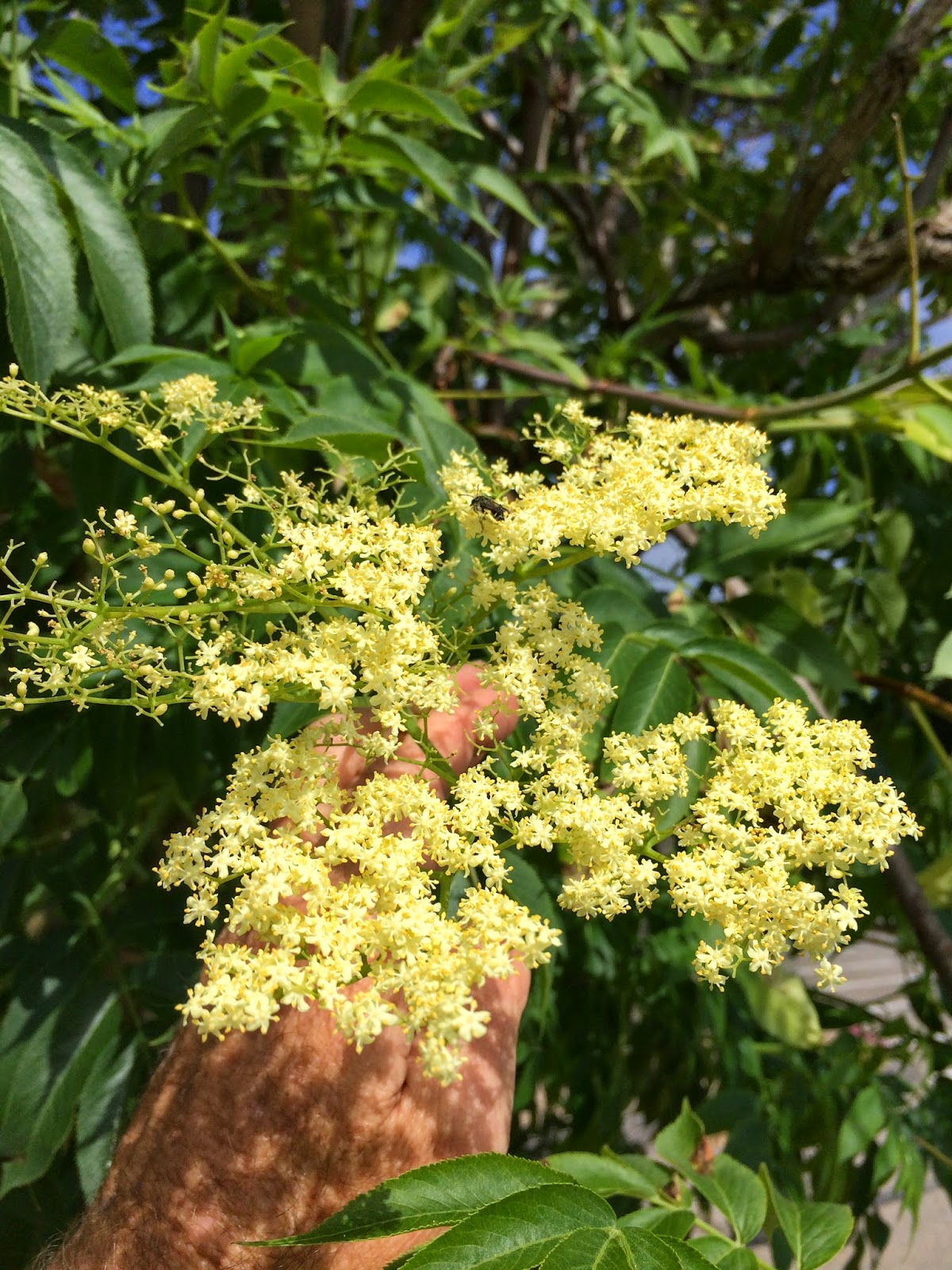
Sambucus mexicana - Blue Elderberry

A California native deciduous shrub or tree growing 15-25' tall forming an irregularly rounded to spreading form with multiple stems arising from an older trunk. Old trees have thick trunks but the wood making up the canopy is usually fairly young as suckers arise along the trunk or flat lying branches. Usually found near water, but seems to be pretty tolerant of dry soils.


Leaves are deciduous, opposite, pinnately compound, 6-12" long, with 5-7 lanceolate to narrowly ovate leaflets with serrated margins and noticeable unequal leaf bases. Leaflets are about 2-4" long and about 1" wide, and medium green. Trees growing with little water have smaller leaves that are often curled.


Flowers yellowish white, in a flat topped cyme. Individually small, but in large quantities making a nice display.


Fruit is blue when ripe, 3/8' diameter, sometimes with a distinct waxy covering. Infructescence gets very heavy and hang when fruit is ripe.


Young stems are bright green with orangish lenticels. Suckers can be very thick and grow very rapidly.


Bark on older trees is ridged, reddish brown in color.


I learned this plant as Sambucus caerulea back in the day, and will always recall seeing them all over Pullman WA and "getting" the caerulea part due to the fruit color. Also called S. mexicana caerulea or S. nigra cerulean.

Misidentification:
Not hard to identify, suckering habit, unequal leaflet bases, blue fruit.

Location:
Just about everywhere you find native plants growing.

Aptos
Nisene Marks all over the road prior to the pay station,
502 Loma Prieta Dr. 

Saturday, May 23, 2015

Fraxinus ornus - Flowering Ash

The Flowering ash or sometimes called the Manna ash is a small to medium sized deciduous tree growing 25-50' with a spreading habit. Most literature suggests they are small trees in their native habitat of Spain. Not a great shot below, nor a great specimen being pruned by highway crews, but for now it's all I have.


Leaves deciduous, opposite, pinnately compound, 8-12" long, with 7-9 leaflets. Each leaflet about 2-3" long, medium green, oblong except the terminal which is a bit wider, margins serrated, cuneate base and acuminate tip, lower surface lighter green. Known to have weak reddish fall color, but having just stumbled on this one specimen, I have not seen the fall color.


Flowers creamy yellow in mass but more or less white close up. Trees are androdioecious, new term for me, where plants can produce perfect flowers or they can produce only male flowers. Then again I read that they might not be "functionally" androdioecious?? The flowers are borne in very showy panicles emerging with the spring foliage, males with two stamens, four white strap-like petals and fragrant. They have the typical privet smell.


Fruit is a narrow samara typical of ash trees.


Terminal bud is large, dull brown, many other Ash trees are copper colored buds. Leaf scars are pretty small and more or less flat topped.


Misidentification:
Any other ash tree if not in bloom. Actually, I drive by the specimen almost every day on the freeway and I suspect I thought it was a Sambucus but the other day it just looked different to me so I went back to look. Flowers in May, looking a lot like Chionanthus flowers. Foliage is slightly different that others around here, the terminal is quite broad and the terminal buds are large and dull brown.


Location:
Aptos
9057 Soquel Dr. Really across the street at the bus stop.

Thursday, May 14, 2015

Acacia longifolia - Sydney Golden Wattle

Sydney Golden Wattle is more likely a large shrub but we will consider it a small tree commonly used as a utility tree along freeways. These evergreen trees grow really fast to 20' x 20' with a rounded habit, dense canopy with branches to the ground. The end result is nondescript evergreen screen. Trees become visible as soon as they bloom. Most commonly seen along the freeway.


Leaves are alternate, evergreen, simple, oblanceolate, thick, bright green, no distinct upper or lower surface, more or less 4" long, sometimes slightly curved. Like all simple Acacia leaves, these are phyllodes or flattened petioles.


Stems are thin, green with small rounded vegetative buds.


Older stems are sort of cool looking, nice color and lines on the stems from the buds.


Flowers in mid winter.  Flowers are small, yellow, rounded balls of flowers in elongated clusters, fragrant. Bright yellow.


Fruit is a pod, usually twisted.


Misidentification:
In bloom, not as likely, the flowers are super bright yellow on an elongated inflorescence.

Location:
Most commonly seen on the freeway.
Aptos
Just below the railroad overpass closest to Rio Del Mar Exit

Santa Cruz
Along the highway at the old drive in movies, now the swap meet. (Pulled out for more lanes)

Thursday, April 23, 2015

Fremontodendron 'California Glory' - California Glory Flannel bush

California Glory Flannel Bush is a large evergreen rounded shrub or small tree native to California, potentially reaching 20' tall and wide. They are pretty stiff looking plants, with branches going off in various directions in mostly two dimensions or flattened herringbone pattern. 


Leaves are evergreen, simple, palmately lobed with 3 to sometimes 5 lobes. Leaves are dark green on the upper surface and covered with whitish stellate shaped hairs that are an irritant to many people. There is a tremendous variability in leaf shape in many specimens of flannel bush species and cultivars. The species has yellow hairs.


Flowers are yellow with 5 yellow petals and 5 orangish sepals. Produced in the spring and summer. This cultivar is very yellow and almost flat flowers and has more orangish coloring when viewed from behind. Large stamens are obvious. 


 Fruit is a capsule surrounded by bracts.


Stems are also covered with those nasty hairs. Be very careful working with these plants, the hairs get in your nose and are very uncomfortable to say the least. Stipules present as well.


This cultivar is a hybrid between Fremontodendron californium and F. mexicanum and introduced by Rancho Santa Ana Botanical Garden in 1962. My guess is all the cultivars are hybrids. 'California Glory', 'Pacific Sunset' and 'San Gabriel' came from Rancho Santa Ana, while the others originally came from Saratoga Horticultural Foundation.

'Pacific Sunset' - Large plant, 30' and wider according to Nevin Smith (Native Treasures), Upright grower with stiff branches, flowers deep golden yellow with orange
'San Gabriel' - As large as 'Pacific Sunset' (Smith) Larger leaves and medium yellow flowers.
'Ken Taylor' - 5' tall and 8' wide, somewhat rounded and  mounded.
'Eldorado Gold' - Low spreading form, see below. Picture from Cal Poly I think.


Misidentification:
Other Fremontidendrons likely, this one has more white tomentum. Saw 'Butano Ridge' at the UCSC sale, the leaves are very dark.

Location
Aptos: 
Freedom Blvd at the intersection with Soquel Drive. Two specimens.

Moss Landing is not in our county but the nicest ones are at the Dolan Rd intersection around the power plant.

Thursday, January 1, 2015

Acacia retinodes - Water Waddle

The Water Waddle is a fast growing evergreen tree or large shrub reaching 20 x 20' forming a rounded to oval shape, if growing alone, but these seem to be in groves. Makes a nice fine textured screen. Reportedly blooms throughout the season, and called Ever-blooming Acacia.


Leaves are evergreen, alternate, simple, narrowly lanceolate to oblanceolate, slightly curved, dull gray green, no distinct upper or lower surface, slightly enlarged area near the base of the petiole.


Flowers are pale yellow or cream colored, fragrant, in clusters. Clusters (heads) are arranged in racemes with 5-9 heads per inflorescence. Other sites call this the ever-blooming wattle as it may bloom sporadically year round. My pictures are from winter, and only a few branches had flowers.


Fruit is a pod with some restrictions between the seeds. 4-5" long.

Young stems are bright red-mahogony eventually turning gray.


Trunk reportedly scaly at maturity but these trees are pretty young and smooth.


Wirilda Wattle is another common name.
There are two botanical varieties, but they seem to look alike, one preferring wetter soils.

Misidentification:
While taking pictures of the flowers one day a neighbor wanted to know what I was doing. After informing him he told me the tree was a black acacia and since he worked for a tree company for 30 years he was sure. But if you step back and look at the leaves, and flowers, he was not far off.

Odd Acacias are tough, helps to see the flowers, pods and leaves.

Location:
Santa Cruz
Harper St. at the east end, past the sign that says private road (oops) across from Daniva Ct. and above all the trash cans.

Friday, November 28, 2014

Robinia pseudoacacia 'Tortuosa' - Contorted Black Locust

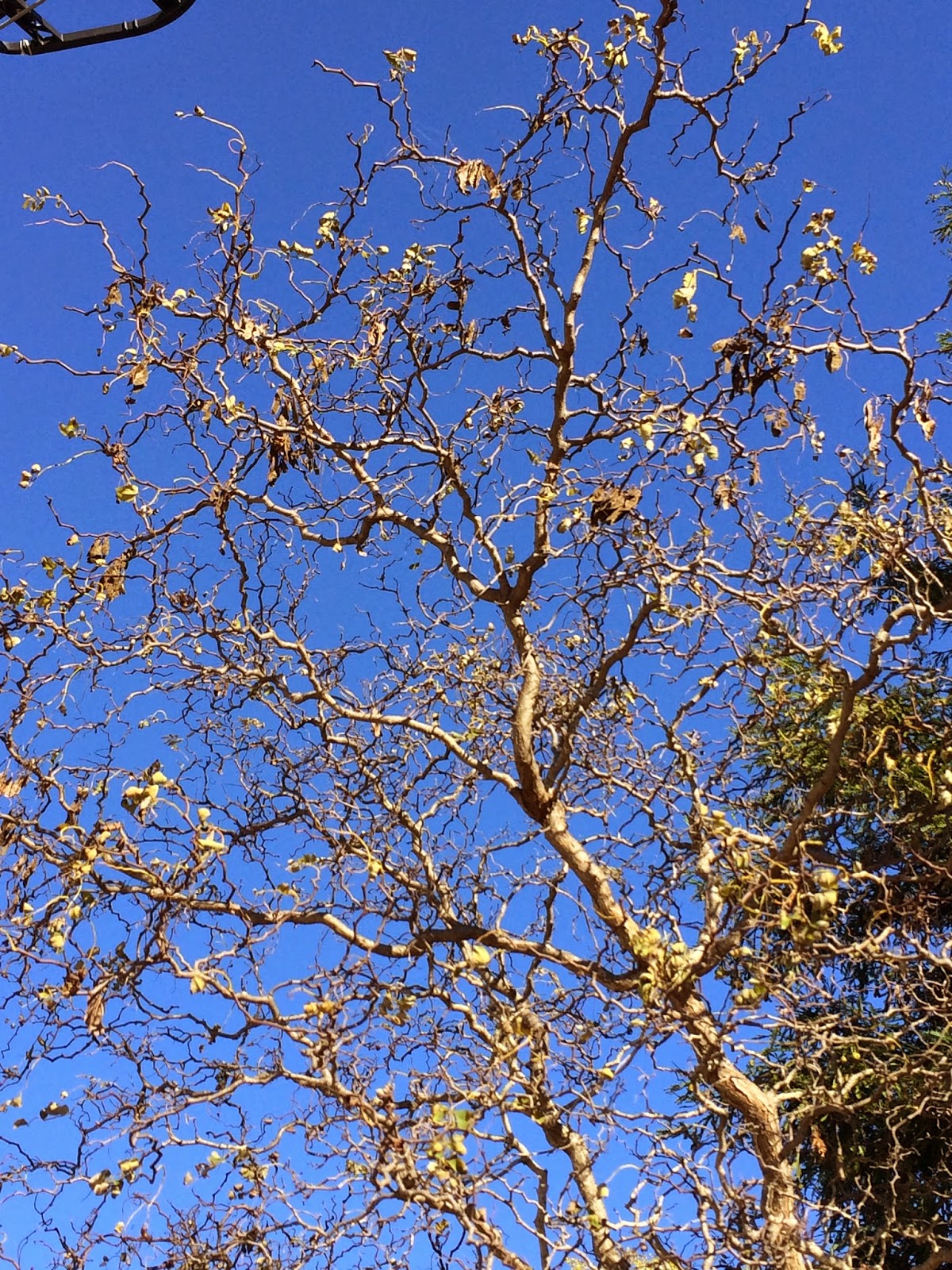
I love twisted or contorted plants, and this one is pretty twisted. Apparently there are two versions of this plant, 'Tortuosa' and 'Lace Lady'. 'Tortuosa' has the potential of reaching 40' and are likely the ones seen on Jordan, while 'Lace Lady' are said to reach 15'. Regardless, we have a dwarf twisted form of the black locust, depending on the cultivar the plant may be 15'-40' tall. I may like it best in the winter without the twisted leaves.


Same plant in the winter.


Leaves are smaller then normal, twisted, but look like a black locust leaf with inch worms. This one is mine, in a pot and most likely 'Lace Lady'.


Flower clusters are smaller, shorter perhaps, but look like the species.


Misidentification:
Hard to guess what you might think this is. Maybe you are looking at a Harry Lauder's Walking Stick in winter?


Location:
Capitola
729 Monterey Blvd.
230 Junipero Ct.

Santa Cruz
127 Jordan on the Escalona Drive side of the house with 3 very large specimens and I think one on the Jordan side.