Search This Blog

Showing posts with label thorns. Show all posts

Friday, November 28, 2014

Robinia pseudoacacia 'Tortuosa' - Contorted Black Locust

I love twisted or contorted plants, and this one is pretty twisted. Apparently there are two versions of this plant, 'Tortuosa' and 'Lace Lady'. 'Tortuosa' has the potential of reaching 40' and are likely the ones seen on Jordan, while 'Lace Lady' are said to reach 15'. Regardless, we have a dwarf twisted form of the black locust, depending on the cultivar the plant may be 15'-40' tall. I may like it best in the winter without the twisted leaves.


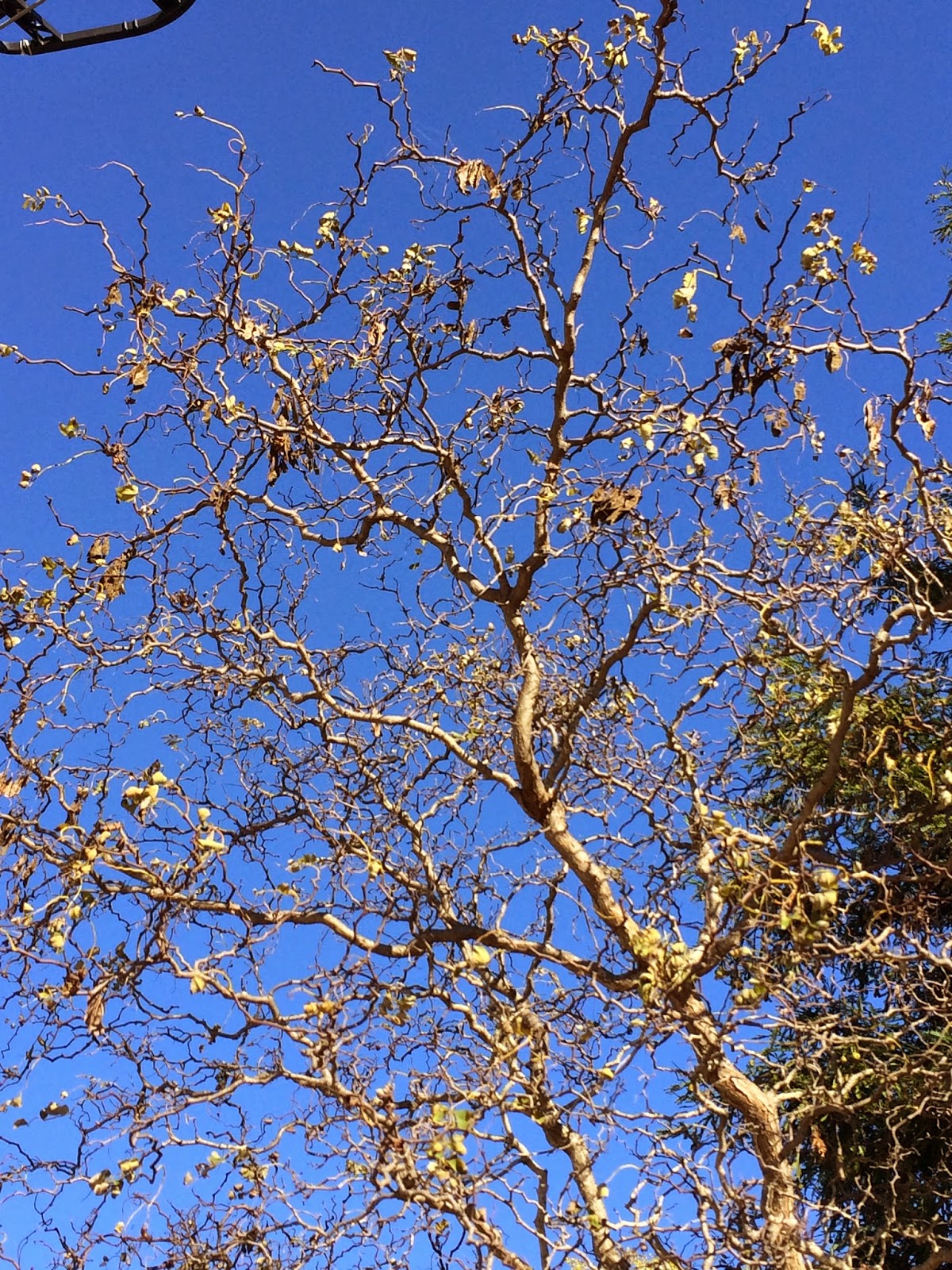
Same plant in the winter.


Leaves are smaller then normal, twisted, but look like a black locust leaf with inch worms. This one is mine, in a pot and most likely 'Lace Lady'.


Flower clusters are smaller, shorter perhaps, but look like the species.


Misidentification:
Hard to guess what you might think this is. Maybe you are looking at a Harry Lauder's Walking Stick in winter?


Location:
Capitola
729 Monterey Blvd.
230 Junipero Ct.

Santa Cruz
127 Jordan on the Escalona Drive side of the house with 3 very large specimens and I think one on the Jordan side.

Saturday, July 19, 2014

Erythrina caffra - Coral Tree

The Coral Tree is a medium sized deciduous (Semi-evergreen) tree growing in a rounded spreading habit to 30-35' tall and wide. Typically looses its foliage mid winter. Damaged by cold weather. 


Leaves are alternate, trifoliate, each leaflet dark green, rhomboid to ovate shaped, with a somewhat elongated tip. The base can be more flattened resulting in a deltoid shape. Leaflets 2-5" long, laterals smaller that the terminal. Prickles (sometimes called thorns) along the mid vein.


Stems are stout, green when young, and usually covered with shape prickles, usually dark colored. Leaves can be clustered at the tips appearing whorled.


Flowers are beautiful and very tropical looking. They are orange - scarlet red, 2" long, about 1" wide and borne in a 1' long panicle.


Fruit is a pod with constrictions between the bright red seeds. I have not seen them set fruit here, these pictures were taken in SLO.


Older stems and bark is pretty cool. Often multi stemmed, light tan color with shallow ridges.


A variegated species, seen in warm climates only.


Misidentification:
Could be E. crus-galli the cockspur coral tree, but they have narrow trifoliate leaves. You can see one of these at city hall or in the Salvia garden at Cabrillo.

Location:
Santa Cruz
Floral Park  - Pleasure Point - 3 trees
3020 Pleasure Point Dr.
115 Toledo - very large specimen

Sunday, January 19, 2014

Ceiba speciosa - Silk Tree

The silk tree is quite rare in Santa Cruz County. It's a medium to large semi-deciduous tree growing to 30-60' with a spread of about the same. Variable in form, some specimens are very broad while others tend to be more upright. Many examples I've seen south of SC are much wider than the images I have. Trees are unique with a large swollen trunk with prickles, large primary lateral branches upright but also can be going off in odd directions, (one of its common names is palo borracho = drunken stick). Beautiful in bloom. Formerly known as Chorisia speciosa.


Alternately arranged, palmately compound leaves, 6-12" diameter with 5-7 lanceolate to elliptic to oblanceolate leaflets each 3-5" long with slightly serrated margins. Petiole as long or longer than the leaf blade area.


Stems are covered with prickles, not spins, not thorns, but prickles. Usually dense when young, but as the trunk expands they tend not to produce more of them. I fell in love with this tree while attending Cal Poly. It was being grown by the department and I bought one and had it for years, actually leaving it in Petaluma with my in-laws while we went to Pullman for grad school, and it stayed there till they moved.


Flowers are pink with a light yellow or white throat, 5 thin petals, sort of lacy usually borne without leaves.


Fruit are oval to rounded pods 6-8" long opening up to reveal black seeds covered by cotton like hairs. Blooming in fall.


Green bark and stems, becoming gray with age.


Misidentification:
Hardly, with the stems covered with prickles. 

Location:
Aptos:
Corner of Rio Del Mar and Highland - Very nice tree

Capitola
4815 Crystal Ave is a small one.
4440 Opal Cliff Dr, 3 nice ones

Santa Cruz
City Hall has two of them.


Thursday, July 12, 2012

Crataegus phaenopyrum - Washington Thorn

The Washington Thorn is a great small tree. I like the leaves, the fall color and the fruit, and especially the thorns. The leaves are nice, flowers okay. Its just well behaved, and does what you wanted it to do. This is one of many hawthorns (Crataegus) that are present but its the best in my opinion.

The trees are deciduous, rounded to broadly oval tree to 25' with about the same spread. Often single stemmed but can frequently see multi-stemmed trees with a moderate growth rate. Fairly dense canopy with nice flowers, fruit and fall color. The best plantings I have seen are on Portola Drive in the median leaving Capitola and entering Live Oak. 


Nice row of trees in the fall.


The deciduous leaves are alternate, simple, ovate, 3-5 lobed with the center lobe much larger than the others. Sometimes it does not really look lobed, like the one at the bottom of this picture, while the one on the top is lobes, but maybe not like you think of lobes. Margins are serrated. Leaf color is dark green. Leaves are shinny.


This one is lobed, and look at the thorns.


Fruit are small (1/4") glossy red pomes in big clusters of a dozen or so. They are very persistent through winter. Then when ripe the birds will strip the tree in a matter of minutes.


Flowers are small, off white in clusters in June. Sort of a funky smell.


Stems are greenish brown, with prominant thorns. I love trees with thorns. These are great, can be 2-3" long and very sharp. You find the best thorns on vigorous growing stems.


Misidentification: Not sure, maybe another hawthorn. Last hawthorn to bloom, nice thorns though others have nice ones also.

Locations: Pretty common actually, you just might not notice them.

On Captiola Rd in the median leaving Capitola and entering Live Oak. Great planting, and why we need to see more of them. They run all the way to where Capitola Rd intersects with Soquel Ave.

Soquel: On Center St across from the White Church.