The Cockspur Coral Tree is a small deciduous tree with an umbrella shaped canopy reaching 15-20' in Santa Cruz, but you may find them smaller than that. The most obvious one in town is at city hall. Not a great specimen, was not sure why, but I looked at google street view history and the space was dominated by a Hollywood Juniper and this tree was being crowded out. When in full bloom it looks pretty nice. Waiting for the fall color… supposed to be yellow….
Leaves are deciduous, alternate, trifoliate, leaflets narrowly elliptical 3-5" long, margins slightly less than smooth, and spines on the lower portion of the main veins. Distinct swollen area at the base of the petiole, the pulvinus.
Flowers in the spring occasionally in summer and into fall, fragrant, showy bright red or pinkish-red, in long drooping panicles. Individual flowers are "pea-like" with a distinct elongated lower petal shaped like the keel of a boat. This is taken in December, winter here, but you can see the elongated lower petal. Looks like thrip damage maybe.
These are the flowers about to open.
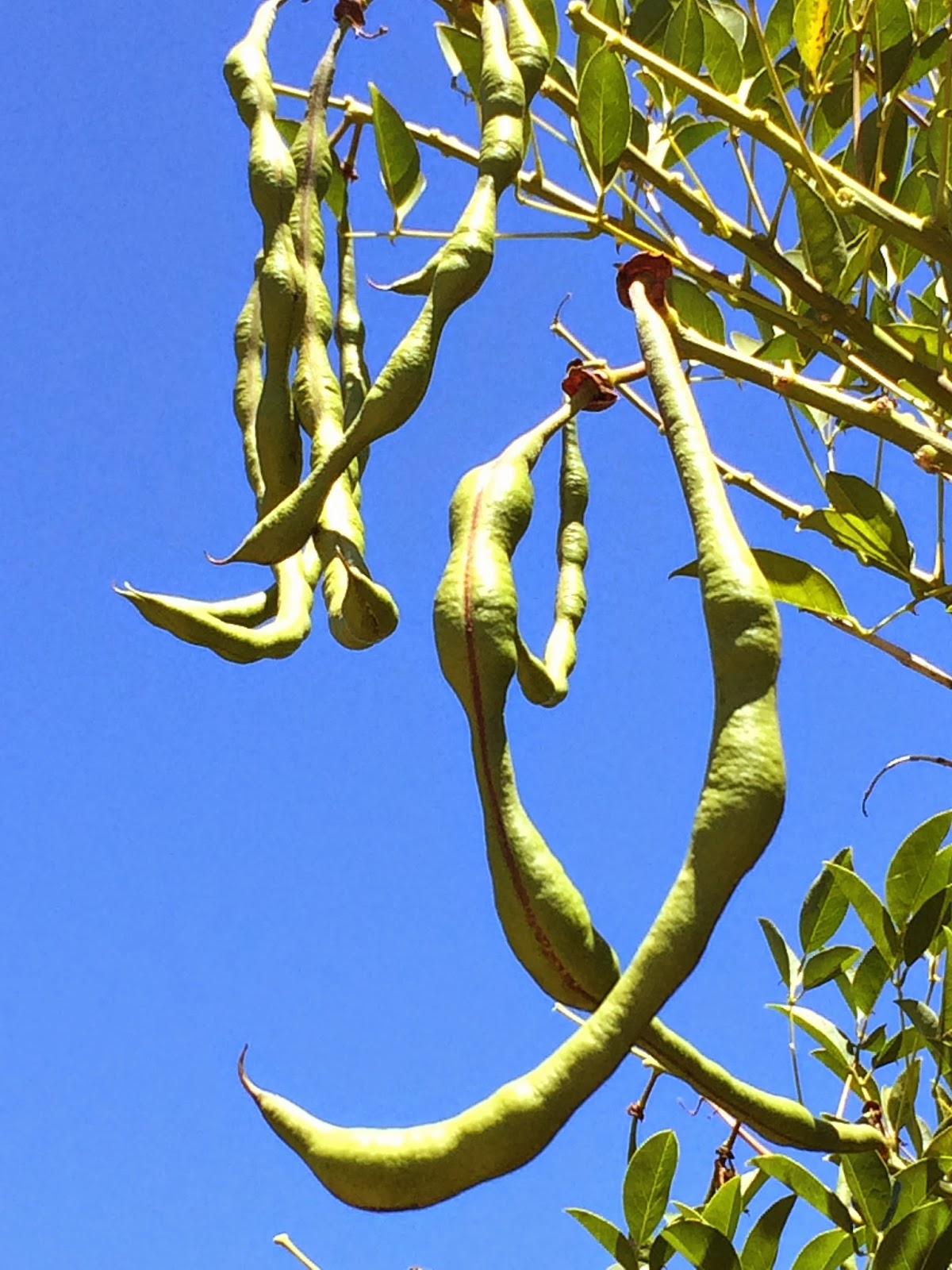
Fruit is a brown pod, with constrictions between the seeds. Ripening in the fall. This is summer. You can see the constrictions.
Interesting seeds if you take the time to look at them.
Stems are green, stout, with nasty prickles. You can even see the tell tale pulvinus on the petiole of the leaf.
Bark is usually attractive, potentially deeply furrowed.
Tree is also known as the Coral Tree, Crybabytree, Christ's Tears.
Misidentification:
Erythrina caffra, around here anyway, if you are in a more tropical area you are likely to become very confused. These have narrower elliptical leaflets and are smaller trees.
Location:
Aptos
Cabrillo College Hort Department has one in back garden area, its low growing.
Santa Cruz
City Hall along Center St.
114 Myrtle St.
Santa Cruz County has a wide assortment of tree species grown and some great examples located in public spaces. Trees are covered like a field guide. Walking and Driving tree tours are listed on the right. Search by common name or tree attributes in the search engine.
Search This Blog
Showing posts with label trifoliate leaves. Show all posts
Tuesday, August 4, 2015
Saturday, July 19, 2014
Erythrina caffra - Coral Tree
The Coral Tree is a medium sized deciduous (Semi-evergreen) tree growing in a rounded spreading habit to 30-35' tall and wide. Typically looses its foliage mid winter. Damaged by cold weather.
Stems are stout, green when young, and usually covered with shape prickles, usually dark colored. Leaves can be clustered at the tips appearing whorled.
Flowers are beautiful and very tropical looking. They are orange - scarlet red, 2" long, about 1" wide and borne in a 1' long panicle.
Fruit is a pod with constrictions between the bright red seeds. I have not seen them set fruit here, these pictures were taken in SLO.
Older stems and bark is pretty cool. Often multi stemmed, light tan color with shallow ridges.
Misidentification:
Could be E. crus-galli the cockspur coral tree, but they have narrow trifoliate leaves. You can see one of these at city hall or in the Salvia garden at Cabrillo.
Location:
Santa Cruz
Floral Park - Pleasure Point - 3 trees
3020 Pleasure Point Dr.
115 Toledo - very large specimen
Thursday, May 1, 2014
Acer triflorum - Three-flowered maple
The three-flowered maple is a great little tree rarely seen in SC county. I saw a few for sale at Hidden Gardens (Dig Gardens Aptos) at one time and came upon one recently planted in Seacliff area. Hoping it grows well and the owners appreciate a very rare tree. (Still there and growing nicely 5/25.) They grow slowly to 20' with a rounded full crown. Will keep most of the lower branches in place which will hide the nice bark.
Leaves are opposite, trifoliate, leaflets about 3" long, somewhat leathery, with red petioles. Lateral leaflets are unevenly serrated with the outer edge serrated. Fall color is beautiful.
Stems are small, thin, twiggy, but develop exfoliating bark at a young age. Love the buds when they start to expand.
Flowers are in clusters of threes, hence the common name, small, greenish yellow and hardly noticeable.
Fruit is a winged samara that hang almost parallel to one another, about 1.25" long.
Bark is beautiful. Exfoliates in thin sheets that look more like a Heritage birch than a paperbark maple. Older bark does not peel off and turns brown with deep furrows.
Misidentification: Paper bark maple - but the bark is not deep red.
Location:
Aptos
142 Seacliff Dr.
Leaves are opposite, trifoliate, leaflets about 3" long, somewhat leathery, with red petioles. Lateral leaflets are unevenly serrated with the outer edge serrated. Fall color is beautiful.
Stems are small, thin, twiggy, but develop exfoliating bark at a young age. Love the buds when they start to expand.
Flowers are in clusters of threes, hence the common name, small, greenish yellow and hardly noticeable.
Fruit is a winged samara that hang almost parallel to one another, about 1.25" long.
Bark is beautiful. Exfoliates in thin sheets that look more like a Heritage birch than a paperbark maple. Older bark does not peel off and turns brown with deep furrows.
Misidentification: Paper bark maple - but the bark is not deep red.
Location:
Aptos
142 Seacliff Dr.
Friday, January 10, 2014
Rhus lancea - African Sumac
The African Sumac is a small evergreen tree, 15-25' feet tall, with a dense broad spreading to rounded to dome-shaped with slightly weeping branch ends. It falls into the category of trees you really don't notice unless its flowering and the flower parts are falling on your car.
Evergreen leaves alternately arranged, 3-5" long, trifoliate, with a long petiole, leaflets lanceolate, middle one larger than the laterals, dark green above, lighter below. Hanging off the thin somewhat weeping branches.
Flowers December around here. Dioecious (male and female plants). Large clusters of very small yellowish green, attracts lots of bees.
Fruit is a orangish or yellow drupe, on female trees only.
The stems are thin, somewhat grooved, olive green when young, turning orangish brown when older bark develops.
Bark is attractive I guess, other reference say so, but its okay, showing a brown alligator like skin with orange colors coming through in the cracks. Middle age stems are orangish brown with dark lenticels.
Misidentification: Looks somewhat like Geijera parvifolia (Australian Willow) but has trifoliate leaves.
Location:
Capitola
41st Ave at Pizza My Heart
Live Oak
Capitola Rd and El Dorado
Labels:
African Sumac,
evergreen,
Rhus lancea,
small tree,
trifoliate leaves
Subscribe to:
Posts (Atom)

