Search This Blog

Showing posts with label attractive bark. Show all posts

Tuesday, April 7, 2015

Leptospermum laevigatum - Australian Tea Tree

The Australian Tea Tree is a large evergreen shrub or small multi-stemmed tree that's often wider than tall, eventually reaching 30' but generally 20' range. The dense canopy masks the spectacular branching pattern and bark. Best pruned to expose the twisting branches.


Leaves are evergreen, simple, alternately arranged, elliptical to oval, about an inch long, dull, light bluish green, thick, stiff, entire margins with a slight point at the end. 


Flowers are white, about 1" diameter, stiff looking with 5 wide spreading petals.


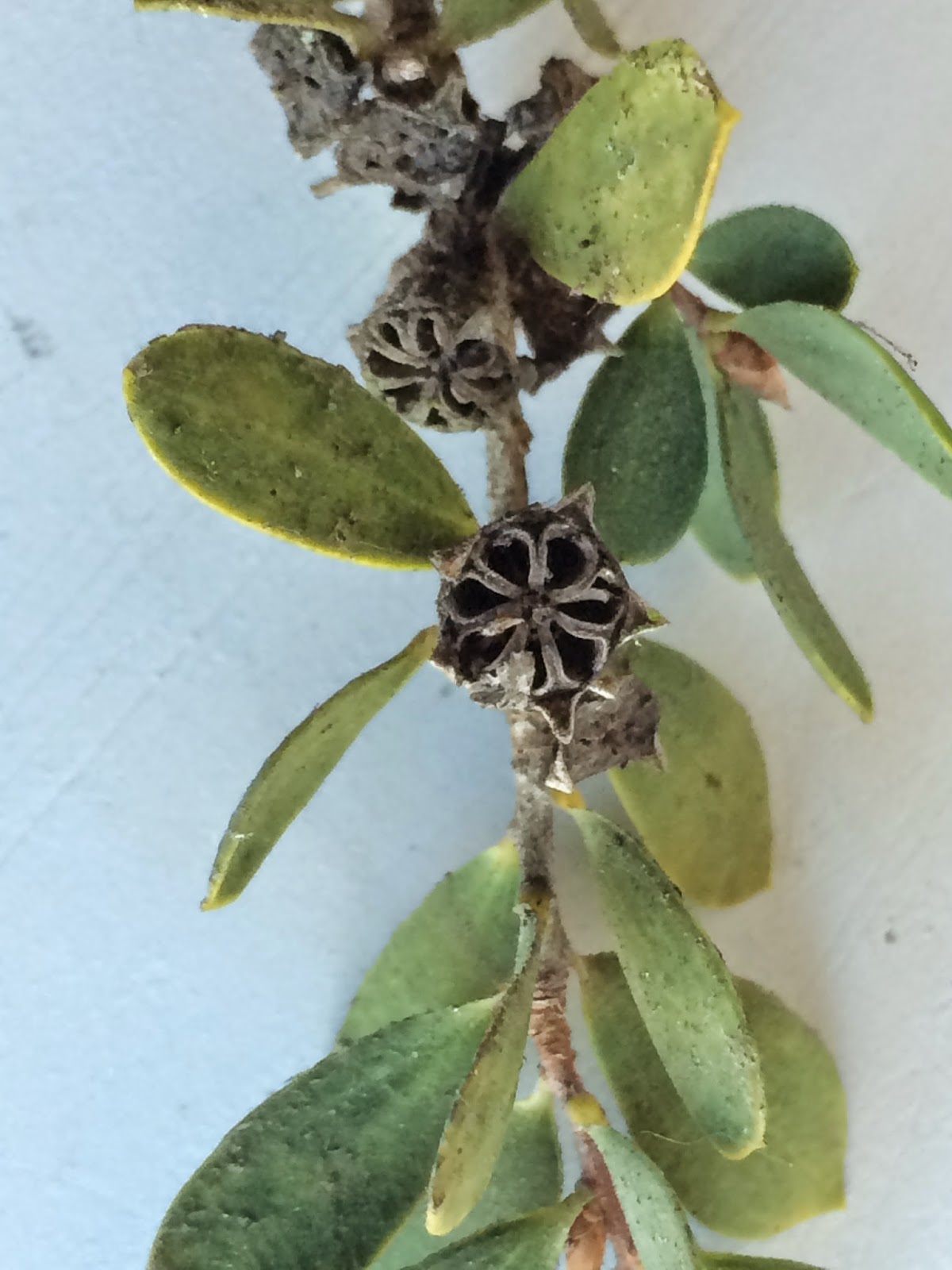
Fruit is a capsule, persistent on the stems for years.


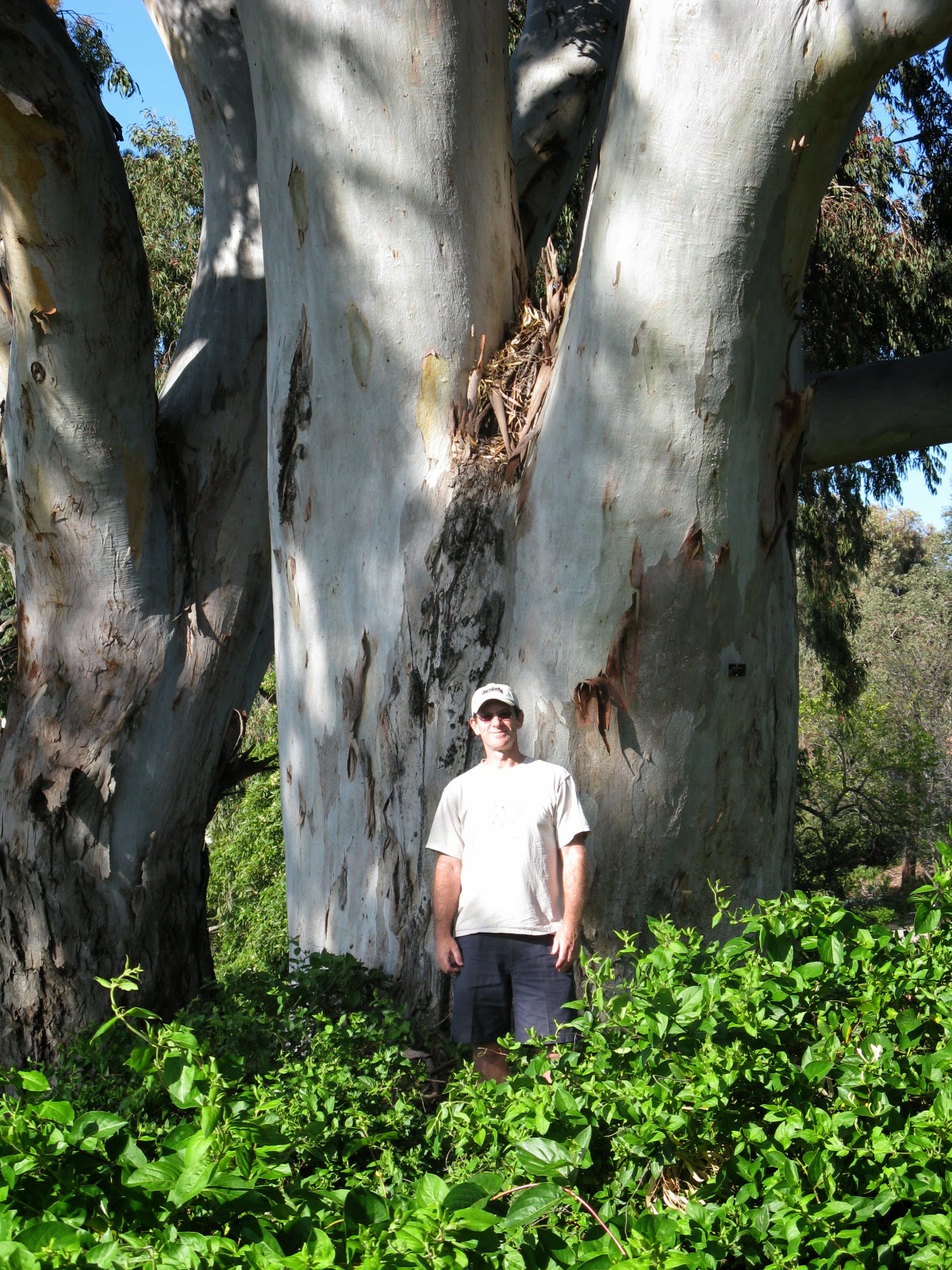
This is a shot of a tree in SF Golden Gate Park. Wonderful specimen.


Misidentification:
other tea trees I guess, the leaves are fatter.

Location:
Aptos
1037 Via Tomasol

Capitola
612 El Salto

Sunday, March 15, 2015

Luma apiculata - Chilean Luma

This beautiful small tree from Chile is known as the Chilean Luma, Orange-Bark Myrtle or the Chilean Myrtle due to its resemblance to Myrtle trees. I guess I see it, but not really. Luma grows quite large in its native forests, but in our climate I think they will likely top out at 25-30'. They form an upright slightly arching habit with multiple trunks, which is great because the bark is beautiful.

This is the clump of trees next to the fire station and the Civic. Used to be 3 trees, but one was cut down…...


Here is a single tree in SLO.


Leaves are opposite, simple, evergreen, leathery textured, dark green, 1" long, ovate, spicy fragrant with a distinct point at the tip of the leaf which is where it gets its name apiculata. Leaves are fragrant.


Flowering in the summer, in what appears to be an umbel of a dozen flowers, they are about 3/4" in diameter, white or pinkish, with four petals and lots of long stamens.


Fruit looks like a blueberry, develops late summer, Edible.


Bark is attractive, reddish - cinnamon when young and flaking off in small bits. At an older age it seems to develop patches of white.


Older tree at the SF arboretum.


Misidentification:
I think the foliage resembles Azara microphylla if you only look closely. Luma has opposite leaves and a distinct pointed tip, along with nice bark.

Location:
Santa Cruz
Center St between the Civic Auditorium and the Fire Station.

329 Lincoln St.

Friday, November 14, 2014

Eucalyptus cinerea - Argyle Apple

The Argyle Apple (?) really, what the heck does that mean, I know funny golf socks but, whats the apple? Okay, the evergreen tree grows very fast to 25-50' with a variable habit, upright oval but generally irregular with a full canopy. This one has been pruned heavily. Nice color foliage, nice bark. More common and more obvious than E. purverulenta. Also known as Silver Dollar Tree (but so is E. polyanthemum)


Juvenile leaves opposite, clasping the stem without a petiole, round to ovate, covered with wax. Intermediate taking on a narrowly ovate to lanceolate shape but still opposite.
Adult leaves alternate, simple, broadly lanceolate, 3-4" long, less than 1" wide, blue gray due to the waxy covering (glaucous).


Oddly enough, they bloom on juvenile and adult stems. Flowers in clusters of 3's, with a glaucous bloom, caps with a short point, showy bits are yellow stamens.


Fruit is a capsule, about 3/8" diameter, with a raised ring around the middle.


Bark is rough, fibrous, persistent, deeply furrowed, reddish brown


Misidentification
E pulverulenta. has very similar look but the truck sheds its bark.

Location
Aptos
1935 Dolphin Dr

Santa Cruz
209 Merced Ave - cut to 8' tall stumps, hate when that happens

132 Kenneth Dr, Nice big specimen

Monday, October 13, 2014

Eucalyptus camaldulensis - River Red Gum

The River Red gum is a massive tree, growing over 100' tall with huge trunk. Generally planted along freeways, not recommended for residential areas as it tends to shed branches in minor winds, and there is a ton of litter.


Massive tree at Cal Poly SLO.


Bluish green leaves, alternate adults, lance shape. 4-8" long,


Flowers white or yellowish, clusters of 7, about 1" diameter.

Flower buds are always key in identification of Eucalyptus and these have a very long and pointed cap.


Fruit is a capsule, smallish, less than 1/2", with valves beyond the ring.


Bark is very attractive, multicolored, white, brown, green and exfoliating.


Misidentification:
Foliage is less curved than many others, more blue green, and the bark is very much mottled.

From what I have read online there are 3 subspecies and the flower buds are not the same on two of them and the bark is also different, so its pretty foggy but my guess is we have the "normal" subspecies.

Location:
Watsonville
Highway 1 at the south bound Main St exit, between the highway and the exit
Highway 1 on the north bound entrance off Airport Rd.

Saturday, June 7, 2014

Acer capillipes - Snake Bark Maple

The snake bark maples are a really cool group of understory maples. Most are from Asia, but there is one from the east coast. Trees can reach 30 - 40' with a dense rounded crown. Often multi-stemmed with primary scaffold branches being upright and spreading. More branches = more cool bark. But young branches are the best. Not very common in our area. 


Leaves are deciduous, opposite, simple, 4" long, broadly ovate, with coarsely to finely 3-5 lobes, lobes serrated as well. Leaf veins deeply set and prominent on the lower surface. Petioles red. New leaves in spring are reddish as well.


Buds are stalked, slightly raised on a very short stem.


Flowers are small, yellowish green in long chains in early spring, blooming early March. This specimen does not produce fruit that I have seen.


Bark is awesome, but is best when young. Young stems are green with vertical streaks of white, as the stems age the white becomes more brown and slightly ridged, still nice.


Misidentification:
The snake bark maples are a tough group to differentiate from one another. Its too bad we have so few! This one is distinct due to its red petioles and lacking reddish hairs on the lower leaf surface. A. davidii has leaves that are rarely strongly lobed, usually only 3 lobes if any at all. There as several A. davidii specimens around but are not close to the street to see.

Location:
Better go see this one soon, just saw the house was for sale and you never know what people will do when they move in. Yep, gone.

Santa Cruz - Pleasure Point
3421 Yucca Dr. (Gone, too late, they saved the Liquidambars - go figure)

Tuesday, May 27, 2014

Lagerstroemia - Crape Myrtle

Lagerstroemia, commonly known as Crape myrtles, are small deciduous multi-seasonal  trees with beautiful flowers, fall color and bark. There are two species,  several hybrids and lots of cultivars. We generally see one of three colors, white, lavender and dark red. There are so many and I will not even start to guess which is which. Maybe some day I'll sort them out. So for now, they are all crape myrtles.


Foliage is deciduous, simple, opposite to subopposite, 1-1/2" to 3" long, ovate to elliptical, entire margins, often folded up on itself forming a V shape. Variable as I am including hybrids of at least two species under this generic listing. New leaves of some varieties show a reddish cast.


Flowers are pretty interesting to look at closely. The sepals form a 5 sided ball through which the petals come out with a long skinny stalk along with the stamens and single stigma.


Flowers are arranged in large 1' long panicles with tons of individual 1" flowers. Whites, reds, pinks, and lavenders are commonly seen. Blooms on new wood.


Fruit are small capsules about 3/8" diameter, brown.


Bark is beautiful, especially wet. Bark is the real selling point for me, but they do provide winter, summer and fall interest.


Fall color is about as good as it gets here in SC.


Misidentification:
bark? if you happen to see a Stewartia


Location:
Soquel
Corner of Soquel Drive and Potter

Santa Cruz
17th Ave is a great spot to see many older trees
1592 Seabright Avenue

Scotts Valley
Mt Hermen Shopping centers, the movie theater side.

Thursday, May 1, 2014

Acer triflorum - Three-flowered maple

The three-flowered maple is a great little tree rarely seen in SC county. I saw a few for sale at Hidden Gardens (Dig Gardens Aptos) at one time and came upon one recently planted in Seacliff area. Hoping it grows well and the owners appreciate a very rare tree. (Still there and growing nicely 5/25.) They grow slowly to 20' with a rounded full crown. Will keep most of the lower branches in place which will hide the nice bark.


Leaves are opposite, trifoliate, leaflets about 3" long, somewhat leathery, with red petioles.  Lateral leaflets are unevenly serrated with the outer edge serrated. Fall color is beautiful.


Stems are small, thin, twiggy, but develop exfoliating bark at a young age. Love the buds when they start to expand.


Flowers are in clusters of threes, hence the common name, small, greenish yellow and hardly noticeable.

Fruit is a winged samara that hang almost parallel to one another, about 1.25" long.

Bark is beautiful. Exfoliates in thin sheets that look more like a Heritage birch than a paperbark maple. Older bark does not peel off and turns brown with deep furrows.


Misidentification: Paper bark maple - but the bark is not deep red.

Location:
Aptos
142 Seacliff Dr.

Sunday, January 19, 2014

Cupressus forbesii - Tecate Cypress

Evergreen conifer growing 30-50' usually branching low at the base to create a wide spreading multi-stemmed tree. Mature trees tend to be wide spreading and open, while young trees are pretty full as the lower branches are still close to the older ones. Trees have a distinct upward arching of the lateral branch tips. With the renaming of the new world cypress, I think it should be Hesperocyparis forbesii.


Leaves are scale-like, very small, (1/16") light to medium green. Dried resin absent, meaning there are no little white spots on the leaves like you would see on Arizona cypress.


Branches radially around the stems creating a full branching pattern.


You can see the upright arching habit of the ends of the branches.


Cones are 1" diameter, more or less round with 4-5 pairs of scales which have a bump on the scale backs or not very obvious at all. Light brown when mature.


Bark is beautiful. Reddish brown with green and gray colors depending on the season, may get fibrous at the base of old trunks.


This is Cupressus guadalupensis in the California section of the UCSC Arboretum. Plants are much fuller, upright, bark is different as well as the foliage. Native to the Island of Guadalupe off the coast of Baja.


Misidentification:
Where do I begin? Look for the exfoliating bark, its about the best ID characteristic we have for the Cupressus like conifers here.

Location:
Aptos:
Cabrillo College by the Gym along Soquel as well as to the left of the entrance to the gym parking lot.

Scotts Valley:
Lockewood Lane across from the entrance to Oak Tree Villa. Interplanted with Monterey Cypress.

Santa Cruz:
701 High St on the Laurent side of the house
Empire Grade just past the Arboretum at the water tower.