Search This Blog

Showing posts with label capsule. Show all posts

Saturday, May 23, 2015

Eucalyptus leucoxylon - White Ironbark

The white ironbark is a beautiful evergreen tree from Australia growing 30-90' in their native habitat and depending on the botanical variety. Most are upright with spreading branches with weeping smaller branches. According to some experts, the most popular variety has red or pink flowers. Ours seem to be of the white variety, Eucalyptus leucoxylon var. connata.


Leaves are evergreen, alternate, simple, lanceolate to slightly falcate, 4-6" long, pendulous with both surfaces the same.


Flowers off white though many images show red. All stamens. Flower buds with a long pointed cap, which you can see on the lowest flower. Inflorescence with 3 flowers.


Fruit is a small urn shaped capsule, with the valves hidden below the lip.


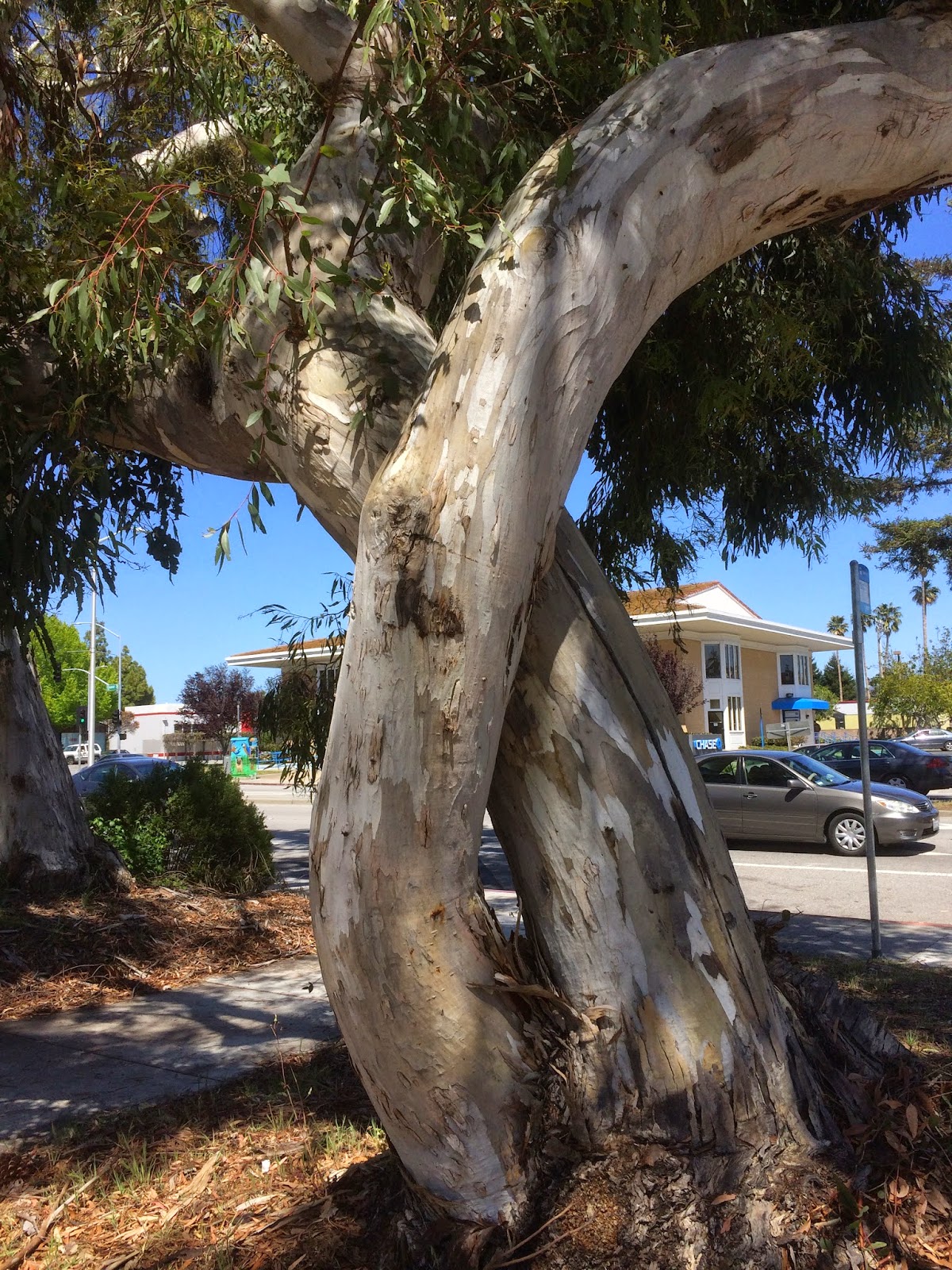
Bark is beautiful, retained near the base, but exfoliating above. Younger stems mottled.


Misidentification:
Any white flowered Euc, look at the fruit, 3 flowers per cluster and the bark on younger branches.

Location
Santa Cruz
Ocean St at the county court house, hasn't everyone been there?

Friday, November 14, 2014

Eucalyptus cinerea - Argyle Apple

The Argyle Apple (?) really, what the heck does that mean, I know funny golf socks but, whats the apple? Okay, the evergreen tree grows very fast to 25-50' with a variable habit, upright oval but generally irregular with a full canopy. This one has been pruned heavily. Nice color foliage, nice bark. More common and more obvious than E. purverulenta. Also known as Silver Dollar Tree (but so is E. polyanthemum)


Juvenile leaves opposite, clasping the stem without a petiole, round to ovate, covered with wax. Intermediate taking on a narrowly ovate to lanceolate shape but still opposite.
Adult leaves alternate, simple, broadly lanceolate, 3-4" long, less than 1" wide, blue gray due to the waxy covering (glaucous).


Oddly enough, they bloom on juvenile and adult stems. Flowers in clusters of 3's, with a glaucous bloom, caps with a short point, showy bits are yellow stamens.


Fruit is a capsule, about 3/8" diameter, with a raised ring around the middle.


Bark is rough, fibrous, persistent, deeply furrowed, reddish brown


Misidentification
E pulverulenta. has very similar look but the truck sheds its bark.

Location
Aptos
1935 Dolphin Dr

Santa Cruz
209 Merced Ave - cut to 8' tall stumps, hate when that happens

132 Kenneth Dr, Nice big specimen

Friday, January 10, 2014

Koelreuteria paniculata - Golden Raintree

The golden raintree is a nice small to medium sized deciduous summer blooming tree. Related to the larger and more commonly planted K. bipinnata it shares some of the leaf and flower characteristics. However, its a much smaller tree growing to 30 feet. Usually forms a nicely rounded, fairly compact crown. Trees have the ability to produce decent yellowish fall color.


The deciduous leaves are alternately arranged, 8-14" long,  pinnately compound. The leaflets have differing degrees of incised margins resulting in some leaflets looking/being compound. This would result in the leaf being considered bipinnate. Generally you will see the leaflets in the middle of the leaf more compound than others. 


New foliage emerges red. Nice looking in the spring.


Stems are reasonably stout, brown with some distinct lenticels. Buds are small and pointed. Stems much smoother than K. bipinnata.


The small yellow flowers (1/2") are arranged in large panicles that develop at the ends of the current seasons growth. The common name arises when the flowers all fall to the ground creating yellow rain. Can say I have seen that heavy flowering.


Fruit is a capsule, red or orange when ripening and maturing a tan color with a small black seed inside, sort of like a chinese lantern.


Bark is pretty, brown with furrows that have an orangish color.


Misidentification
Koelreuteria bipinnata is commonly confused with this one. Look at the foliage, K. bipinnata are totally bipinnate while K. paniculata is only partially so.

Location
Aptos
Deluxe Foods Parking lot

Thursday, January 19, 2012

Lophostemon confertus - Brisbane Box

Nice tree, too bad about the name. Was Tristania, now Lophostemon, yikes. Anyway as I said,  the Brisbane box is a beautiful evergreen tree, 35 - 45' x 25', moderate to fast grower. Generally narrow cone-shaped or narrowly oval but some are broadly oval to almost rounded. Too bad they are so variable, it possibly impacts selection for use as a street tree. The first picture is from Cal Poly and was called Tristania when I was there.


This one is at the Arboretum but looks like the ones on Soquel Ave just south of Chanticleer  Ave.


Leaves are evergreen, opposite, simple, 4 - 6" long, x 1 to 1-1/2" wide, elliptical to lanceolate, entire margins, leathery, dark green, lower surface lighter green. (Petioles smooth unlike madrone). New foliage has a nice red color.


Small white flowers with fringed stames. Interesting to see but not really showy in the tree. What's with the stamens on southern hemisphere plants anyway?


Small capsules, eucalyptus like, 3 sided, about 1/2" diameter.


Stems reddish brown as you can see in the above picture.

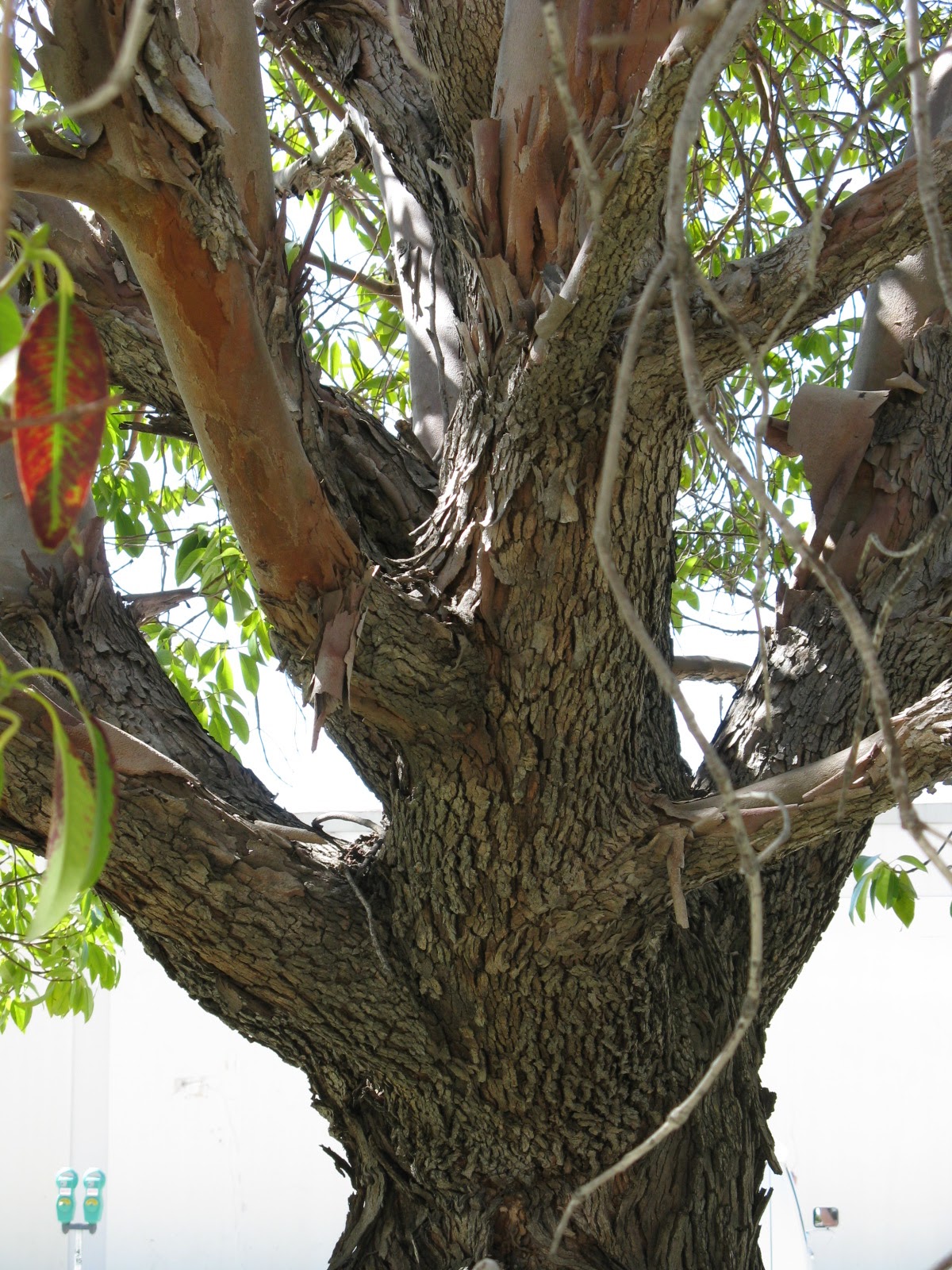
Bark smooth until later, exfoliating in paper like sheets somewhat like our native madrone. Eventually bark is gray brown in small plates.


Misidentification: Often confused with the Madrone, the Arbutus menziesii, but the young stems on the madrone are hairy usually as the madrone has fleshy fruit, the leaves are serrated on the madrone but the bark does look similar.

Location:
Soquel Ave south of Chanticleer are some decent looking specimens.
Nice row as street trees on Poppy Way in Aptos.