Search This Blog

Showing posts with label deciduous. Show all posts

Tuesday, July 28, 2026

Populus tremuloides - Quaking Aspen

I was a bit surprised to see a Quaking Aspen here in Santa Cruz. Also a bit disappointed, they are adapted to growing from one plant into hundreds. Pando, is a grove of Quaking Aspen in Utah that is considered to be one of the largest organisms on earth. The grove is one clone, connected to 47,000 trees by roots (suckering) and covers over 100 acres and is considered to be over 1000 years old. Think what it can and will do in your yard.

They are medium sized trees, 20-50' with an upright narrowish crown. Where there is one…..


Having seen many planting of Quaking Aspen in Spokane, I quickly came to the conclusion that this is a beautiful tree in the fall or windy, with rustling foliage They are very short lived. Luckily (?), but when one dies hundreds show up.


Leaves are alternate, simple, ovate to triangular, slightly crenated margins, dark green in summer, turning a beautiful gold in fall. Like many poplars, they have a flattened petiole, which causes the leaf to flutter or quake in any light breeze. (The doctrine of signatures suggested that this plant was the cure to shaking palsy.)


Trees are dioecious, male and female plants. Males in long catkins.

Stems are smooth, with a large terminal bud.


And the bark is one of the reasons people like it. Silver, smooth with dark branch collars.


And best of all is the fall color. Bright yellow to yellowish orange.


Misidentification:
Other poplars, perhaps. You are not likely to encounter P. tremula in SC but if you are reading this from colder climates you might encounter a columnar form.

Location:
Capitola 
301 Fanmar. Pretty sad looking specimen. 

Malus ioensis ‘Klehm’s Improved Bechtel’ - Bechtel Crabapple

I like this late blooming crabapple with beautiful pink double flowers. The trees are small to medium sized 15-20' with a rounded and dense canopy. It's a pretty old-school tree but easily identified by the large flowers.


Leaves are deciduous, simple, alternate, ovate shaped, 2" long with slightly serrated margins mostly near the tip of the leaf. The trees are susceptible to several fungal diseases and this one gets black spot yearly.


Flowers are large, double, pink, and fragrant. Did I say they were late? Compared to most of the other crabapples that bloom early here (before the cherries) this one blooms late Mid to June.


Fruit is pretty non existent, if any show up they are pink to green and a little over an inch in diameter.


Another name - Malus coronaria ssp. ioensis 'Bechtel' 

Misidentification: Almost any crabapple not in bloom. 

Location
Aptos 309 Martin Dr.

Tuesday, December 10, 2024

Acer x fremanii 'Jeffersred' - Autumn Blaze®

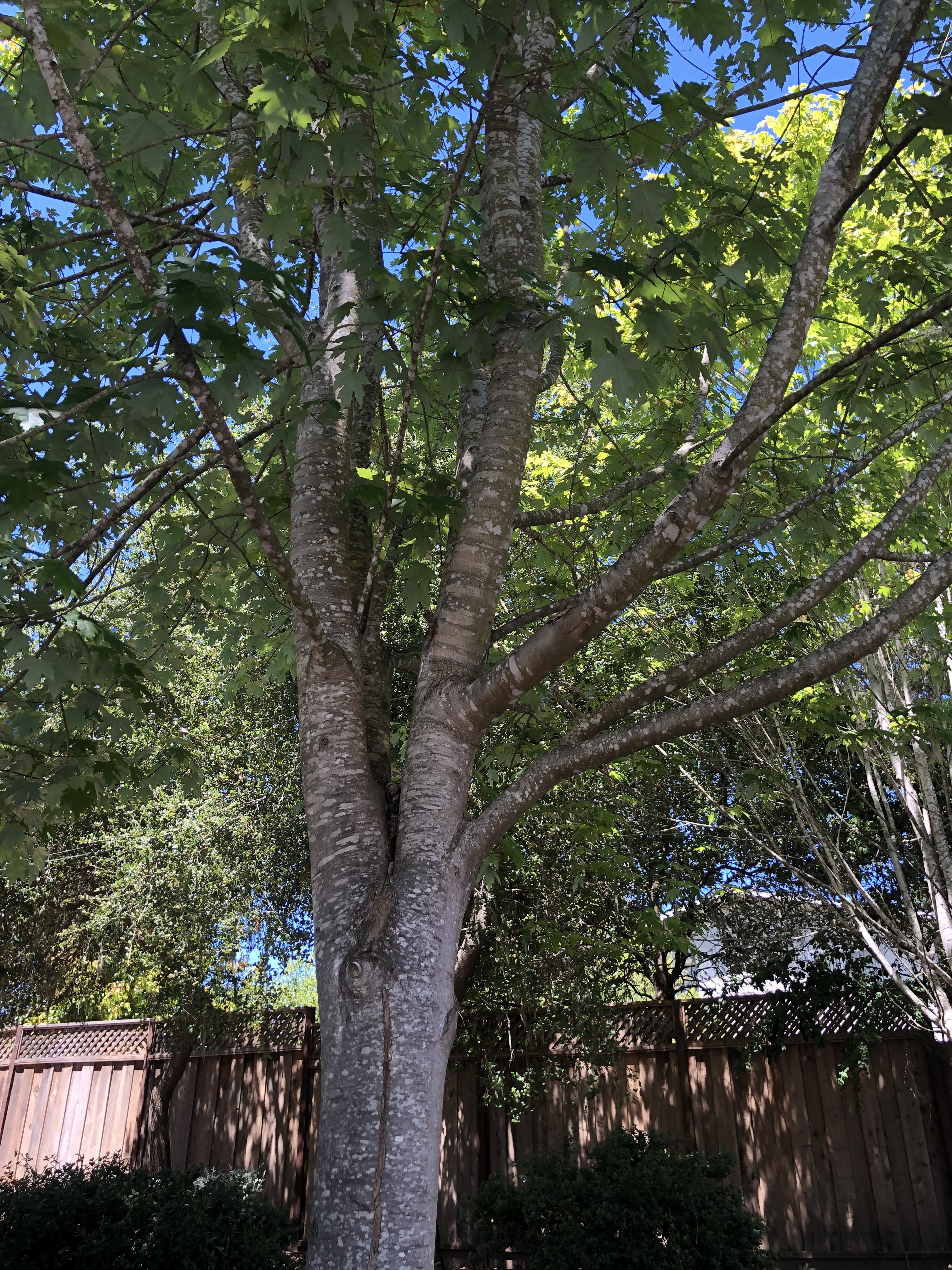
The hybrids between the red (A. rubrum) and the silver A. saccharinum) have been around for a long time but they are not very common in our area. The two species overlap in their natural habitats so the hybridization has been occurring naturally as well as controlled hybridizing. The red maple parents provide the fall color and the "better" branching structure while the silver maple parents provide the leaf shape and fast rate of growth and perhaps tolerance to adverse conditions. There are a handful of cultivars. This particular cultivar grows into an upright oval shaped form to 60'. The Autumn Blaze® is the trademarked name but used interchangeably with the common name.

This image is really 3 trees in a row so they look a little wider than a single tree.


Fall color is one of the reasons people plant these trees.


Leaves are opposite, simple, 6-8" long and almost as wide. The leaves look more like the silver maple leaf than a red maple leaf. The lower surface is white like the silver maple.


The branch structure needs work when young or you end up with several co-dominate leaders. I mentioned better structure, but they usually end up with co-dominate leaders that result in splitting the trunk.


Oregon State University Horticulture department page and a nice writeup on these and red maple cultivars. They have been given various names, sometimes as a red maple cultivar or as a hybrid. 

This image was published by The Journal of Aboriculture years ago showing this cultivar listed as a red maple cultivar.


Misidentification: Silver maple most likely. The leaves look more Silver but the Silver leaves have a deeper dissection. Silver Maple

Location
Aptos 
404 Townsend Dr.
407 Ewell Ave.

Saturday, October 7, 2017

Acer palmatum dissectum 'Seiryu' - Seiryu Japanese Maple

The Japanese maple cultivar 'Seiryu' is considered the only upright growing dissected maple available although my guess with such variety in the species there are others. Growing to about 15' they are usually a bit more open than the one shown below, which has been pruned over the years. These are fast growing maples with great dissected leaves and nice fall color.


Leaves are opposite and maple like though deeply dissected and each lobe is deeply serrated. Medium to light green in color, about 2" long. Fall color is nice gold though you might see some red depending on the site and the environment.


Flowers and fruit identical to other Japanese maples.

Misidentification: Doubt it.

Location:
Aptos
524 Humes, just recently planted.
505 Encino Dr and 2 great trees.


Seacliff
421 Hillcrest Dr. See above, pruned into a ball but still nice.

Sunday, July 2, 2017

x Chiranthodendron lenzii

I can't tell you how many times I must have driven past this tree and not seen it. Then, a few days ago there is was in full bloom standing up against a larger magnolia that must have caught my eye.

This is a man made hybrid between the Mexican hand tree and a California native.
Chiranthodendron pentadactylon x Fremontodendron 'Pacific Sunset'. Sometimes called x Chiranthofremontia lenzii and I recall a citation that the whole group might be one species. There is not a lot of information on these trees and I think I have only seen 3-4 of them in person. I think the more common name is the Hybrid Monkey Hand Tree.

Evergreen tree growing 30+ feet tall upright branching, sort of pyramidal to columnar with stiff branches. Lower branches flattening out, which is nice because the flowers sit on the tops of the stems.


Foliage is attractive, resembling its parents, alternately arranged, simple, 4-5" long and wide, palmately lobed with 3-5 lobes, dark green glossy leathery upper surface and a whitish bronze below due to all the hairs on the surface.


Stems are also covered with hairs, at least when young. The oldest specimen I have seen shows smooth bark.


Flowers are really pretty cool looking. Borne on the upper surface of the stems, they are a yellowish orange color on the outside and more orange inside. The monkey paw part of the flower is the 5 stamens and are golden colored rather than red like one of its parents. You can see the stigma pointing to 11 o'clock.


Flowers with the stamens still closed.


Flower bud.


Flowers are often found along the tops of the branches.


Misidentification:
Likely to think its a Fremontidendron but the flowers are different, these flowers have red/orange inside and not yellow like our native tree.

Chiranthodendron pentadactylon has red stamens.


Location:
Corralitos
2957 Freedom Blvd

Santa Cruz
Arboretum, past the small nursery growing area.

Thursday, August 13, 2015

Carya illinoinensis - Pecan

The pecan is an unusual tree in our area. Looking very much like a walnut, its easily misidentified as such. The pecans are large deciduous trees, 50+ tall and wide, with a large rounded crown, and several main scaffold branches. One on Laurel and this one in SLO. Our's in Santa Cruz has been removed.


Here is ours on Laurel. (Cut back but coming back.)


Foliage is alternate, pinnately compound, 12-18" long with 9-15 elliptical to lanceolate, serrated leaflets, dark green. Leaflets have an unequal base.


Flowers are male catkins, yellowish green, pendulous, female back some distance, small.


Fruit is large, 1-1/2" long, oblong, brown, thin shelled, dry drupe, usually in clusters of three.


Bark is thin when young, becoming fissured with age. Brown, mostly.


Twigs stout, thick, pubescent in the spring, large leaf scars, pointed buds, terminal large, and pubescent. Superposed bud (one bud on top of another, usually a flower bud, with the vegetative bud being the smaller one).


Misidentification
Black walnuts. Look at the fruit if possible, and the lateral buds are rounded on the walnut, pointed on these.

Location
Santa Cruz
302 Laurel Ave (removed) But trying to make a comeback

Corralitos
1800 Hamas Rd.

Tuesday, August 4, 2015

Erythrina crista-galli - Cockspur Coral Tree

The Cockspur Coral Tree is a small deciduous tree with an umbrella shaped canopy reaching 15-20' in Santa Cruz, but you may find them smaller than that. The most obvious one in town is at city hall. Not a great specimen, was not sure why, but I looked at google street view history and the space was dominated by a Hollywood Juniper and this tree was being crowded out. When in full bloom it looks pretty nice. Waiting for the fall color… supposed to be yellow….


Leaves are deciduous, alternate, trifoliate, leaflets narrowly elliptical 3-5" long, margins slightly less than smooth, and spines on the lower portion of the main veins. Distinct swollen area at the base of the petiole, the pulvinus.


Flowers in the spring occasionally in summer and into fall, fragrant, showy bright red or pinkish-red, in long drooping panicles. Individual flowers are "pea-like" with a distinct elongated lower petal shaped like the keel of a boat. This is taken in December, winter here, but you can see the elongated lower petal. Looks like thrip damage maybe.


These are the flowers about to open.


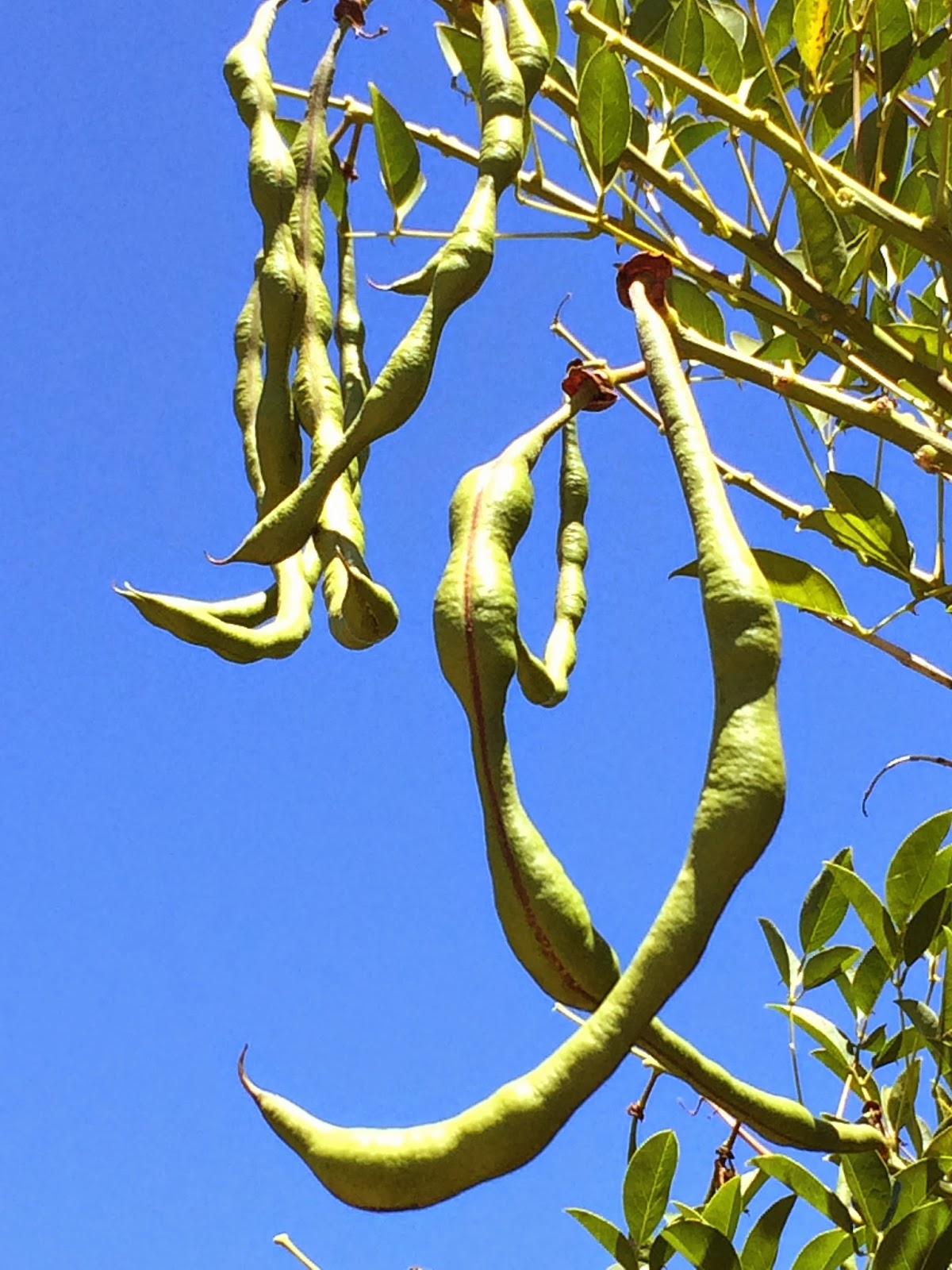
Fruit is a brown pod, with constrictions between the seeds. Ripening in the fall. This is summer. You can see the constrictions.


Interesting seeds if you take the time to look at them.


Stems are green, stout, with nasty prickles. You can even see the tell tale pulvinus on the petiole of the leaf.


Bark is usually attractive, potentially deeply furrowed.


Tree is also known as the Coral Tree, Crybabytree, Christ's Tears.

Misidentification:
Erythrina caffra, around here anyway, if you are in a more tropical area you are likely to become very confused. These have narrower elliptical leaflets and are smaller trees.

Location:
Aptos
Cabrillo College Hort Department has one in back garden area, its low growing.

Santa Cruz
City Hall along Center St.

114 Myrtle St.

Friday, July 31, 2015

Elaeaganus umbellata - Autumn Olive

I encountered a specimen of the Autumn Olive (Japanese Silverberry) while looking at some ash trees and thought, wow, who would have planted that? I am very familiar with the Russian Olive, Elaeagnus angustifolia, and its weedy weak wooded habits, but not with this tree. So a little digging and the only reason someone might have planted it could have been the fruit, tiny as they are, contain significantly more lycopene than tomatoes. The plant roots are colonized by a nitrogen fixing bacteria. They are also considered noxious weeds. A deciduous small tree or large shrub, they are more or less rounded.


Leaves are deciduous, alternate, simple, narrowly lanceolate to elliptical, 1-4" long, with somewhat undulated margins. In the spring they are covered with silver scales. The scales fall off the top of the leaf by summer but remain on the lower surface.


Flowers have a long tubular calyx that spreads at the tips and are often described as bell-shaped start shaped with four white sepals, about 1" long, fragrant, opening in the spring, in the axils of the leaves singularly or in groups.


Fruit is a small red berry-like drupe (?), with silver specks. Plants produce lot of them in the summer ripening in fall.


Young stems also completely covered with silver scales when young, becoming reddish brown by years end. Buds are also silver. Trunk is reddish brown and smooth, later becoming furrowed and peeling.


Misidentification:
My first thought when seeing this specimen was the Russian Olive but the fruit looks different.

Location
Aptos
300 Poppy Way

Sunday, July 26, 2015

Ulmus procera - English Elm

The English Elm, sometimes called the English Cork Elm, is a large deciduous tree growing over 100' in it's native habitat, but more likely 60' in cultivation. The trees form a somewhat narrow crown with several large primary scaffold branches growing upward and then out. Fast growing, somewhat weedy, spreading by underground suckers, the trees show up in lots of places in large quantities. We have a "grove" of them on the campus in a ravine just north of the campus. The name could also be U. minor var. suberosa.


Leaves are deciduous, alternate, simple, 2-4" long, about half as wide, elliptical - ovate shaped, double serrated margins, upper surface quite scruffy (stiff hairs, scabrous) with the lower being slightly so as well as having lots of pubescences in the axils of the veins. Marginal yellow fall color.


Stems generally slender, zigzagging, light brown or slightly reddish.  May have lots of irregular corky growth. Not symmetrical like others like the U. alata which had 2 distinct rows of cork.


Flowers before leafing out in early spring, flowers reddish color.

Fruit is a rounded samara, about 1/2" diameter, papery when dry, seed in the middle of the fruit, tip of the samara lightly notched.


Bark is deeply ridged.


Misidentification:
Look for the seriously scabrous upper leaf surface, as well as the pubescent lower and the leaf size. Fruit is always helpful identifying elms.

Location:
Atpos
Cabrillo college, in the ravine north of the Sesnon House.
6900 block of Freedom Blvd.

Santa Cruz
Cedar St in the parking lot of the Calvary Episcopal Church - May be dead and removed soon.

7th Ave and Eaton St. on the 7th side of the house.