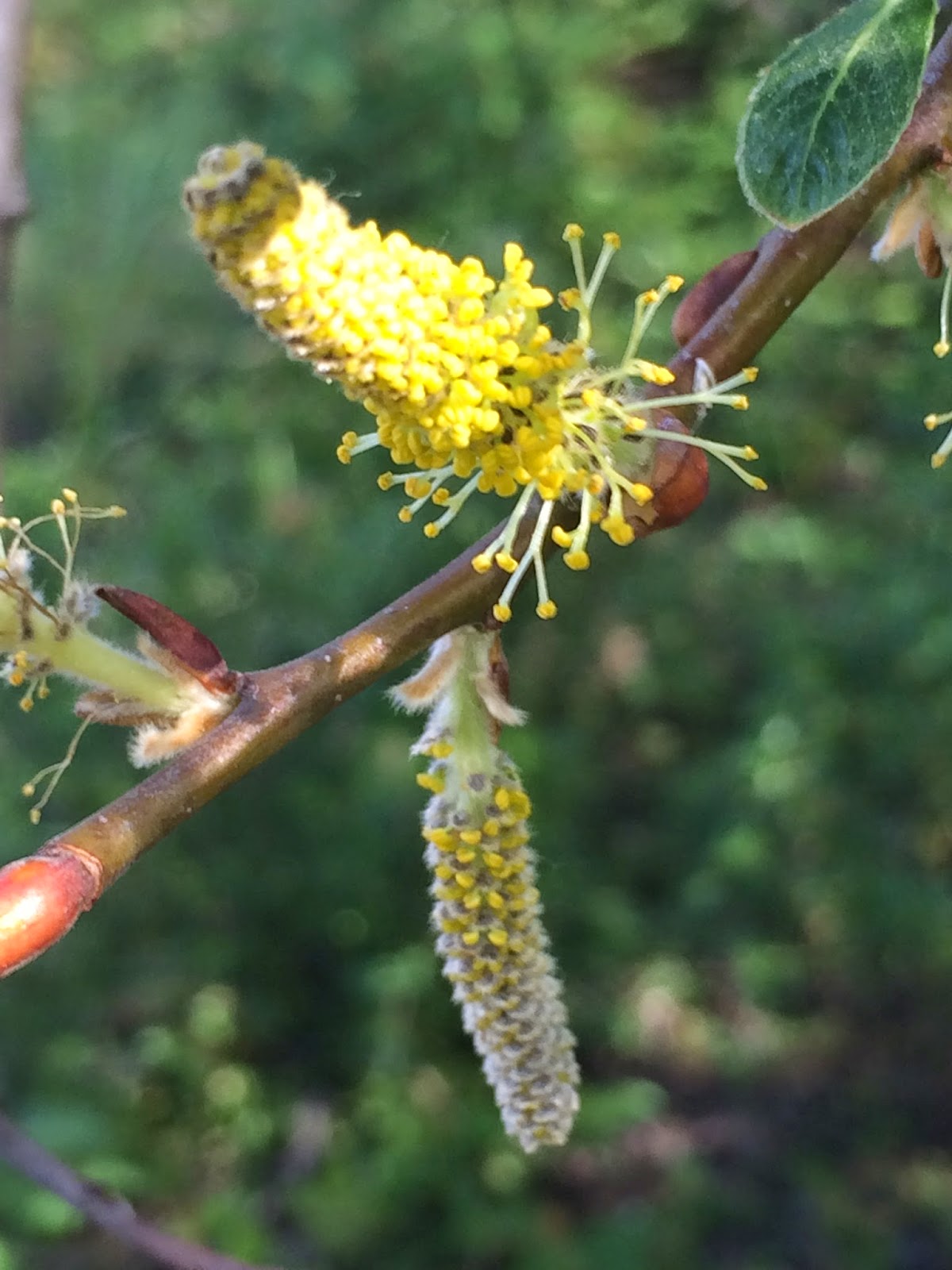
The Carob Tree is a medium evergreen tree growing to 25-30' here, (much larger in warmer areas) with a broad dense canopy. Interesting female plants that produce a fruit that can be used as a cocoa substitute. Though most of the trees I see are males.
Leaves are alternate, even pinnately compound, with 6-10 broadly oval leaflets. Individual leaflets are 1 - 2.5" long, dark green to bluish green and glossy with coarsely undulated margins. Like many legume members the base of the petiole is swollen.
This is a cultivar called 'Cal Poly', not sure its origin of if anyone grows it but I like the blue foliage.
Stems are reddish brown, lightly lenticeled and have a waxy covering. You can see the swollen base of the petiole, typical for legume family.
Flowers in the spring from spurs. Males and females separate plants but could be on one plant. This is an inflorescence of males. Males have an odd less than desirable smell.
Here is a close up of female flowers.
And here is an hermaphrodite. You can see the female at the free end and the male pollen sacs at the attached end (top of picture)
Large spurs on the stems from where the flowers come out each year. Pretty odd looking.
Fruit is a 5-12" long light to dark brown flattened pod containing 10+ flattened seeds. When ripe the seeds are free inside the fruit and rattle when shaken that are glossy. When dried and ground up they are a substitute for cocoa.
The trunks can be really cool with age. This one is downtown Palo Alto.
Misidentification:
Other pinnately compound leaved plants. Carrotwood maybe, with fewer leaflets.
Location:
Capitola
41st Ave divider near Safeway and Soquel Drive
Santa Cruz
104 Kalkar Dr.
Corner of Chestnut St. and Union St. Two males and one female.
Seabright Ave, near the Clinton cross street