Search This Blog

Wednesday, May 22, 2013

Photinia serratifolia - Chinese Photinia

The chinese photinia is a small evergreen tree with beautiful flowers. Grows to less than 25' with a nice compact dense rounded habit. Not to be confused with the red photinia. Gets a lot of bad press as an invasive in the south. The few that I have seen around here all look very nice year round.


Foliage is alternate, simple, obovate to oblong with very finely serrated margins and leathery in texture, as well as shiny.  


In the early spring you will find some leaves turning red, ahhh fall color.


New foliage in the spring is very much lighter green.


Flower clusters are large, maybe 8" across and can cover the entire plant. Individual flowers are small, white with 5 petals.


Fruit is a small red berry.


Stems thinnish, green with red tinges, eventually turning brown.


Misidentification
Other photinias, especially P. x fraserii, early spring they have very red new leaves.

Location
Aptos
433 Ewell Ave as seen in the picture at the top
5489 Soquel Drive a pair flanking the driveways of the duplex

Pinus patula - Mexican Weeping Pine

There was a quote about a pettable tree earlier but this one is beyond pettable. The Mexican Weeping Pine tree is so soft when young it is one you just want to have in your yard so you can rub up against it. I cant remember the first one I saw, may have been this one below at Kew Gardens but I fell in love with them and still feel the same.


Most commonly seen in our area as a small to medium evergreen tree with a rounded crown, growing to maybe 35' by 30 wide. Primary lateral branches are low and tend to be ascending with the secondary and smaller being weepy. 

The oldest/largest one I have encountered can be seen from Green Valley Road just east of the Kralj Dr. intersection. Gone.(Hard to photograph).  This one below (actually 2 in the picture) is over the hill.


Leaves are in clusters of 3-4 (5) long 6-9", and slender, light green to yellowish green. They tend to be in two rows on either side of the stem which arches slightly at the tip. Lasting only 2-3 years on the stems. Stems have a whitish bloom when young.


Medium aged trunks are beautiful. Reddish brown with some yellow, slightly flaking off in bits. 


Cones are a yellowish-chestnut brown color, 2-4" long, elongated egg-shaped with a short stalk holding on the stem. Growing in clusters, rarely alone. Scale tips are pretty smooth without a distinct raised area or prickle.


Misidentification
Any other weeping pine. Look for 3-4 needles, a reddish bark and smaller cones. Many other weeping pines are white pines with 5 needles.

Location
Watsonville, Not exactly sure where its home is, only looked at it from Green Valley but it looks like it could be in the back of the Trinity School on Lawrence or just in a vacant lot along Kralj. (Gone.)

Capitola
502 El Salto Ave. not in great shape but large. (Gone.)

Santa Cruz (Pleasure Point)
339 Anchorage is a nice larger one

Aptos
386 Baltusrol Dr.(Gone)


Wednesday, May 15, 2013

Acacia cognatum - River Wattle

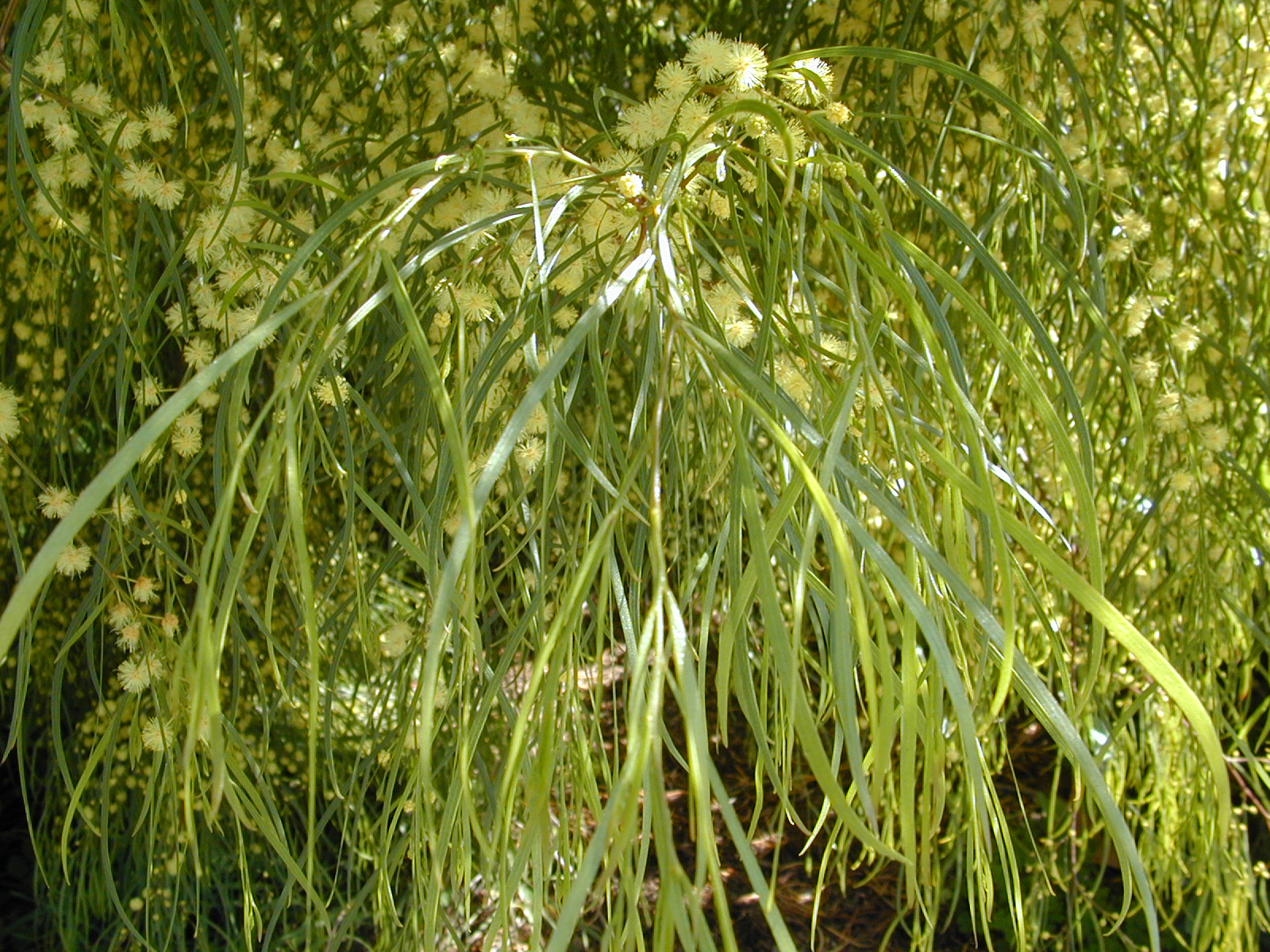
The first time I came across this beautiful tree I was blown away with its soft texture and form. I have grown to like it more and more over time, however like many acacias it might not be long lived. The river wattle is fast-growing, lacy, smallish evergreen tree, 20-30' tall by 20-30' wide. Very attractive graceful tree or shrub with weeping branches.


The leaves evergreen, linear shaped, sort of curved (sickle-shaped), 1 1/2" long, less than an 1/8" wide light green color. Leaves are really phyllodes (modified petioles), take a look at the veination pattern which is typical of most all these acacias. 


Small light yellow flowers appear clusters in pairs along the stems in spring.


Small thin pods, look like brown versions of the leaves with small constrictions around the few seeds inside. Have not seen them.

Thin wispy stems, light brown with very small green to brown rounded buds.


Misidentification:
Acacia boormanii maybe, which is not really soft and weepy but more upright, and shorter leaves. You can see both side by side at 3536 Flora Drive (Both are gone)

Location: 
Capitola
Depot Hill, corner of Central and Escalona. You can see if from Monterey Ave intersection leading into Depot Hill.

Pinus wallichiana - Himalayan Pine

I love weeping pine trees, especially large ones. I first saw a few of these in Spokane and then encountered lots in the UK. And, lucky for me I see this one everyday driving home. Its not really as weepy as you might think but the leaves are very droopy on the stems. Works for me. You might actually find the cultivar 'Zebrina' which is variegated and more popular though I have not seen one planted as of yet.

"If any tree could be described as pettable, it would have to be the Himalayan pine" Nancy Rose (arnold arboretum)

The Himalayan (white or blue) pine is medium sized pine growing to about 35-40' with a spread of about 25' (much larger in its native habitat). This one is growing next to a larger acacia.


Leaves are needle like, in clusters of 5, each about 8" long. Thin, and eventually pendulous on the stems. Sheath is deciduous as is true of most white pines.


Male reproductive structures on lower stems.


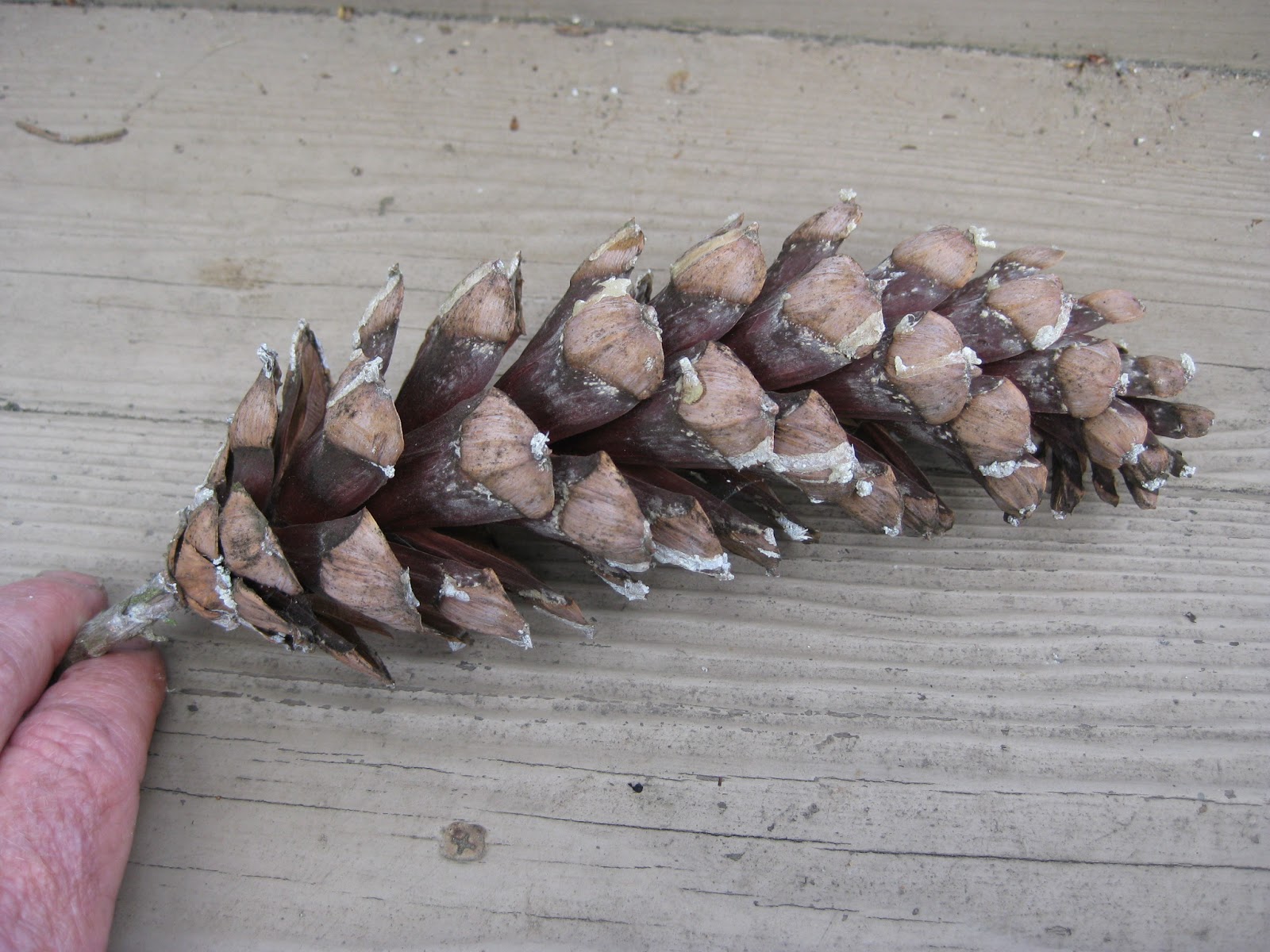
Cones are typical of white pines, 6-8"  long however they may get to 12" long. Light tan when mature. While they are growing they are long and slender and green.


In the picture above you can see open mature cones and to the left you can see next years cone.


Misidentification
Other 5 needle pines, especially white pines. But we dont have many white pines here, lucky you. Can't say I have seen any western white pines and only a few eastern white pines.

Pinus patula maybe. Cones are much smaller, the leaves are in 3's and even more pettable (weeping).

Location
Aptos
311 Clubhouse Drive

Acer saccharinum - Silver Maple

The silver maple is a fairly common large shade tree in our county, especially in older areas of town. You might think it's our native maple due to the leaves but they are not really that close. As far as I can guess its common name comes from the silvery lower leaf surface.

This is a fast growing larger tree, maybe to 45-50 feet here but over 75' elsewhere. It has upright and spreading branches making it the ideal street tree shape except it has weak wood and likes to lift the sidewalks and streets. It likes wet soils, likes septic systems, and may be a tree to plant where nothing else will grow.

This species is native to the central states and has a native range that overlaps with A. rubrum which has resulted in many hybrids in commerce. (Hybrids are named A. x freemanii.)

This image is located in the PNW and shows the size as well as the nice yellow fall color.


These two trees are in front of Native Revival Nursery. (no longer in business)


Leaves are opposite, 5 lobed, 3-6" with very deeply acuminate lobes. The center lobe is often strongly 3 lobed but all the lobes are toothed. Leaves medium green color and silverish beneath (waxy bloom). Maple people like to point out the angle formed by the lobes. Its called the sinus. The sinus is angled at about 45 degrees (see our native maple which have rounded sinuses in the image at the bottom.)


Flowers are produced very early in the season. They are orangish and can be pretty showy. Male and female flowers on same tree (monoecious).


Fruit is a winged pair of samaras, wings spreading to about 90 degrees. They dry a light brown color and generally are not of equal size.


Trunk is thick, smooth gray when young developing shallow fissures showing a light orangish color.


Misidentification:
Perhaps several other maples. The native big leaf maple has larger leaves but the lobes have less teeth on them and the silver maple has distinct white on the lower surface.


There are many hybrids with the red maples and many of the true hybrids look more silver than red and can be hard to identify, but the flowers of most hybrids and reds seems to be red while these tend to be more yellow red.

Locations:
Aptos
Mar Vista Ave in front of Native Revival Nursery. (Image of the deciduous trees above are in front of the nursery.

Soquel
At the Persimmon house, on the corner of Main St and Soquel Drive, 3010 N. Main St.

2800 Chanticleer across from Mission Tile

Aesculus x carnea - Red Horse Chestnut

The red horse chestnut is a beautiful late spring blooming tree (late April early May). They are medium sized trees with a rounded crown and spreading branches. Generally 25-35' tall with the same spread. The trees are deciduous and a bit messy with flower parts and big leaves falling all over the ground.

This plant is a hybrid, between the large A. hippocastanum and a smaller red flowering buckeye (horse chestnut) A. pavia. You may be looking at the cultivar 'Briotii' which is  generally the form available in the industry however, larger ones in our area all seem to have the lighter pink colored flowers.

Buckeyes and horse chestnuts are in the same genus. Not sure why the different names, but I guess "The" Ohio State University didn't want to be known as the Ohio State horse chestnuts.

The picture below is located on Opal Cliff.


This one is worth looking at just because of the garden and the view. At the end of Oakland Ave. on Depot hill overlooking the ocean.


Foliage is arranged oppositely on the stems and is palmately compound. Leaves are a medium to dark green, and about 8". Generally with 5 ovate to oblong leaflets. The leaflets look more quilted (not a botanical term but the veins seem to be more deeply set in the leaf) than the other horse chestnuts. 


They look really cool unfolding. Young leaves covered with coppery colored hairs.


Stems are stout as are the main laterals off the trunk giving it a nice course texture in winter. Terminal bud is large but not sticky like A. hippocastanum. Young stems are green and often have copper stuff on them from the buds,


Beautiful pink or red flowers in an upright panicle. The cultivar 'Briotii' has larger and dark red flowers as seen in the first image, while the species is second.


Fruits are fun. The seeds are contained in a green fleshy husk with prickles. It was a 3 seeded capsule but only one seed matures. Seeds are the classic sling shot projectile, glossy browns and patterned. Seems that the fruit can be either smooth or prickled. These individual fruits didn't produce any seeds, but you can see the overall shape and surface.


Here are the seeds from a fruit that has a smooth husk.


Trunks are large with smooth bark for years, eventually developing small fissures and often have rounded plates.


Misidentification:
Other horse chestnuts without flowers. These are pink or red, and is a smaller tree with smaller leaves than those of A. hippocastanum, and the terminal leaflet is not obovate. Additionally, the terminal bud is not sticky.

Locations
Capitola
621 Gilroy Dr. ('Briotii')
308 Grand (at the ocean end of Oakland Ave.)

Santa Cruz
4410 Opal Cliff Drive
Broadway near Ocean
221 Windham St is a beauty

Corralitos 
Aldridge Lane County Park has a couple of very nice trees.

Edited 5/24

Dead Trees

I think I will start this post with my all time favorite dead tree.


Its located on the top of KT22 at Squaw Valley. Just in case you were not sure it was dead, they posted it as such........


Sequoia National Forest


Plumas County… Twisted wood from unknown conifer.


Dead juniper (I think) at Smith Rocks Oregon.


Another one from Tahoe


Acer macrophyllum - Bigleaf Maple

The bigleaf maple is a common riparian tree seen in most stream beds in the county. It's native range includes most of the pacific coast from south of Santa Cruz up to British Columbia. In Maple Valley Washington they have a big leaf contest, and some of the leaves are really huge, like up to 24" across.

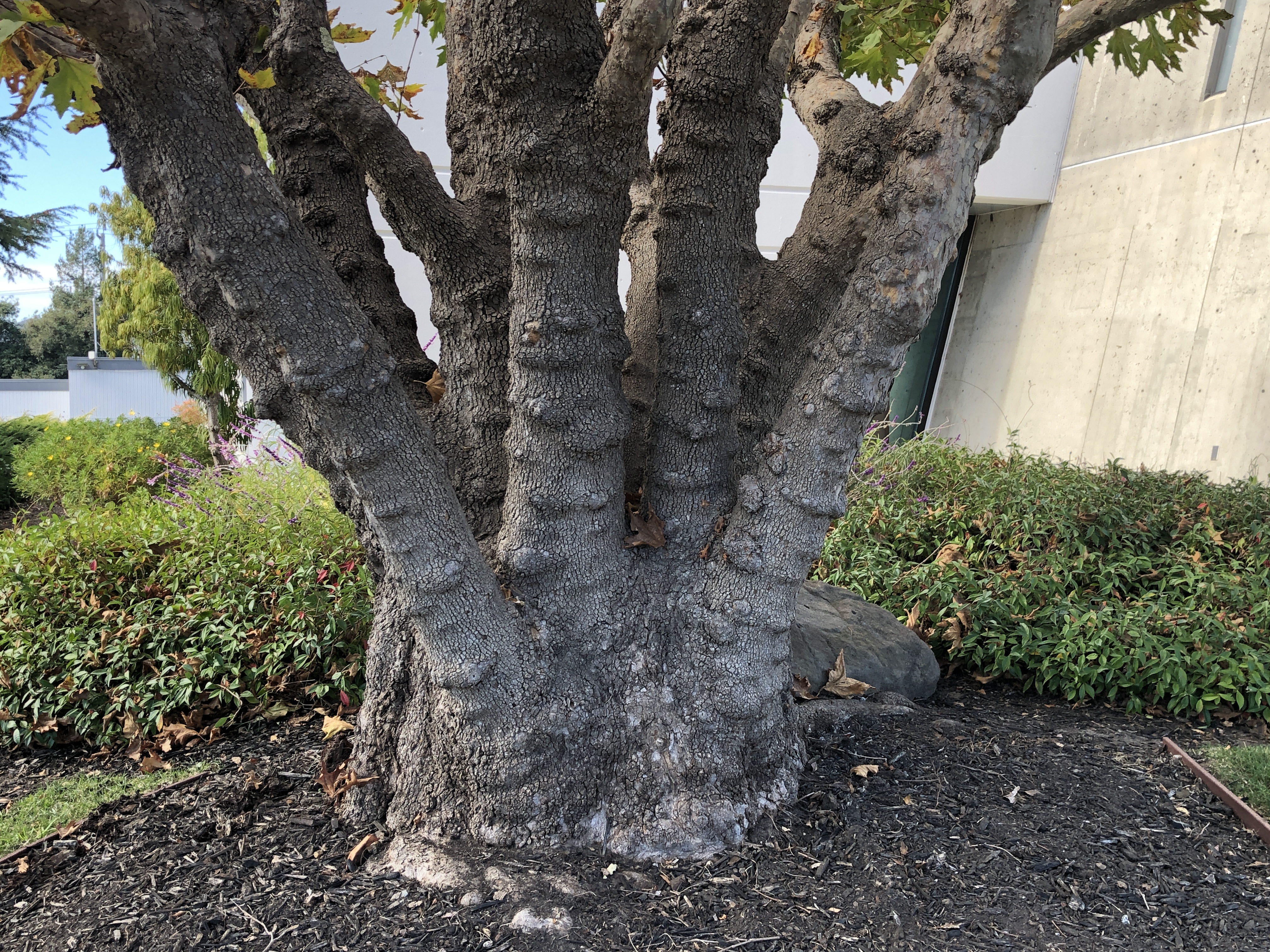
This is a medium to large deciduous tree, 30-100 (but generally about 50 around here) feet tall and about half as wide as tall, forming an upright oval shape. Generally multiple trunks. Very fast growing. Fall color can be yellow in areas getting frost. 
 
 My favorite Bigleaf maple, in Portland, formerly pollarded and eventually left to grow.


Leaves are deciduous, opposite, simple, palmately lobed with 3 or 5 lobes. Leaves are variable in size, maybe 5-18" long and almost as wide. They will not get that large here. Dark green above and slightly pubescent,  pale green below. Lobes are very deep, each with several teeth but more or less entire otherwise. Very long petioles, 4-6" long. In spring the foliage can be various shades of purple when emerging from the buds. White milky sap from the petiole or stem.


This is an uncommon leaf shape in our area.


It's somewhat interesting to note that some of the plants have leaves that emerge purple and then fade to green. This is also seen in A. platanoides and resulted in a cultivar named 'Schwedleri'. Eventually someone found a purple one that lasted all summer. I am surprised that has not happened with this species. Okay, so it has, there is a cultivar called 'Mocha Rose' introduced from non other that Bucholtz and Bucholtz Nursery (one of my all time favorites). Here is a great link to a blog post on this cultivar and species by Talon B himself Article on species and cultivars. You should look at his photographs, wow.

(There's a cultivar called Seattle Sentinel' that is columnar and might be worth having around here.)


Flowers (seen above) are quite showy in the early spring. Staminate (male) and perfect flowers in drooping clusters, up to 10" long. Flowers are slightly fragrant, 1/4" diameter and yellow. 


Fruit is typical of maples, with the samaras arranged in pairs. Samaras about 2" long, wings at about 90 degrees or less. Samaras arranged in long drooping clusters up to 10" long. Light tan colored and covered with yellow or brown hairs except on the wings which are glabrous.


Stout twigs, green to reddish colored, large buds with hair on the margins. Notice the white sap coming out of the stem by the bud, one of several maples that have this.


Trunks lightly checked, mostly silver gray for many years.


Fall color is a nice yellow if we have a good year, sometimes our weather does not lead to great colors. First image is in Nicene Marks State Park, the second one in the Pacific Northwest.


Misidentification:
You might think its a London Plane but the LP has alternate leaves, or you might think its a Silver Maple, Acer saccharium. The silver maple gets its name from the silver undersides of the leaves so look for that, as well as the leaves. The silver maple leaves are smaller, the lobes are more deeply incised and have more minor teeth on them than our native.


Silver on the left - Big leaf on the right


Location:
Any riparian area. Along Hecker Pass going over to Gilroy.
Highway 1 and 41st ave in the clover leaf by Home Depot and the opposite side.

Aptos
Loma Prieta 736 or close. There is one on the other side of the street as well.
Aptos creek road, up the road a bit, near the steel bridge are some nice ones.

Capitola
Along Park Drive nearing the beach, on the railroad side of the street.
506 El Salto on Depot Hill