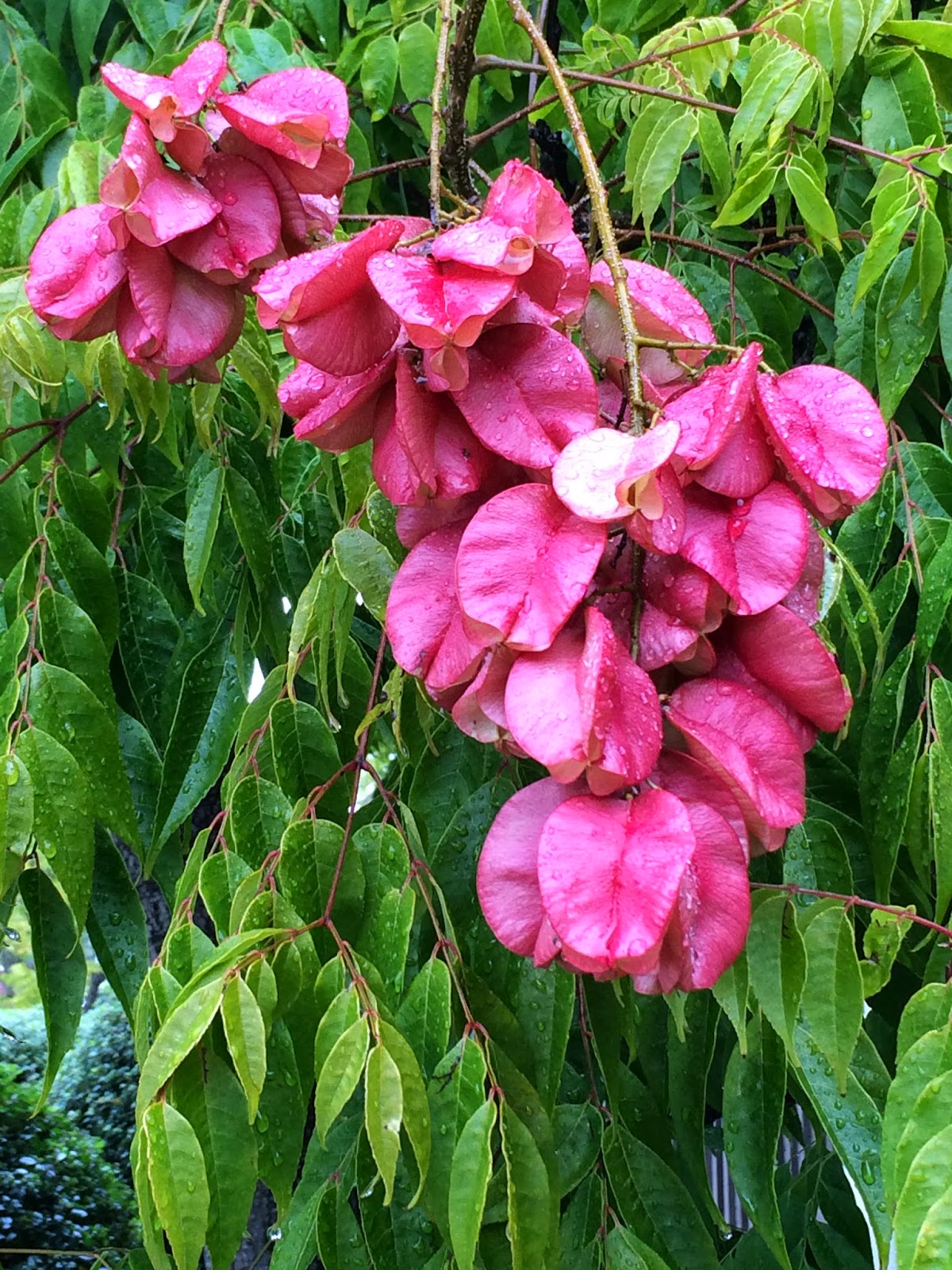
The Chinaberry tree is a small to medium deciduous tree with an upright to spreading crown hitting 20 - 40'. Grown for its beautiful fruit and interesting flowers. Considered a weed in its native Australia, so be careful. Not commonly encountered here.
Leaves are deciduous, alternate, bipinnately compound, up to 20" long, glossy, leaflets 2" long, elliptical, serrated. Rachis and petiole green.
Flowers are purple, fragrant, in loose clusters about 1/2" to 1" wide. Borne in the spring.
Fruit is a yellow drupe ripening in the fall, maturing in late fall to winter. Poisonous to humans if eaten in quantity. Makes for a nice show, but more likely messy. Birds love them.
Stems are stout, reddish brown with lenticels, interesting leaf scars, and almost white buds, terminal bud lacking as seen below.
Bark is greenish brown, reminds me of Laburnum bark.
Misidentification:
Bipinnate leaves are not that common, especially with these fruit or blue flowers.
Location:
Watsonville
Sierra Azul Nursery display gardens.
Santa Cruz County has a wide assortment of tree species grown and some great examples located in public spaces. Trees are covered like a field guide. Walking and Driving tree tours are listed on the right. Search by common name or tree attributes in the search engine.
Search This Blog
Showing posts with label bipinnate. Show all posts
Tuesday, November 11, 2014
Tuesday, August 26, 2014
Albizia julibrissin 'Rosea' - Rosea Silk tree
A nice dark pink or rose colored cultivar of the standard Mimosa tree. From what I can tell they look just like the species in all aspects except the flower color, so please see the description of the tree in that post.
Flowers are much darker pink almost rose colored.
You will see that some good references consider this a botanical form or forma and not a cultivar.
The RHS considers it a forma
The USDA considers it a variety
Cal Poly considers it a 'Cultivar'
Location:
Aptos
Marlo Ct off Soquel Dr.
Capitola
216 Central Ave
Flowers are much darker pink almost rose colored.
You will see that some good references consider this a botanical form or forma and not a cultivar.
The RHS considers it a forma
The USDA considers it a variety
Cal Poly considers it a 'Cultivar'
Location:
Aptos
Marlo Ct off Soquel Dr.
Capitola
216 Central Ave
Albizia julibrissin - Silk tree
The Silk tree or Mimosa tree is a fast growing small to medium deciduous tree commonly planted in Santa Cruz. Growing to 30' tall with an upright vase shape to a wide spreading umbrella habit, with horizontally layered branches on which the flowers are borne. Trees bloom in summer. They quickly lose all their foliage in fall and are late to leaf out. If you google Albizia you will see it's most common websites discuss its invasiveness.
Leaves are deciduous, alternate, bipinnately compound, 18-20" long, each of the 20 or so lateral leaflets is also compound with 40 to 60 tiny 1/4" long linear leaflets.
Fruit is a pod, about 4-6" long, flattened and tan color. Reasonably persistent.
Misidentification:
In flower not likely, however students have a hard time with just the foliage, looking a lot like Jacaranda mimosifolia. But the Albizia leaf is shorter, as are the leaflets.
Location:
Aptos
421 Clubhouse Dr.
Capitola
1540 45th Ave
Leaves are deciduous, alternate, bipinnately compound, 18-20" long, each of the 20 or so lateral leaflets is also compound with 40 to 60 tiny 1/4" long linear leaflets.
The shade created by the foliage is nice, as is the view up into the canopy.
Flowers are beautiful and one of the reasons people plant these trees. Again, like some others in the Legume family that don't look like peas. The attractive part of individual flowers are the stamens. Individually they are small, borne in large clusters in a branched inflorescence.
Fruit is a pod, about 4-6" long, flattened and tan color. Reasonably persistent.
In flower not likely, however students have a hard time with just the foliage, looking a lot like Jacaranda mimosifolia. But the Albizia leaf is shorter, as are the leaflets.
Location:
Aptos
421 Clubhouse Dr.
Capitola
1540 45th Ave
Labels:
Albizia julibrissin,
bipinnate,
common,
deciduous,
Mimosa Tree,
pink flowers,
Silk Tree,
small tree
Sunday, January 19, 2014
Cyathea cooperi - Australian Tree Fern
The tree ferns are not really trees, per se, but we will have a look because they are used as small trees in landscapes for a district tropical look. Slowly growing to 20' The Australian Tree fern has a very narrow truck thought they appear to gain girth near the foliage, its mostly leaf bases that will fall off. They are less hardy than the Tasmanian Tree fern and is damaged during cold winters (30 degrees). There is one popular faster growing cultivar 'Bentwood'. From what I understand it grows faster has a fuller head with more upright leaves and might have more copper colored hairs. This large specimen is on Riverfront in Capitola.
Leaves, or fronds as they are called, are 6' -12' long and about 3' wide, bipinnately compound, with longer compound pinnae than the Tasmanian. The stipe (stalk) is covered with dark hairs.
Trunk is initially covered with dark hairs and old leaves which eventually fall leaving behind a smooth trunk with distinct circular leaf scars.
Misidentification: Cyathea and Dicksonia are easily distinguished from one another. Cyathea has a narrow smooth trunk and wide leaves, while Dicksonia has a thick stem with remnants of the petioles attached and narrow leaves.
Locations: All over the county but both tree ferns can be seen at the following locations:
Aptos
415 Locke Dr
Capitola
205 Magellan St
316 Cliff Drive
Leaves, or fronds as they are called, are 6' -12' long and about 3' wide, bipinnately compound, with longer compound pinnae than the Tasmanian. The stipe (stalk) is covered with dark hairs.
Fiddleheads from a young developing leaf. You can see that all parts of the leaf unroll.
Trunk is initially covered with dark hairs and old leaves which eventually fall leaving behind a smooth trunk with distinct circular leaf scars.
Misidentification: Cyathea and Dicksonia are easily distinguished from one another. Cyathea has a narrow smooth trunk and wide leaves, while Dicksonia has a thick stem with remnants of the petioles attached and narrow leaves.
Locations: All over the county but both tree ferns can be seen at the following locations:
Aptos
415 Locke Dr
Capitola
205 Magellan St
316 Cliff Drive
Labels:
Australian Tree Fern,
bipinnate,
Cyathea cooperi,
evergreen,
fern,
Tropical
Dicksonia antarctica - Tasmanian Tree Fern
The Tasmanian Tree fern is a common sight here in Santa Cruz County. Along with the the Australian Tree Fern they are used in landscapes to create a tropical look. Dicksonia grows to 15' with a wide rough stem that retains the leaf stocks and is covered with fine brown hairs. This picture is from Trebah Garden in Cornwall England.
Much more vertical arrangement on the stems than Cyathea.
Stems are thick, retaining the leaf stipe for years. Covered with hairs.
Misidentification: Cyathea and Dicksonia are easily distinguished from one another. Cyathea has a narrow smooth trunk and wide leaves, while Dicksonia has a thick stem with remnants of the petioles attached and narrow leaves.
Locations: All over the county but both tree ferns can be seen at the following locations:
Aptos
415 Locke Dr
Capitola
205 Magellan St
316 Cliff Drive
Labels:
bipinnate,
Dicksonia antarctica,
evergreen,
fern,
Tasmanian Tree Fern,
Tropical
Sunday, June 17, 2012
Jacaranda mimosifolia - Jacaranda
One of the few blue flowered trees that you might encounter, the Jacaranda is a semi-deciduous tree forming a rounded or oval canopy growing quickly to about 30' tall. By semi-deciduous I mean it loses its leaves late in spring for a very short time before growing new foliage. This is a picture of one at Cal Poly SLO at the hort center. They really bloom better inland with heat but ours do okay.
This is on Oceanview in SC, not bad.
The leaves are alternate, bipinnately compound, about 12" long with 13-25 pairs of lateral compound leaflets. There are also about the same number of leaflets. Each leaflet is about 1/2" long. Albizia has similar leaves but shorter.
Branching is layered with the ends of the branches arching up.
Flowers are blue, 1-2" long, tubular, in 6-12" long terminal clusters in June. Very attractive.
Fruit is pretty cool looking, sort of a flat round pod, about 1 1/2 - 2" in diameter, splitting open to release lots of tiny winged seeds.
Misidentification: Albizia julibrissin has leaves sort of like this, but the Albizia leaves are smaller, the tree is smaller with layered flatted branches and totally different flowers, other than that they look alike, sort of.
Location:
Santa Cruz,
Lincoln St at Washington is a nice one.
Oceanview
Tuesday, January 24, 2012
Acacia baileyana - Bailey Acacia
Bailey Acacias are small upright ascending trees about 15 - 25' tall. Reasonably thick and somewhat congested. Branching pattern may be pretty random. Beautiful in bloom. This image was taken at the UCSC Arboretum.
This is the purple foliage form.
The leaves are alternate, bipinnately compound 1-3" long and about as wide, 4-8 pairs of pinnae, generally an even number, each with about 20-40 leaflets about 1/4" long. Interesting little gland at the base of each pair of primary pinnae, roundish with a hole. Leaves are gray green or silvery colored.
Yellow flowers are clustered into small round heads on a long racemes. Very showy and one of the reasons the trees were so very popular in the day. Blooms very early, many years late January or early February, slightly later than A. dealbata.
The fruit are called legumes. These are 2-4" long, 1/2" wide or less and sometimes constricted between the seeds.
Trunks are smooth, gray color. Nothing to write home about.
'Purpurea' is a cultivar with purple tinged leaves and flower stalks. My opinion of them has soured over the years.
447 9th Ave SC
Misidentification: Most likely A. dealbata, which looks similar, blooms about the same time with the same looking yellow flowers. However, the foliage of A. dealbata is much larger, the lateral leaflets longer. And the tree is taller, and maybe more likely to fall down.
Location:
Soquel
The purple one seen above it located on the corner of Soquel Dr and Crystal Heights,
Santa Cruz
2422 Mission St in the parking lot at the Sunset Inn (Purpurea again)
447 9th Ave
447 9th Ave SC
Misidentification: Most likely A. dealbata, which looks similar, blooms about the same time with the same looking yellow flowers. However, the foliage of A. dealbata is much larger, the lateral leaflets longer. And the tree is taller, and maybe more likely to fall down.
Location:
Soquel
The purple one seen above it located on the corner of Soquel Dr and Crystal Heights,
Santa Cruz
2422 Mission St in the parking lot at the Sunset Inn (Purpurea again)
447 9th Ave
Wednesday, June 29, 2011
Koelreuteria bipinnata - Chinese Flame Tree
The Chinese Flame tree is much more common in Santa Cruz than its relative K. paniculata (Golden Rain Tree). A medium sized deciduous tree with a broadly spreading to rounded crown to slightly upright. They are enjoyed for their beautiful flowers (not always seen here), interesting fruit and mildly attractive yellow fall color. Often single stemmed but can be seen multi-stemmed around town, Grows slow to 20-30'. Native to China. These are on Park in Aptos.
The foliage is bipinnately compound, quite large, 1-2' long, and about the same width. Side leaflets are compound with 8 or so leaflets, each about 2-3" long, elliptical with a pointed tip and entire (smooth) or slightly serrated margins and a strong stout petoile.
Young stems are thick, green with distinct lenticels. Notice the base of the petioles how they are grooved to make way for the bud. (I am sure there is a term for that, have to look it up someday.)
Older stems and truck are gray-brown with orange in the shallow fissures.
Flowers are very attractive, bright yellow on long racemes (unbranched), and develop late in summer, usually July or August, sometimes not at all.
Fruit is pretty interesting. The seeds are enclosed in a papery seed coat looking like a Japanese lantern. The fruit start out green but develop into an attractive pink or red late fall. They eventually turn brown.
Misidentification?
Well, could be the K. paniculata, look at the leaves 10-14" long vs almost 2 feet, leaflets which have toothed or lobes margins rather than entire, and the stems are not covered with lenticles. This is also a bigger tree generally.
Might also be Alianthus altissima but the leaves are only pinnately compound but they do look sort of similar.
Location:
Aptos
As shown these are on Park Ave between the freeway and Soquel Dr.
Santa Cruz
Nice one downtown on Rose Alley off Chestnut.
The foliage is bipinnately compound, quite large, 1-2' long, and about the same width. Side leaflets are compound with 8 or so leaflets, each about 2-3" long, elliptical with a pointed tip and entire (smooth) or slightly serrated margins and a strong stout petoile.
Young stems are thick, green with distinct lenticels. Notice the base of the petioles how they are grooved to make way for the bud. (I am sure there is a term for that, have to look it up someday.)
Older stems and truck are gray-brown with orange in the shallow fissures.
Flowers are very attractive, bright yellow on long racemes (unbranched), and develop late in summer, usually July or August, sometimes not at all.
Fruit is pretty interesting. The seeds are enclosed in a papery seed coat looking like a Japanese lantern. The fruit start out green but develop into an attractive pink or red late fall. They eventually turn brown.
Well, could be the K. paniculata, look at the leaves 10-14" long vs almost 2 feet, leaflets which have toothed or lobes margins rather than entire, and the stems are not covered with lenticles. This is also a bigger tree generally.
Might also be Alianthus altissima but the leaves are only pinnately compound but they do look sort of similar.
Location:
Aptos
As shown these are on Park Ave between the freeway and Soquel Dr.
Santa Cruz
Nice one downtown on Rose Alley off Chestnut.
Subscribe to:
Posts (Atom)