Search This Blog

Showing posts with label list 7. Show all posts

Monday, April 23, 2012

Quercus rubra - Red Oak

The beautiful red oak, so variable, yet so distinct in appearance. Beautiful rounded shape, beautiful fall colors and handsome foliage. The red oak is one of a half dozen  "red oaks" that you might encounter so we will look at several of the common ones here in Santa Cruz.

The red oak is a large deciduous tree, 60-75', often with multiple leaders developing a rounded crown. However in youth it may be rounded or pyramidal with a central leader, as I mentioned, quite variable especially when young.


Leaves are deciduous, simple, alternate, obovate, deeply lobed, with bristle tipped lobes. Lobes extend about half way to the midrib. Leaves are 6-8" long. 


Fruit is an acorn, 3/4-1" long, with a small cap. Seem to produce large quantities of acorns around here.


Male flowers are in catkins. Females are found in small clusters further back from the tip. Male catkins are not seen in the winter like Birches.


Stems are stout, reddish to green color, glabrous. Buds are clustered, imbricate, 1/4-1/3" long and sharp pointed.


Fall color is beautiful. Reds followed by browns.


Misidentification: Just about any other pinnately lobed oak. Especially one you dont know is around. Leaf size is important, so is the shallow lobes, and the longish more rounded buds. The tree shape is also important as they tend to be more rounded than other oaks.

Locations:
Santa Cruz, Corner of Cedar and Walnut
511 Caledonia St
541 Buena Vista Ave on the Pine St side of the house.

Syzygium australe - Brush Cherry

The brush cherry has the potential of being a medium to large tree but they are almost always planted to be sheared as a hedge, and they make a pretty good one at that. When I see a tree form it always catches my eye because it has a nice habit and when in fruit it makes a pretty good show. 

As a tree it can reach 50 feet but is more likely to be about 35 x 20' wide, with an upright somewhat spreading habit and lateral branches that weep at the ends. Usually multi-stemmed as a tree form. Some specimens seem to be shaped very different, like tall columns but they grow into this shape if allowed.


The evergreen foliage emerges in the spring with a pretty reddish - bronze color but changes to a medium dark green soon after obtaining full size. Leaves are opposite, simple, elliptical to ovate shaped, 1 - 3" long, glossy green with a lighter lower surface and entire margins.


Flowers are white and all the showy bits are, like so many from the southern hemisphere, male parts.
Attractive and as you can see, they open before last years fruit has fallen.


The fruit is not a cherry, but a true berry. Rose colored and produced in large quantities. As a kid we used to write stuff on the sidewalks with the fruit and it stained the cement.


One of several problems, the plants are very susceptible to a psyllid that deforms the new growth.


This plant is usually called S. paniculatum or Eugenia  but was wrongly named years ago and the name is not likely to change.

Misidentification: not likely, can't think of anything,

Location:
Santa Cruz Great one at 1128 King St.

Watsonville:
800 Green Valley Rd

Prunus serrulata 'Kwanzan' - Kwanzan Flowering Cherry

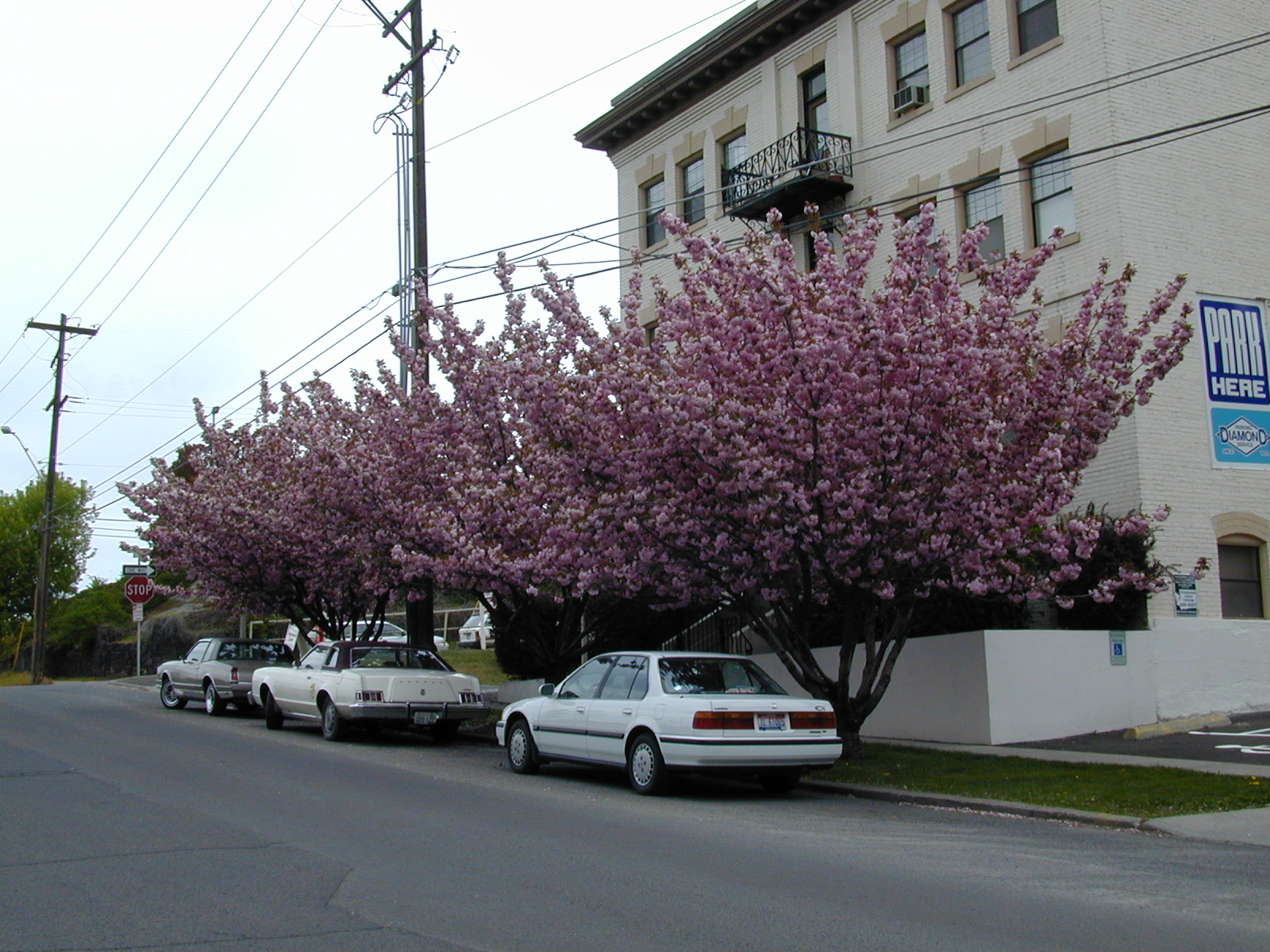
The Kwanzan cherry tree is one of the most popular of the many Japanese Flowering Cherries. It's distinct upright V shape also makes it easy to recognize and easy to use in landscapes. Growth is medium to 20-30' tall with a 15-20' spread. If you are lucky you bought one with Prunus serrula grafted as the interstock so you have a nice purplish exfoliating bark that adds interest year round. This cultivar is a good choice for streets as it has a form that allows it to be out of the way of pedestrians yet still be small and have great flowers.


The leaves are alternate, simple, ovate to elliptical shaped, emerging with a nice bronze tinge in spring, changing to a medium green after growing to its final size. Margins are very finely serrated and the tip is long and pointed. Like all cherries, it has a gland on the petiole.


On rapidly growing stems you will see funny little leaf like structures called stipules. They look like an insect ate most of the leaf.


Cherries have obvious lenticels, on young and older stems. On young ones they are rounded and look like slightly raised glands. On older stems and trunks they form longitudinally arranged bands.


The flowers are why we plant Japanese cherries anyway, and these are especially nice. They are double, dark pink, about an inch in diameter and emerge before the foliage.


An added bonus is the beautiful fall color, usually a pretty yellow orange color.


There is a selection of this cultivar that retains its bronze colored leaves called 'Royal Burgundy'. There is a small one on Morrissey Blvd near Soquel Drive, actually next to the large canary island palm, corner of Melrose and Morrissey.


Misidentification: Double purple flowers, distinct V shape habit make it easily identifiable.

Location:
Santa Cruz : downtown on Pacific Ave.

Aptos: Cabrillo College along Soquel Drive.

Monday, July 4, 2011

Platanus x hispanica - London Plane Tree

London plane trees are one of the most commonly planted trees in CA and very common here in Santa Cruz. They have a long history as very tough landscape trees. When I asked a great friend and arborist why he thought they were so popular his response was "they are tolerant of just about anything".

They originated in England during the industrial revolution after European plant explorers brought together 2 species (P. occidentalis and P. orientalis) usually separated by thousands of miles of ocean. They proved to be very tough and tolerant of heavy particulate pollution commonly seen in London back in the day. This is one of my favorite plantings in Bath England.


London plane trees are large (70'+), bold with a very strong habit. Upright to pyramidal when young but becoming rounded with broad spreading branches. Habit really depends on the cultivar being grown. This is the planting on Walnut street in SC. These trees line so many streets. They close the canopy very nicely.


Leaves are alternate (6-8"), 3 to 5-lobed with light bristles on the lobes. Dark green upper surface with a pubescence on the lower surface that falls off fairly early in the season. A bit of an irritation to many.


Stems are brownish green, stout and slightly zig-zag. Buds are large and well hidden by the leaf base.


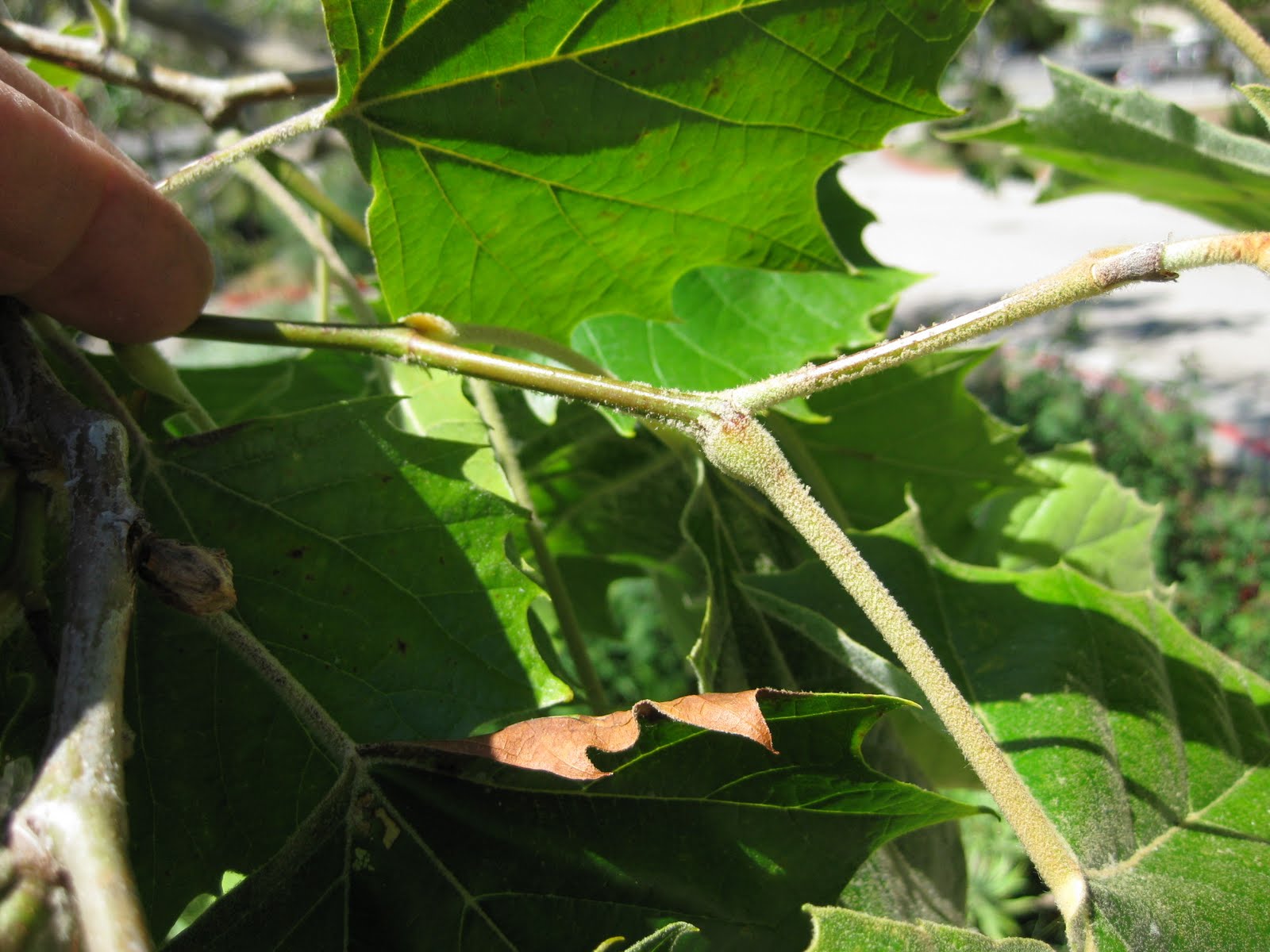
This is a young stem in summer and not really hardened off but you can see the small bud and the base of the petiole, which is hollow.


On young vigorous stems  you might see small leaf like appendages at the base of the petiole, they are called stipules. 


Flowers are monoecious in clusters, reddish coloring to the cluster pretty early in the spring.


Fruit is an aggregate, 1" diameter. They break up before falling usually but are still a mess. Generally borne in pairs. (Sycamores are single, plane trees in pairs)


As I mentioned, they are tolerant of almost anything and one is a special type of pruning called pollarding. You can see examples of them pruned like this at the Farm on Soquel Drive. These are from Filoli gardens.


These are in SF at the bandstand in golden gate park.


They are also likely to be damaged by a disease called Anthracnose which causes the leaves to brown and fall off early in the spring and continue later into summer. The tree will need to spend lots of energy to replace the leaves and it causes the plant to weaken over time. They also look sort of funky with most of the foliage out on the ends of the branches or they might develop what is called witches brooms.


This shows the canker where the fungal spores overwinter and provide the source of the fungal spores to infect the new leaves the following spring, when the rain splashes them onto the new leaves.


Several cultivars are available that are more resistant to anthracnose disease. 'Bloodgood' and 'Columbia' are commonly encountered. 'Yarwood has been planted in front of the new Cabrillo College bookstore, reportedly has single fruits and a very tight pyramidal habit. The native sycamore is very susceptible to this disease and should not be planted (sorry native tree lovers).

Here are a few others that I like, this one is in Canterbury England.


This one is from Amsterdam.


Can't recall the garden…. Canterbury as well I think….


Misidentification:
Not likely to be mistaken for another tree but perhaps the native sycamore, P. racemosa. This tree has very white bark when old, usually defoliated due to anthracnose disease and the leaves are more deeply lobed but not bristle tipped.

The tree is also known as P. x acerifolia and looks a lot like a maple leaf, especially Acer plantanoides, the norway maple.  Funny, there is also an Acer pseudoplatanus, the sycamore maple. So we have 2 maples that look like a sycamore and a sycamore that looks like a maple.

However, heard an interesting story about P. racemosa and P. x hispanica, they hybridize freely and it has been suggested that any California sycamore less than 150 years old is likely to have P. x hispanica in it. Might not be a bad thing considering the problem with anthracnose.

Location:
Almost everywhere.

Aptos:
Soquel Drive at Cabrillo College

Wednesday, June 29, 2011

Koelreuteria bipinnata - Chinese Flame Tree

The Chinese Flame tree is much more common in Santa Cruz than its relative K. paniculata (Golden Rain Tree). A medium sized deciduous tree with a broadly spreading to rounded crown to slightly upright. They are enjoyed for their beautiful flowers (not always seen here), interesting fruit and mildly attractive yellow fall color. Often single stemmed but can be seen multi-stemmed around town, Grows slow to 20-30'. Native to China. These are on Park in Aptos.


The foliage is bipinnately compound, quite large, 1-2' long, and about the same width. Side leaflets are compound with 8 or so leaflets, each about 2-3" long, elliptical with a pointed tip and entire (smooth) or slightly serrated margins and a strong stout petoile.


Young stems are thick, green with distinct lenticels. Notice the base of the petioles how they are grooved to make way for the bud. (I am sure there is a term for that, have to look it up someday.)


Older stems and truck are gray-brown with orange in the shallow fissures.


Flowers are very attractive, bright yellow on long racemes (unbranched), and develop late in summer, usually July or August, sometimes not at all.


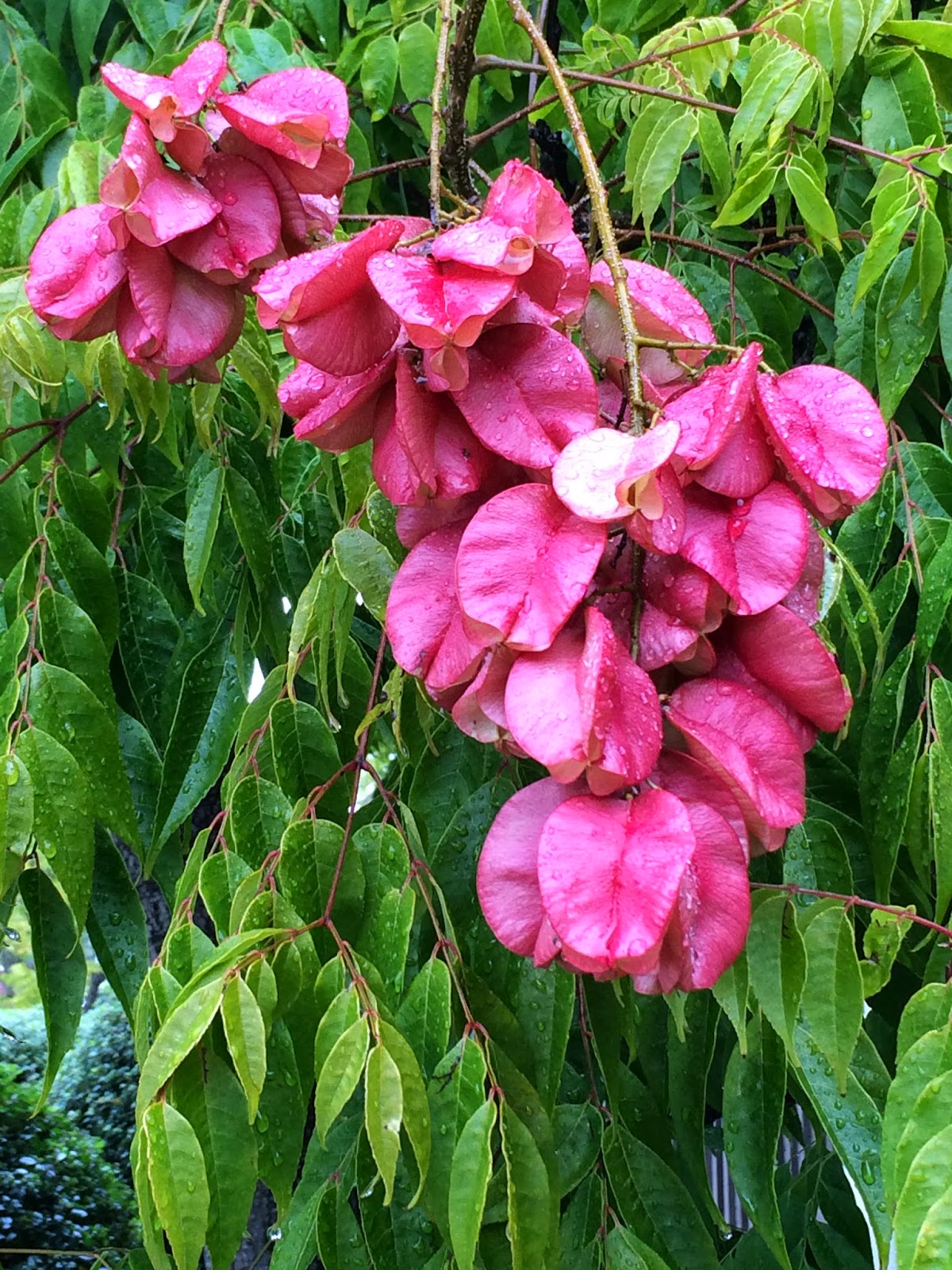
Fruit is pretty interesting. The seeds are enclosed in a papery seed coat looking like a Japanese lantern. The fruit start out green but develop into an attractive pink or red late fall. They eventually turn brown.


Misidentification?
Well, could be the K. paniculata, look at the leaves 10-14" long vs almost 2 feet, leaflets which have toothed or lobes margins rather than entire, and the stems are not covered with lenticles.  This is also a bigger tree generally.
Might also be Alianthus altissima but the leaves are only pinnately compound but they do look sort of similar.

Location:
Aptos
As shown these are on Park Ave between the freeway and Soquel Dr.

Santa Cruz
Nice one downtown on Rose Alley off Chestnut.

Monday, March 28, 2011

Liquidambar styraciflua - American Sweetgum

Ah yes, the poor Liquidambar, so out of its native element that it can't even drop its leaves. Native to the east-coast and down past Texas and into Mexico resulting in trees that go dormant early winter and those that wait until spring. Those grown here seem to have more of the semi-evergreen.

To illustrate this range, this is a picture taken the last week of January at the Temple Beth El on Soquel showing the variability of the trees. Notice there are 2 completely deciduous with almost identical habits, one smaller red one and a larger green/orange one behind it. (The smaller green on up against the building is not the same species. There is also a larger one behind the building showing more red and green.)


The American sweetgum is a fast growing, very large semi-deciduous to deciduous tree, up to 85' or so, but generally 40' or so here. Width is about 2/3 the height depending on the cultivar. They usually have a nice large straight truck, especially in their native habit. When young they are pyramidal. They are also bigger than most people want, so they end up getting pruned improperly. They will develop codominate stems if not watched carefully. This picture shows why an architect wants to use named cultivars, so they are all the same.


On Bay in Capitola.


The leaves are very distinct (though a cultivar called 'Rotundaloba' defies this statement). They are palmately lobed with 5 pointed lobes (sometimes 7). The lobes are finely toothed. Leaf size is about 4-7" long and wide. They somewhat resemble a maple leaf, but are arranged alternately on the stem (one per node, maples have 2 leaves at each attachment point). Summer leaves are very dark but bright green.


Flowers are clustered in heads, males and females separated spacially, like a good private school. Females are in small clusters on a short stalk.


Fruit develops from the round female cluster into a nasty little capsule. These 1" capsules are hard, sharp and prolifically produced. Sometimes called ankle bitters or ankle twisters.


Here they are covering the ground, lots of fun.


Fall color, or should I say winter to spring color can be fantastic. Reds, purples, oranges to yellows. Very beautiful and lasting a long long time. In the spring the new leaves actually have to push off the old ones. I was riding my bike about the first of April and saw what looked like a huge puple leaf plum having finished blooming, so I went to investigate, low and behold a liquidambar still with fall color.


Stems can be smooth or they can have neat looking corky ridges. The tree either has corky or not, its not something that might come along.


Very commonly planted street tree, lawn tree and such. Be very careful, it will more likely be too large for your location and they have a well deserved reputation of lifting sidewalks. Keep the trees 8-10' from any concrete to help avoid this problem.

'Festival', columnar form, light green foliage and reds to oranges in fall.

'Palo Alto', Pyramidal form, rich green leaves and bright red-orange fall color, uniformly over the whole tree, introduced by the Saratoga Horticultural society

'Burgundy' Wine red to deep purple red fall color; may persist into winter.

'Silver King' from Spokane


Misidentification:
I don't think so, some leaves might look like a maple, but maples have opposite leaves.

Location:
Santa Cruz
305 Effey is a massive specimen.