Search This Blog

Showing posts with label list 6. Show all posts

Saturday, May 5, 2012

Lyonothamnus floribundus aspleniifolius

The Catalina Ironwood is a really unique and attractive tree. Native to the Channel Islands off the coast of California. The variety with cut leaves is more common in nature as well as in cultivation. The trees stand out due to their habit, tall and narrow, growing up to 60' x 20'. Evergreen, with distinct leaves and beautiful fibrous bark make it a popular landscape tree. This is a fairly young specimen growing in a grove at Cabrillo.


The leaves are very distinct. Alternately arranged, pinnately compound, with deeply divided margins, that look like large fins or saw blades. Even the rachis is toothed. Dark green, 5-6" long, shiny, lighter on the lower surface. Usually 5 but sometimes 3 leaflets, considered palmately compound by some authorities. Jepson says, "simple to pinnately to palmately compound". Say what?


Young stems brown, with a nice large pointed terminal bud.


Flowers are very showy, but can be very high up in an old tree. Individual flowers are very small, arranged in a flat topped inflorescence that measures 8-16" across. Blooms in the middle of summer. 


This is the remnants of the flower cluster.


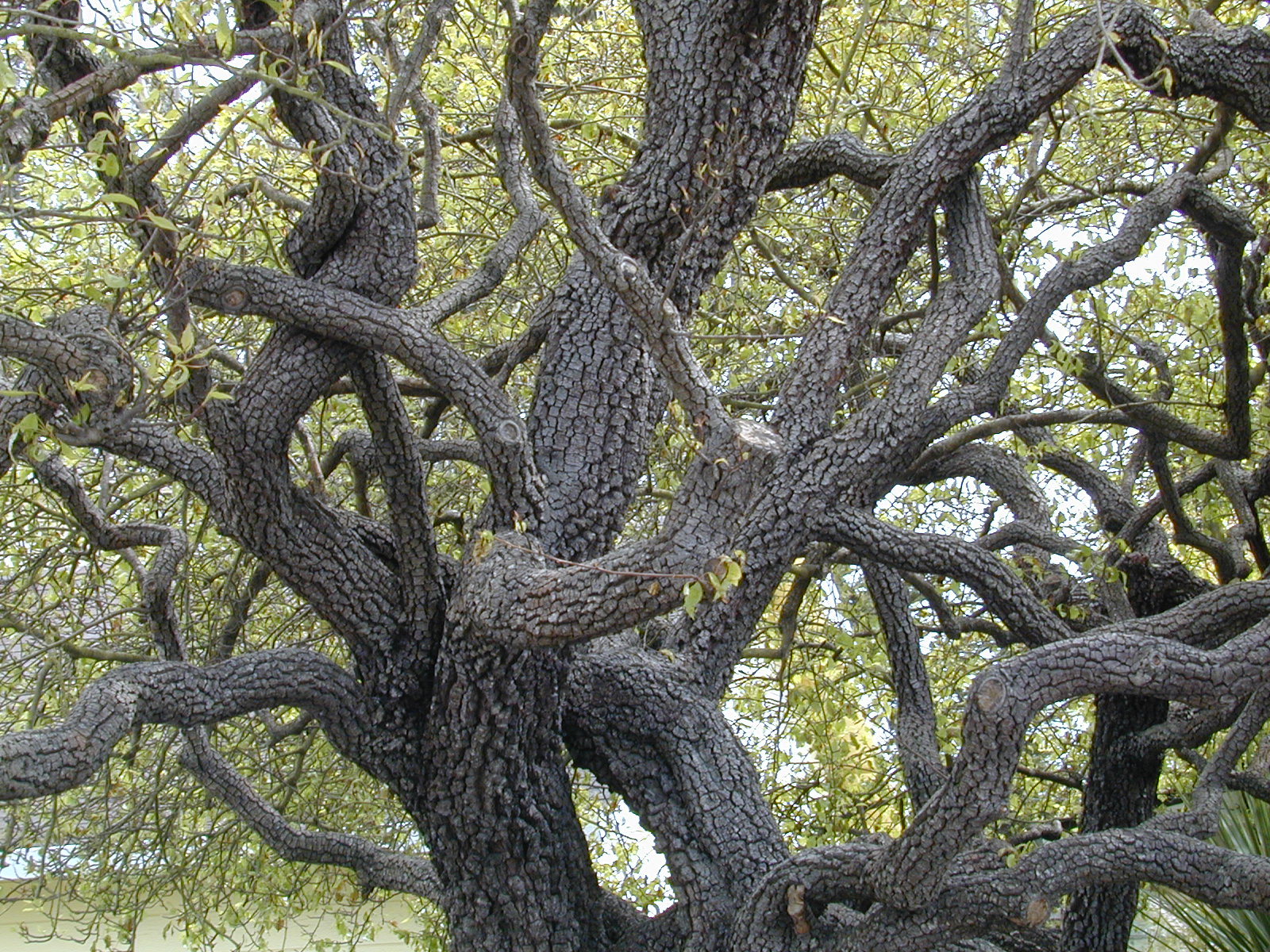
The bark is really one of the nicest features of the tree. Reddish brown to tan exfoliating in long thin strips. 


Misidentification: not likely, the leaves are very distinct.

Location:
Aptos: Sesnon house has 2 flanking the old house,
584 Rio Del Mar Blvd, is a nice large one.

Capitola: Interchange of 41st and Highway 1

Thursday, April 26, 2012

Morus alba - Fruitless Mulberry

The fruitless mulberry is a very fast growing deciduous tree to 30 - 40' forming a rounded crown. It is not a great tree for landscapes as it has surface roots and the canopy needs constant pruning. It does have decent fall color and is of course fruitless. It also has so many water sprouts in the canopy that it is impossible to keep shaped without constant pruning.


The deciduous leaves are alternate, simple, 2-4" long and variable in shape being oval to lobed. Margins can be slightly serrated to deeply lobed. Leaf base is unequal. Leaves are glossy green, medium to dark and turing yellow in the fall. 


The flowers are small, greenish yellow, with males and females appearing on separate trees and yes, this one is the male.


Bark is smooth when young, turning to a brown color with light furrows.  


You can see the large surface roots in the lawn.


This cultivar is a weeping fruited variety which they should have named Cousin It of course. 
Morus alba 'Pendula' is one of several weeping cultivars that does produce fruit, but they all do not produce fruit.


Misidentification: not sure, look at the variable leaves and the water sprouts (aerial suckers) in the canopy.

Locations:
Aptos, Cabrillo College

Wednesday, April 25, 2012

Ceanothus 'Ray Hartman' - Ray Hartman Ceanothus

The Ray Hartman ceanothus (Wild Lilac is another common name for Ceanothus) is a beautiful small evergreen tree. Fast growing mounded large shrub or smaller tree to 20'. Drought tolerant, beautiful flowers, long lived, attracts butterflies, what else do you want? 


Leaves are evergreen, alternate, simple,  ovate to elliptical, lightly serrated and slightly revolute margins,  2-3" long, dark shiny green, with 3 deeply set veins starting at the base that curve towards the tip. Leaves feel rough to the touch. 


Young stems are green with shallow grooves. 


Flowers emerge late winter - early spring. Medium blue flowers on 6" long clusters, tiny individual flowers,  attracting lots of flying insects. Wow, really pretty plant in bloom.


Fruit is a small capsule.


The Ray Hartman Ceanothus a hybrid of 2 species of Ceanothus native to CA. C. arboreus and C. thrysiflorus griseus
Misidentification: Not sure, other Ceanothus perhaps?

Location: 
Aptos
Cabrillo Hort Center

Capitola
Corner of El Salto and Hollister (Depot Hill)

Santa Cruz

Wednesday, March 28, 2012

Pyrus kawakamii - Evergreen Pear

The Evergreen Pear is a semi-deciduous tree, more likely evergreen to some extent, growing moderately to 15-20' and about the same width. It can have multiple trunks and have more of a shrub like appearance. It generally forms a broad spreading dome shaped canopy. Generally thin in appearance, because the leaves are killed by a fungus.


Leaves are alternate, simple, bright glossy light green 2-3" long, obovate to broadly elliptical with undulated and serrulated margins. Petiole is reddish, and often grooved. The tree generally looks pretty bad as a foliage disease seen below causes the leaves to fall prematurely. Entomosporium is the fungus causing the spots, and Fire Blight is also a big problem.


Stems with sharply diverging buds.


Flower display can be very attractive, with white 1" flowers in clusters of 10-15 flowers very early in the spring. They really did not bloom well this year.


The tree does produce small little fruit resembling an Asian Pear.


Without a doubt, one of the best assets (only one maybe) of the tree is the bark and the branching pattern. The bark is rough, checked into small plates, dark brown with black.


Misidentification: If there are no leaves and its blooming it looks like other pears, except for the trunks. We used to use the foliage leaf spots as a way it identify the plant, pretty sad.

Locations:
Soquel : on Porter near the intersection of Porter and Soquel Drive

Aesculus hippocastanum - Horse Chestnut

The horse chestnuts are a moderately fast growing deciduous tree to about 50' by about 40' wide. Often oval to oblong shaped or a broadly spreading habit, they create a very dense canopy and dense shade. Beautiful in bloom and usually great fall color. They also have great flowers early spring. This one is in Cambridge England. They are a pretty old-school tree and I don't see them around our area.


Leaves are opposite and palmately compound with 5 leaflets. The center leaflet is generally quite a bit larger than the others. Leaflets are 6-8" long by about 3" wide, obovate shaped with with a slightly drawn out tip and serrated margins. Veins uniformly spaced off the midrib and deeply set in the foliage. 


When just emerging from the buds, the young leaves (petioles and some of the undersides) have a rusty tomemtum near the leaf blade attachment.


Flowers are very attractive, in upright clusters 8-12" tall. Individuals are white with a blotch of yellow that turns red in the throat.


Fruit is an attractive green leathery husked capsule with sharp spines,  2 1/2" diameter releasing 1 or sometimes 2 brown shiny seeds.


Fall color can be spectacular. Often less that so here. Usually more yellow that orangish yellow in this picture. I am a bit surprised I don't have a better picture of this tree during the fall or in flower.


Stems are large and have distinct leaf scars. Buds are sticky. Leaf scars are large, and you can easily see the vascular traces forming a U.


Bark is grayish brown in small shallow irregular shaped scales when old, smooth and gray when young.


There is a double flowered form 'Baumannii'.


Misidentification: Other buckeyes, at least around here you will find A. x carnea more often than A. hippocastanum. A. carnea has dry buds, not sticky, red flowers, smaller leaves and shorter more rounded habit.

Location:
Aptos - Cabrillo College, by the Sesnon house down the side of the hill towards the creek. Only one I know of.

Edited 5/24

Sunday, March 25, 2012

Pinus torryeana - Torrey Pine

The Torrey Pine is a large native evergreen conifer, growing slowly up to 60 tall and almost as wide. The trees have a nice broad conical habit with strong stout upright primary lateral branches. They have a distinctly  bluish cast to the canopy. The Torrey pine is extremely variable in its native habit. Being so close to the coast it might take on a "picturesque" habit.

This native conifer is also very restricted tree in the "wild" and only found natively growing in a very small area in San Diego County and a few islands off the coast. But like others trees from somewhere else, it grows and reseeds nicely here and grows fast in cultivation. There are lots of seedlings in and around Sea Cliff State Park. This image is at the park over looking the ocean.


The evergreen leaves are in 5's, gray-green color, 5-12" long, stout and prickly at the tips. Generally clustered at the tips of stout branches. Persisting 3-4 years.


Cones are oval, dark reddish brown, 4-5" long and almost as wide. They can be very heavy. Takes 3 years to mature. Scales are strongly 4 sided with a prominent recurving spine. Seeds are edible. Cone falls leaving some of the scales behind. This image shows young cones that will be developing later in the season.


These are recently maturing and have not turned brown yet.


Male cones are 1 - 2" long when open, yellow and in clusters at the tips of lower branches


Stout, rough twigs and often sort of a light gray color looking like they have a waxy coating on them.  Short but persistent leaf sheaths.


Bark is gray scaly ridges showing red-brown between the furrows.  It forms rectangular plates.


Misidentification: Count the needles, this is an "odd" 5 needle pine. Most have long skinny cones and soft leaves with non-persistent bundle sheaths. Most five needle pines have smooth bark as well, at least till they are very old.

Locations:
Aptos
Seacliff: At Seacliff State park upper parking lot overlooking the ocean
608 Seacliff Drive has a nice one. (GONE)

Capitola Area
Along Highway 1 in several places. Two on the N bound lanes heading North, just south of the Drive In/Flea market.

Santa Cruz
225 Marnell Ave - Awesome
Heading South from the River St intersection on the right just by the Ocean St exit.
head.
On the golf course in DeLeveaga


Wednesday, June 29, 2011

Aesculus californica - California Buckeye

The California buckeye is a beautiful native tree. Unlike most members of the genus Aesculus, A. californica blooms after the foliage appears and is often summer deciduous in its native habitat. Reported to be a slow grower, it can put on several feet a year when young if properly cared for. Generally up to 20' but can become larger if near water. With age it develops a great broad spreading dome-shaped canopy. Can be multi-stemmed or with a single stem.


Here is a nice specimen on 17th and East Cliff in the winter.


The foliage is typical of buckeyes (horsechestnuts are the same genus), opposite, palmately compound, with five leaflets, oblong or oblanceolate leaflets, 3-6" long and 1-1/2" or more wide, margins are lightly serrated. Dark green above and lighter below. Often crinkled, or quilt-like due to the deeply set veins. Leaflets can be flat or V-shaped  depending on were the tree is growing, in shade it will be wide and flat, and in the sun it will be V-shaped.  For the most part, smaller than other members of this genus.


They look really nice emerging from the bud in the spring.


Stems are smooth, gray silver colored, terminal buds large. Older stems and bark make this a beautiful tree when leafless. The wrinkles around the base of the branches is an area called the branch collar and is part of the trunk, not the lateral branch. Ideal specimen to see this critical area as its were you want to prune, don't cut into the collar.


Flowers are borne late in the spring after the foliage has emerged. They are whitish pink about 1/2" long in a long raceme about 10" long or so. Stamens are long and showy. There is a "Pink" cultivar in commerce, 'Canyon Pink'. This picture is from Wilder State Park.


Fruit is a typical buckeye or horsechestnut. The husk is smooth, thinner than others in the genus, generally containing one seed but occasionally 2. (There should be 3 but 2 abort during maturation.) They are light brown colored when mature, 2 or so inches long, sort of pear shaped. They are poisonous if eaten raw.

Look like little green apples in the fall hanging in the tree.


In the husk, you can see the lines on the fruit showing the three compartments of the ovary that developed into a fruit.


After all these years of not looking at the young fruit I pulled one down and sliced it open. Obviously three carpels (compartments as seen above) but a bit of a shock, there are multiple young seeds developing.
I was always under the false impression that they only had three ovules and for some reason only one developed (sometimes 2) per fruit. Wonder what causes all the others to stop allowing one dominate seed to mature?


Even the roots are silver-gray in color, beautiful specimen hanging on.....


This is one of my favorite ones in Wilder State Park, love the trunk and the Spanish Moss on the branches.


Bonsai specimen at the SF Flower show. Wish it was in bloom, must be spectacular.


Misidentification: Other members of this genus perhaps. A. pavia might look like it when not flowering as the foliage is small as well.

Locations:
Capitola
Corner of Park where it ends at the parking lot for the beach.

Santa Cruz
Wilder State Park,
Entrance to Nisene State Park
17th and East Cliff/Portola Dr.

Edited 5/24